US Holds Interest Rates Steady but Signals Additional Hikes This Year
Widening US-Korea Rate Gap Raises Concerns Over Exchange Rates and Capital Outflows
Bank of Korea Likely to Weigh Between Holding Steady and Raising Rates While Maintaining Tightening Stance
The U.S. Federal Reserve (Fed) hinted on the 20th (local time) at the possibility of additional interest rate hikes within the year and a prolonged period of high interest rates, suggesting that the Bank of Korea's (BOK) tight monetary policy stance will also continue for a considerable period. If the Fed raises the benchmark interest rate once more, the BOK will have no choice but to respond with rate hikes, considering concerns over a sharp rise in the exchange rate and capital outflows. However, since this could dampen the domestic economic recovery, the BOK is expected to maintain a freeze stance for the time being while reviewing the option of rate hikes depending on market conditions.
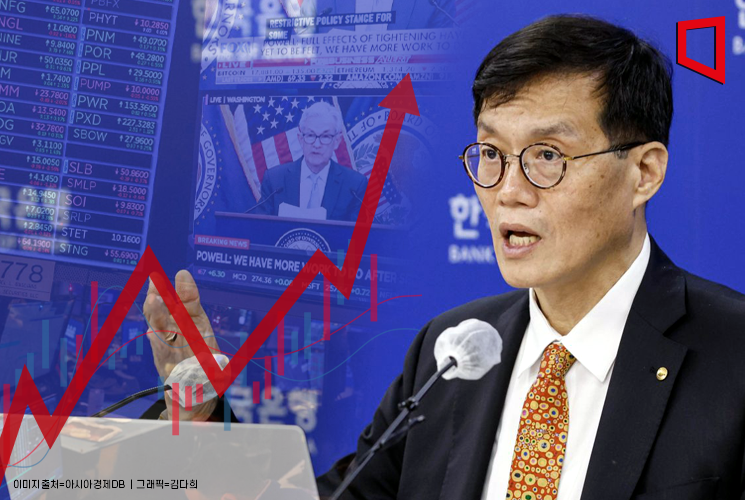
BOK: "US Tightening Stance to Continue for Considerable Period"
On the morning of the 21st, the BOK held a market situation review meeting chaired by Deputy Governor Yoo Sang-dae to assess the impact of the Federal Open Market Committee (FOMC) results on domestic financial and foreign exchange markets. Deputy Governor Yoo stated, "Although the benchmark interest rate was held steady (at 5.25-5.50% annually) at this FOMC meeting, the possibility of additional hikes within this year remains open, and the policy rate outlook for the end of next year was revised upward, indicating that the tightening stance will continue for a considerable period. We will closely monitor the impact on domestic and international financial markets."
With the Fed's rate hold this time, the interest rate differential between Korea and the U.S. has been maintained at up to 2 percentage points. Accordingly, the volatility in domestic financial and foreign exchange markets is expected to be limited for now. On the morning of the same day, Deputy Prime Minister and Minister of Economy and Finance Choo Kyung-ho said at an emergency macroeconomic and financial meeting, "Foreign investors' domestic securities investments continue to show a solid trend, and the exchange rate is stable compared to major countries, while the stock and bond markets are generally in good condition."
However, since the Fed hinted at additional rate hikes within the year, the possibility of increased uncertainty in the future cannot be ruled out. The BOK's New York office commented on the FOMC results, stating, "Fed Chair Jerome Powell said at the press conference that it is too early to be confident that rates have reached a sufficiently restrictive level and that it is necessary to maintain the current stance for the time being," evaluating that the Fed effectively signaled the possibility of a prolonged period of high interest rates.
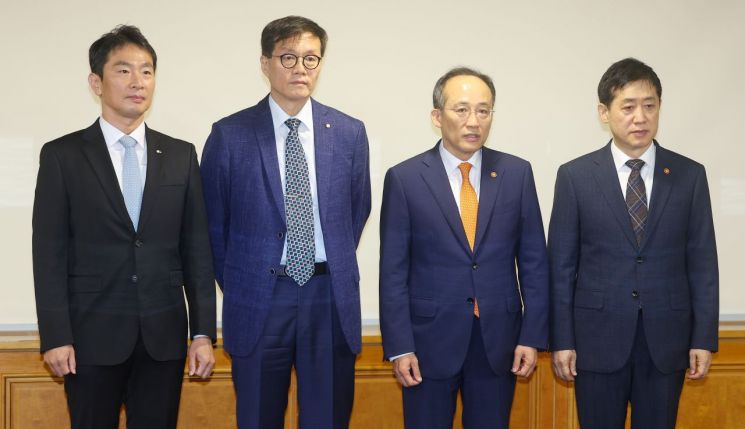 Deputy Prime Minister and Minister of Economy and Finance Choo Kyung-ho is taking a commemorative photo with participants before the Emergency Macroeconomic and Financial Meeting held at the Korea Federation of Banks in Jung-gu, Seoul, on the morning of the 21st. From the left, Lee Bok-hyun, Governor of the Financial Supervisory Service; Lee Chang-yong, Governor of the Bank of Korea; Deputy Prime Minister Choo; Kim Ju-hyun, Chairman of the Financial Services Commission.
 [Photo by Yonhap News]
If US Raises Rates Further, Exchange Rate and Capital Outflow Concerns Increase
Generally, when the interest rate inversion between Korea and the U.S. widens, foreign investment funds in Korea tend to exit, causing the Korean won to depreciate and increasing instability in financial and foreign exchange markets. Although there is no immediate concern about the exchange rate or capital outflows, the experience of the won-dollar exchange rate soaring to 1,444.2 won last October and the net outflow of $1.7 billion in foreign securities investment last month?the largest since December last year?make it difficult to be complacent.
On the same day, the won-dollar exchange rate opened at 1,332.5 won, up 2.4 won from the previous trading day, and showed an upward trend in the early session, rising to the mid-to-high 1,330 won range.
The BOK is likely to maintain a tightening stance aligned with U.S. monetary policy for a considerable period. BOK Governor Lee Chang-yong said at a press conference after the Monetary Policy Committee meeting on the 24th of last month, "All six MPC members are open to the possibility of raising the terminal rate to 3.75% for the time being." The recent sharp rise in international oil prices to around $95 per barrel is also a factor encouraging rate hikes.
Within the Monetary Policy Committee, there are many opinions favoring keeping the option of additional rate hikes open. According to the minutes of the MPC meeting on the 24th of last month, one member advocated maintaining the benchmark rate at 3.5% but said, "We need to carefully examine whether key indicators suggest a downward stabilization of inflation and resolution of financial imbalances, and if necessary, adjust the intensity of policy tightening through additional rate hikes."
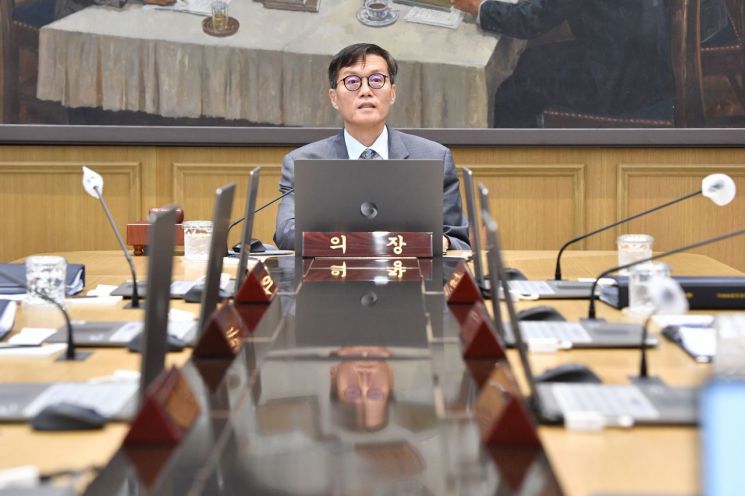 Bank of Korea Governor Lee Chang-yong is presiding over the Monetary Policy Committee meeting held at the Bank of Korea in Jung-gu, Seoul, on the 24th of last month.
 [Image source=Yonhap News]
Raising Rates Could Hurt Growth Recovery... BOK Faces Dilemma
However, concerns about the domestic economy and financial stability remain, making it difficult for the BOK to raise the benchmark interest rate further. The Organization for Economic Cooperation and Development (OECD) forecasted on the 19th that Korea's economic growth rate this year will be 1.5%, which is lower than the global average (3.0%) and even Japan's (1.8%), which has experienced a long-term recession. In this situation, additional rate hikes could suppress private consumption and corporate investment, further slowing growth.
Since Korea's Monetary Policy Committee will meet in October before the next FOMC in November, the BOK is likely to maintain a freeze for now and observe U.S. monetary policy, inflation, and financial and foreign exchange market conditions before deciding on additional hikes. As the Fed raised its rate outlook for next year by 0.5 percentage points through the dot plot, the timing of the BOK's rate cuts is also expected to be delayed accordingly.
Ha Geon-hyung, a researcher at Shinhan Investment Corp., explained, "All BOK MPC members will maintain the stance of keeping the possibility of a 3.75% rate open for a considerable period. Although growth is weaker than in the U.S., considering inflation exceeding targets and rising household debt, the BOK also needs a prolonged period of high interest rates." Professor Kang Sung-jin of Korea University’s Department of Economics said, "Even if the U.S. raises rates once more, considering the domestic economic situation, it will be difficult for the BOK to follow suit. However, if international oil prices surge again causing inflation concerns, the BOK will have no choice but to consider rate hikes."
© The Asia Business Daily(www.asiae.co.kr). All rights reserved.



















