Serious Pollution Problems Caused by Tourists
Mount Fuji, Japan's iconic symbol (highest peak 3776m), is suffering from a waste problem. The pollution caused by tourists has become so severe that there is even talk of the possibility of its World Heritage status being revoked.

According to local Japanese media such as Business Insider Japan and Yahoo News Japan on the 20th (local time), the number of tourists visiting Mount Fuji this year reached 40,000, a 50% increase compared to 2013. This year marks the 10th anniversary of Mount Fuji's inscription as a World Heritage site.
The problem lies in the fact that as tourism has increased, pollution issues have also become serious. Despite active beautification efforts by management companies and volunteers, the waste problem on Mount Fuji has not improved. On social networking services (SNS), photos of dirty public restrooms and piles of trash scattered everywhere have been posted.
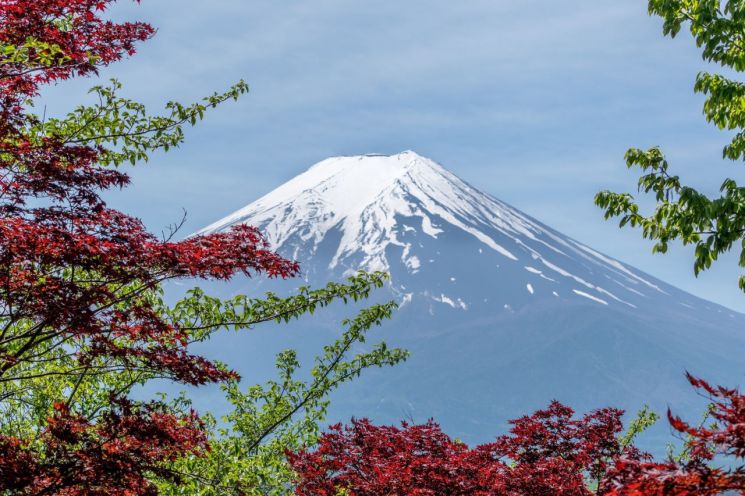
At the time of its World Heritage inscription, Mount Fuji was already suffering from controversy over the so-called "white stream," formed by overflowing human waste and garbage. Within Japan, it has even been nicknamed "the dirtiest mountain in the world."
There are also problems caused by foreign tourists. According to the Shizuoka Prefectural Police in Japan, there were a total of 61 rescue requests for distress on Mount Fuji this year, a 50% increase from last year. Among these, foreigners accounted for one-quarter.
Most of these cases involved climbers wearing inadequate equipment who suffered from hypothermia, altitude sickness, and other issues. Additionally, Mount Fuji faces the problem of "bullet climbing," where climbers push through a no-sleep, two-day schedule due to difficulty in reserving mountain huts.
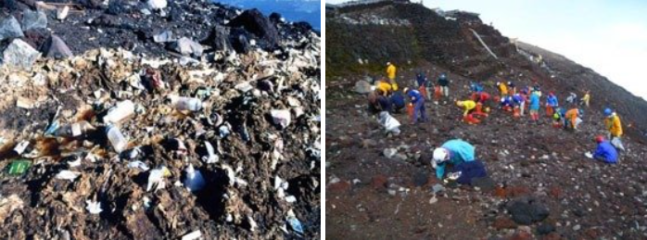 Mount Fuji littered with trash (left), appearance after cleaning work [Image source=Ministry of the Environment, Japan]
A Japanese official told local media, "Mount Fuji is screaming in pain," adding, "The situation is uncontrollable. I fear that Mount Fuji will lose its appeal and no one will come anymore."
There is also a risk that Mount Fuji could lose its World Heritage status due to the waste problem. The International Council on Monuments and Sites (ICOMOS), which advises the World Heritage Committee (UNESCO), regularly evaluates and reviews the qualifications of cultural heritage sites. UNESCO can revoke the inscription of a heritage site based on the advice from this council.
ICOMOS has reportedly already requested Japanese authorities to manage the number of climbers on Mount Fuji. Previously, in 2021, the Waterfront of Liverpool, a famous port city in the UK, lost its World Heritage status due to large-scale redevelopment that destroyed its original form.
Local authorities are reportedly considering measures to reduce pollution and control the number of climbers, such as making an entrance fee mandatory under the name of a Mount Fuji management donation.
© The Asia Business Daily(www.asiae.co.kr). All rights reserved.



















