The U.S. central bank, the Federal Reserve (Fed), kept the benchmark interest rate unchanged while raising the possibility of additional hikes within the year. By raising the interest rate outlook for next year and the year after on the dot plot, it signaled a 'prolonged period of high interest rates.' Due to a stronger-than-expected U.S. economy and inflation, forecasts suggest that the high interest rate stance in the 5% range will continue next year.
The Fed announced through the policy statement released after the September Federal Open Market Committee (FOMC) regular meeting held on the 19th-20th (local time) that the federal funds rate would be maintained at the existing 5.25-5.5%. This is the second freeze decision following June. With this freeze, the interest rate gap between South Korea and the U.S. was maintained at 2 percentage points (based on the upper limit of the U.S. rate).
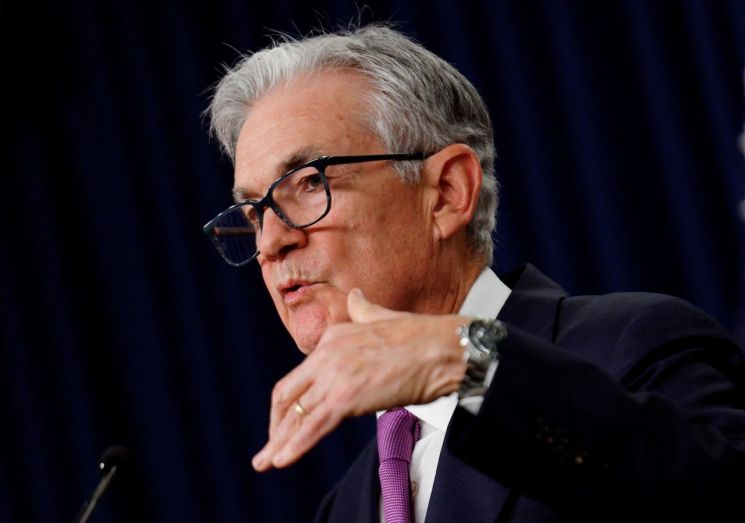
Expected Freeze... Additional Hikes Within the Year, Prolonged High Interest Rates Forecast
Although the Fed kept rates steady, it made clear that the rate hike cycle is not over yet. While the rate was held, the Fed left a hawkish outlook, which can be described as a 'hawkish skip.'
The policy statement retained the phrase 'additional policy firming,' which carries a hawkish tone. Also, in its economic assessment, the Fed changed the description from 'moderate' to 'solid,' indicating that the U.S. economy is stronger than expected. Specifically, it stated, "Job growth has slowed in recent months but remains robust. Inflation is still rising." It further explained, "When determining the appropriate range of additional policy firming to return inflation to the 2% target, we will consider the cumulative tightening of monetary policy, the lag with which monetary policy affects economic activity and inflation, and economic conditions."
Chairman Powell said at the post-FOMC press conference, "If necessary, we could raise rates once more this year," adding, "The majority opinion at the FOMC is to raise rates once more." He said, "We need to see more progress," and "The effects of Fed monetary policy are moving in the desired direction, but it is not yet complete. We will proceed cautiously." At this meeting, seven FOMC members expressed the view that no further rate hikes are needed this year, while twelve members supported one more hike.
The Fed raised the possibility of additional hikes and also signaled a prolonged period of high interest rates. The dot plot released that day showed the year-end rate forecast (median) unchanged at 5.6%. However, the median rate forecast for the end of next year was raised from 4.6% to 5.1%, and the median for the end of 2025 was increased from 3.4% to 3.9%. The number of rate cuts expected next year was reduced from four to two, and the magnitude of cuts was expected to be only 0.5 percentage points. Even if rate cuts begin next year, the forecast is that high interest rates will persist longer than expected.
Chairman Powell warned, "The worst thing for us is failing to restore price stability," adding, "In that case, inflation would reemerge, economic uncertainty would lengthen, and growth would be affected. A miserable period of continuous tightening due to endless inflation could come." Regarding whether additional tightening would be implemented if GDP comes out stronger, he responded, "It could threaten price stability. Our responsibility is price stability and employment, not GDP." The Fed raised its year-end projections for the personal consumption expenditures (PCE) inflation rate from 3.2% to 3.3%, and for GDP growth from 1.0% to 2.1%.
Regarding recent issues such as the United Auto Workers strike, the possibility of a federal government shutdown, the resumption of student loan repayments, and high oil prices, Powell said, "There is a lot of uncertainty," and "We will assess the macroeconomy based on how long these last." On the timing of rate cuts next year, he said, "I will not specify," and "It will be decided based on data."
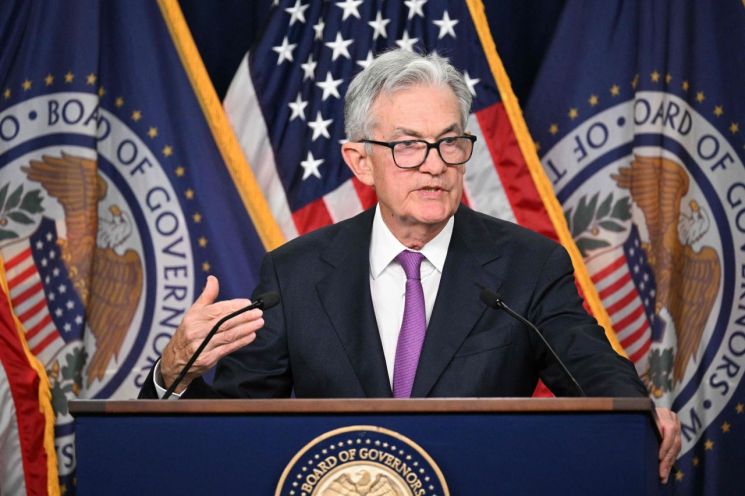
"Hawkish Skip" "Switching to Rate Cuts Will Not Be Easy"
Wall Street views the Fed's message as more hawkish than expected. Alexandra Wilson-Elijondo, Vice President of Asset Strategy at Goldman Sachs, said, "We expected the level of the recent Jackson Hole meeting, but it was more hawkish," adding, "Recent rises in energy prices and economic recovery indicators likely raised the median rate forecast for next year." David Russell, Global Market Strategist at TradeStation, analyzed, "The Fed's message reflects the economic strength we have seen since the last FOMC," and "With oil prices rising and concerns about wage and price increases due to the auto workers strike, policymakers have no reason to adopt a dovish stance." Will Campenor, Macro Strategist at FHN Financial, described it as a "hawkish skip," predicting "There may be additional rate hikes early next year."
Expectations for a pivot in the tightening stance that the market awaited have been dampened. Shima Shah, Chief Global Strategist at Principal Asset Management, analyzed, "The new dot plot strongly indicates that the Fed is confident in a soft landing and, as a result, monetary easing next year will not be easy."
However, the market, which had expected a freeze in this policy decision, also forecasts a rate freeze at the next FOMC. According to the CME FedWatch tool, the federal funds futures market on the afternoon of the meeting reflected over a 70% chance that the Fed will keep rates steady in November. The remaining FOMC meetings this year are scheduled for November and December. Key economic data before the November FOMC include the September 29 PCE Price Index, October 6 Nonfarm Payrolls report, October 11 Producer Price Index (PPI), and October 12 Consumer Price Index (CPI).
The New York stock market reacted immediately to the Fed's hawkish skip. The Dow Jones Industrial Average, composed of blue-chip stocks, closed down 0.22% from the previous session. The large-cap S&P 500 index fell 0.94%, and the tech-heavy Nasdaq index dropped 1.53%. Treasury yields rose. The benchmark 10-year Treasury yield in the New York bond market climbed to around 4.39%, marking the highest level since November 2007. The 2-year Treasury yield, sensitive to monetary policy, reached about 5.16%, the highest since July 2006.
Meanwhile, following the Fed, central banks of Brazil, Indonesia, Japan, Norway, South Africa, Sweden, Switzerland, Taiwan, and the United Kingdom will hold monetary policy meetings this week. The UK’s August CPI inflation rate, released that day, fell to its lowest level since February last year, fueling market speculation that the Bank of England (BOE) may end its rate hike cycle sooner than expected. However, the November 21 meeting is still expected to see an additional "baby step" (a 0.25 percentage point rate hike).
© The Asia Business Daily(www.asiae.co.kr). All rights reserved.


















