Government to pursue reform with legislative goal by end of next year
Need to revise Korea-US FTA... Persuading the US is a 'challenge'
As the government moves to reform the tax base for automobile taxes, the Korea-US Free Trade Agreement (FTA) emerges as a key issue. Revising the tax base requires amending the Korea-US FTA first, but American cars, represented by Tesla, are currently the biggest beneficiaries under the existing system. Additionally, with the upcoming US presidential election next year, the government’s dilemma is expected to continue.
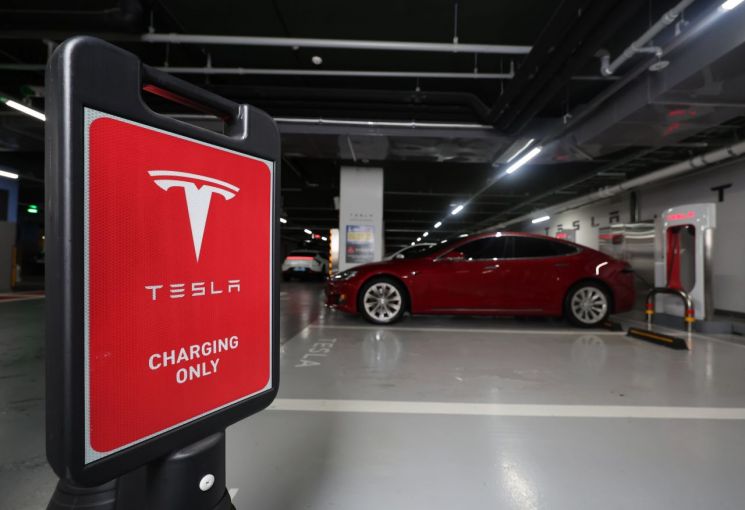 On the afternoon of the 20th, when the Ministry of the Interior and Safety announced that it would prepare a plan to revise the passenger car automobile tax standards, electric vehicles were parked at a Tesla charging station in downtown Seoul.
 [Image source=Yonhap News]
According to the government on the 21st, the Ministry of the Interior and Safety is forming an "Automobile Tax Reform Task Force" together with the Korea Local Tax Research Institute to prepare a reform plan for the automobile tax base. After preparing the reform plan, the Ministry plans to gather opinions from domestic and international stakeholders and the industry, hold public hearings, and then draft amendments to the Local Tax Act in the second half of next year to push for legislation.
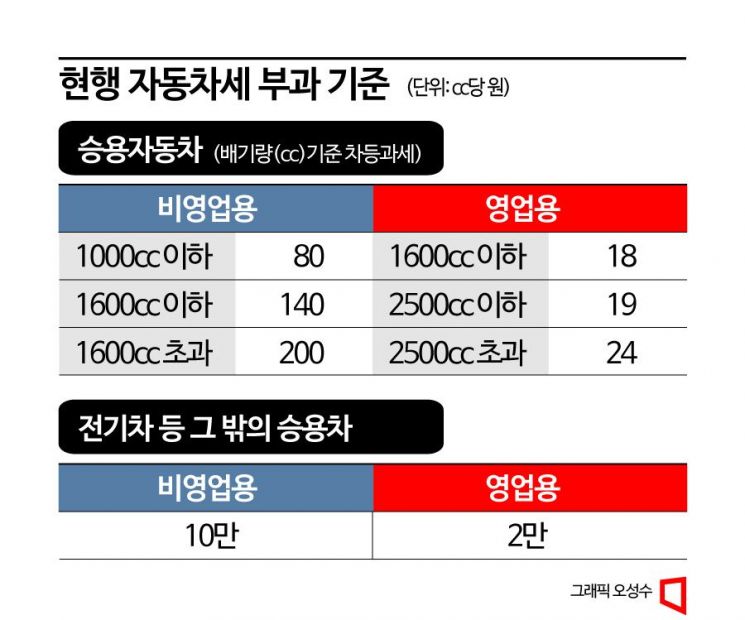
This reform plan was prompted by a recommendation from the Presidential Office last week, based on the results of a public participation debate, to improve the displacement-based criteria applied when levying automobile taxes. Currently, automobile taxes are uniformly based on engine displacement (cc), which has raised issues of tax fairness with imported cars. Therefore, changing the tax base to vehicle price or other criteria is a likely option, but the task force intends to keep all possibilities open for discussion. A representative from the Korea Local Tax Research Institute said, "The task force is still being formed," and added, "Once formed, it will begin work on drawing up the overall framework."
While there is a strong call for reforming automobile taxes, amending the Korea-US FTA must come first. The Korea-US FTA ratified in 2011 includes a clause stating that "the Republic of Korea shall not adopt new taxes or modify existing taxes based on engine displacement to expand tax rate differences by vehicle type." Especially as Tesla, an American vehicle, has been selling well domestically recently, the US is inevitably sensitive to Korea’s tax base reform. Currently, Tesla electric vehicles pay only about 100,000 KRW in taxes annually. For example, the Tesla Model S, which costs over 100 million KRW, pays 130,000 KRW in automobile tax (including local education tax), whereas the 26 million KRW mid-sized Hyundai Avante 1.6 pays 290,820 KRW, more than twice as much. Professor Jeong Ji-seon of the Graduate School of Taxation at the University of Seoul said, "Reforming automobile taxes requires amending the Korea-US FTA, and ultimately, without US consent, reform is difficult," adding, "The key is to create a proposal that can persuade the US by referencing automobile taxes in other countries."
The government is aware of this situation. A Ministry of the Interior and Safety official said in response to questions about the Korea-US FTA, "We will work with various ministries such as the Ministry of Trade, Industry and Energy to resolve this," and added, "We will strive to create a proposal that both our citizens and the US can agree on."
The upcoming US presidential election next year is also an issue. The Korea-US FTA has only been amended once, in 2018. That amendment was made under pressure from the US, which threatened to terminate the agreement, so setting up a revision table is not easy. However, if former President Donald Trump, who is likely to be the Republican candidate, wins the election, discussions on amending the Korea-US FTA could take place. In fact, Trump amended the Korea-US FTA immediately after taking office and has recently emphasized the amendment of the Korea-US FTA as one of his political achievements.
The related industry has responded positively to the reform discussions but wants their opinions to be actively reflected. Kim Ju-hong, Executive Director of the Korea Automobile Mobility Industry Association, said, "The current displacement-based standard lacks fairness in terms of property taxation and burden," adding, "However, since there are many factors to consider, such as the Korea-US FTA and the development of eco-friendly vehicles, broad opinion gathering is necessary."
© The Asia Business Daily(www.asiae.co.kr). All rights reserved.

![Clutching a Stolen Dior Bag, Saying "I Hate Being Poor but Real"... The Grotesque Con of a "Human Knockoff" [Slate]](https://cwcontent.asiae.co.kr/asiaresize/183/2026021902243444107_1771435474.jpg)

















