Energy Technology Research Institute Develops Fault Detection Technology with 95% Accuracy
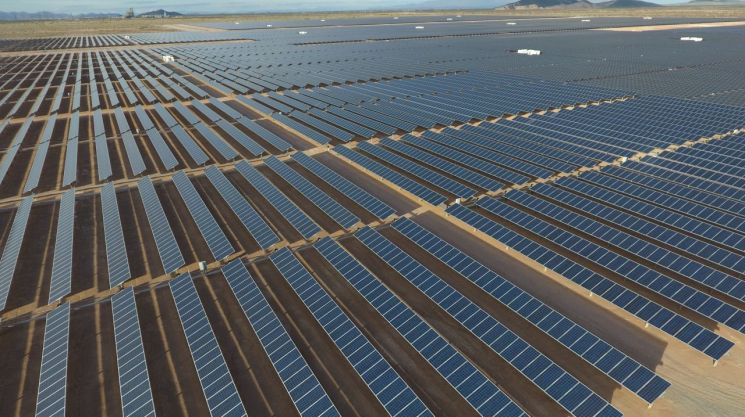
Solar power generation facilities are often installed in locations that are difficult to access, such as farmland, over water, on building walls, and on soundproof barriers. As a result, maintenance is challenging even when performance deteriorates or malfunctions occur. A domestic research team has developed a technology that can detect faults in solar power facilities using artificial intelligence (AI).
On the 20th, the Korea Institute of Energy Research announced that Dr. Goseokhwan’s research team from the Renewable Energy Systems Laboratory developed an AI-based fault diagnosis technology for solar power generation. By creating a database of I-V curves (voltage-current correlation curves of the electricity generated by solar panels) collected over more than 10 years of fault diagnosis and evaluation at solar power plants, and applying an AI model, it is possible to determine contamination, performance degradation, and other issues of solar panels with over 95% accuracy without visiting the site.
The conventional maintenance method for solar power facilities involves periodically dispatching personnel to diagnose and resolve faults on-site. Recently, technologies using drones equipped with thermal imaging cameras have been applied for analysis, but these still require site visits for diagnosis. Moreover, while the location of faulty panels can be identified, the amount of energy lost due to the fault cannot be measured.
The research team addressed these issues by utilizing an AI learning model. By inputting I-V curve data that includes detailed solar panel information, array (modules connected in series and parallel) configuration, and environmental sensors (solar irradiance, temperature) into the AI learning model, it can clearly analyze the panel’s power generation performance and various fault causes such as PID (Potential Induced Degradation) and cell corrosion. Additionally, by training the model with fault I-V data and normal data collected from over 10 years of field testing, they achieved a fault diagnosis accuracy of over 95%.
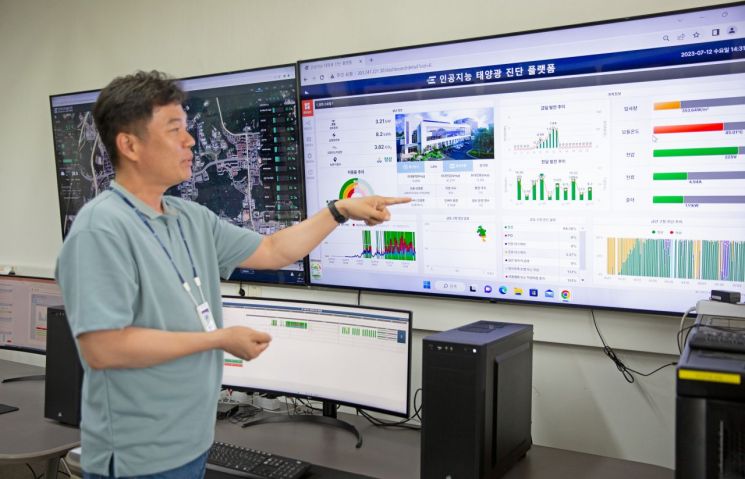 Dr. Seokhwan Go, the principal investigator, is explaining the AI-based solar power generation maintenance technology he developed. Photo by Energy Technology Research Institute
The usability of I-V curve data was also enhanced. Although I-V curve data from solar panels is crucial for evaluating panel performance and fault status, it fluctuates irregularly whenever conditions such as solar irradiance change, making it difficult even for experts to analyze clearly. To improve this, the research team developed an algorithm that models the physical characteristics according to the type of solar panel cells. Even under frequently changing solar conditions, the simulation data for voltage and current was predicted with over 98% accuracy. Using this technology, all power plants capable of collecting I-V data can be remotely managed for performance. This is especially beneficial for facilities installed in hard-to-access areas such as on water surfaces or offshore, significantly reducing maintenance costs.
Dr. Ko stated, “Recently, solar power plants installed in various forms (canals, agricultural land, soundproof barriers, water surfaces, offshore, etc.) have been difficult to inspect for performance and faults due to accessibility issues. Even small losses such as contamination can be diagnosed with over 95% precision, and remote diagnosis is possible, greatly improving maintenance efficiency.”
© The Asia Business Daily(www.asiae.co.kr). All rights reserved.
![User Who Sold Erroneously Deposited Bitcoins to Repay Debt and Fund Entertainment... What Did the Supreme Court Decide in 2021? [Legal Issue Check]](https://cwcontent.asiae.co.kr/asiaresize/183/2026020910431234020_1770601391.png)

















