'Global Business Town' Administrative Facilities Relocated to Major Corporation Office District
"The District Office Did What It Could, Resulting in the Region Becoming Number One in Birth Rate"
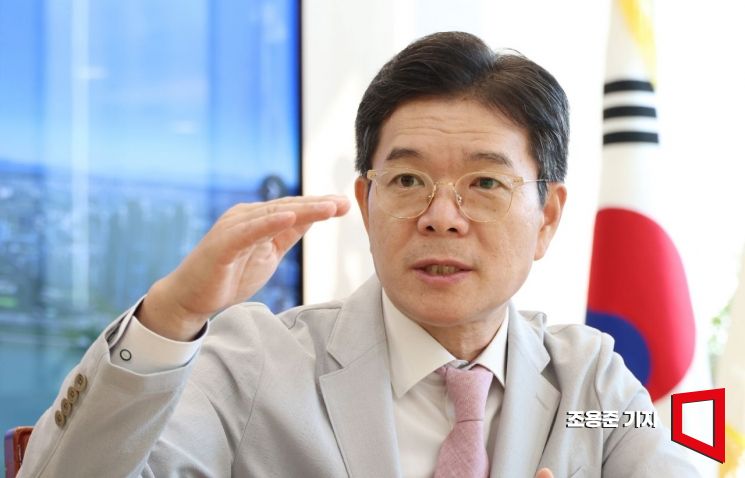 Jung Won-oh, Mayor of Seongdong-gu, in an interview with Asia Economy. He said, "The confirmation of GTX-C line stopping at Wangsimni Station started from 0% possibility," and added, "I will definitely succeed in developing Wangsimni Business District, a perfect hub for metropolitan and subway transportation."
 /Photo by Jo Yong-jun jun21@
When thinking of hot places in Seoul, 'Seongsu-dong' comes to mind. The changes in Seongsu-dong over the past decade are so significant that even the phrase "the landscape has changed" doesn't quite capture it. So, where will bring the biggest changes in Seoul in the next 10 to 20 years?
Yeouido? Yongsan? Apgujeong?
Jung Won-oh, the mayor of Seongdong-gu (55), added one more place to this list: 'Wangsimni.' While Wangsimni is known for its excellent transportation, is this expectation too high? His argument is based on the 'Wangsimni Global Business Town,' a plan to develop a super high-rise business district with buildings 60 to 70 stories tall.
Recently, when I met Mayor Jung at the district office, he said, "All the commercial zones within Seongdong-gu are in Wangsimni, but government offices occupy all of these areas. Once these offices relocate and this area is transformed into a transit-oriented business town, companies will flock here." He also mentioned that he explained this plan to the Seoul Housing and Communities Corporation (SH), which responded positively, and discussions are underway.
Shortly after becoming a three-term mayor last May, Jung announced the '2040 Seongdong Urban Development Master Plan,' which includes relocating administrative facilities such as the district office, district council, Seongdong Police Station, Seoul Metropolitan Seongdong Youth Center, and Seongdong-Gwangjin Education Support Office to sites like Sowol Art Hall in Haengdang-dong. The plan is to develop the area around Wangsimni Station (214,876㎡) into a large-scale commercial and business district. The vision is to leverage Wangsimni's excellent transportation infrastructure to transform Seongdong-gu into a hub for large corporations and big tech companies.
About a year and five months have passed since that announcement. Mayor Jung explained the progress, saying, "Urban planning requires looking 20 years ahead. If we don't design with the future in mind, conflicting interests become entangled, and nothing can be accomplished. If not now, the opportunity will be lost forever." He added, "If the aging Seongdong Police Station is rebuilt on the same site, the Wangsimni development could be stalled and fail. It's important to plan and coordinate such matters in advance."
Since many administrative facilities are concentrated here, consultations with various ministries such as the Ministry of Education (Education Office) and the Ministry of the Interior and Safety (Police Agency) are necessary, and land owned by the Seoul Metropolitan Government must be purchased, making it a complex task. Mayor Jung said, "We have shared the master plan with various agencies since before last year's local elections and are building consensus. Once the execution plan follows the master plan, the plan will be finalized, and the project will officially begin."
Mayor Jung said he plans to announce the execution plan for the Wangsimni Global Business Town within this year. He stated, "Wangsimni will feature commercial and office facilities rather than residential complexes, and the relocation of large corporate headquarters is essential for ripple effects. Time-based urban planning is a global trend, and workers need to commute within 45 minutes to enjoy a happy daily life. Wangsimni's competitive edge lies precisely in this transportation infrastructure."
Wangsimni allows commuting within 45 minutes not only to most parts of Seoul but also to Uijeongbu, Namyangju, Bundang, and even convenient access from Suwon. This aligns with Singapore's master plan for transportation infrastructure, which promotes the concepts of '20-Minute Town' and '45-Minute City.'
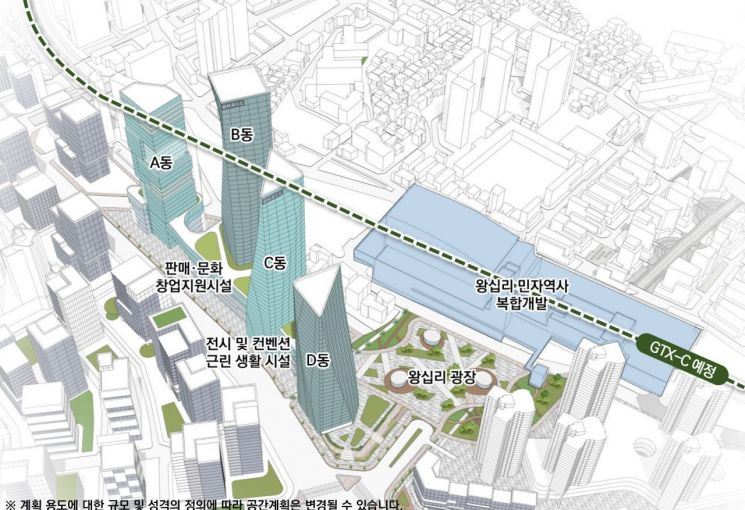
The decision last year to add Wangsimni Station as a new stop on the GTX (Greater Seoul Metropolitan Express Railway) Line C also creates synergy. Mayor Jung explained, "Wangsimni Station was initially not included as a stop on the GTX-C line because it is too close to Cheongnyangni Station, a major transportation hub, and the possibility of adding it was considered impossible. However, the economic logic that it is a key station used by 200 million passengers annually made it persuasive and feasible." Wangsimni Station is served by Subway Lines 2 and 5, the Gyeongui-Jungang Line, and the Suin-Bundang Line. In addition to GTX-C, the Seoul Metropolitan Northeastern Light Rail will also operate starting from Wangsimni Station.
If the creation of the Wangsimni Global Business Town and the development of the Sampyo Remicon site in Seongsu-dong represent the future of Seongdong-gu, policies that have led to the district having the highest birth rate among Seoul's autonomous districts and a sharp decline in the five major crimes clearly illustrate Seongdong-gu's present and past. Mayor Jung also cited childcare, welfare, and safety-focused administration as one of the biggest changes in Seongdong-gu over the past decade.
Mayor Jung said, "There are limits to what a district office (basic local government) can do to increase the birth rate, but one of them is expanding childcare facilities." He added, "When parents decide to have children, the answer lies in understanding what they need and where they have to go. When there was a huge waiting list for public daycare centers in Seoul, Seongdong-gu dramatically increased the number of district-run daycare centers. As word spread that it was easier to send children to public daycare centers in Seongdong-gu, the district soon became number one in birth rate."
Seongdong-gu increased the number of public daycare centers from 46 in 2013 to 69 by June 2017, and expanded to 81 by August this year, raising the utilization rate of public daycare centers to 70%, the highest in Seoul. They persuaded apartment residents to secure common spaces and converted spaces provided by religious facilities such as churches into public daycare centers, enabling rapid expansion at low cost. While building a daycare center typically requires 3 billion KRW, they managed to increase the number with just a tenth of that budget through these ideas. He said, "Issues closely related to birth rate, such as housing, employment, and gender equality, are problems for the nation and society as a whole, but among district-level policies, childcare policy is something that can be differentiated."
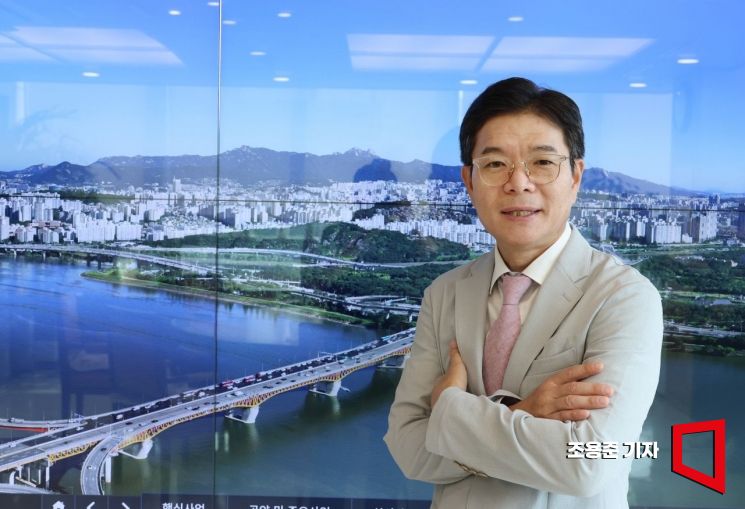 Mayor Jeong is posing in front of a large screen clearly showing Seongdong-gu, including Seoul Forest, filmed by a drone. Seongdong-gu calls this screen, which is also used as a comprehensive situation board, the "Smart Policy Communication Room." Photo by Jo Yongjun jun21@
Expanding security CCTV early on followed a similar principle. Seongdong-gu has been significantly increasing security CCTV, upgrading low-resolution cameras to smart CCTV since six years ago. According to Mayor Jung, the number of CCTVs in the district increased from 1,328 in 2016 to 3,771 last month, a 2.84-fold increase, while the annual occurrence of the five major crimes such as murder, robbery, and rape decreased by 27%.
Mayor Jung said, "If there is something good elsewhere, we benchmark it regardless of domestic or international origin. If there is nothing to benchmark, we research, study, discuss with staff, consult experts, and get verification. If we don't act, nothing happens, so even if there is a risk of failure, we approach it without fear and think we can improve it." This is the secret to being a good mayor that the 10-year veteran mayor shared at the end of the interview.
© The Asia Business Daily(www.asiae.co.kr). All rights reserved.



















