Agricultural and Marine Product Prices Rise to Highest in 5 Years
Heatwave, Chuseok, International Oil Prices... Inflation Concerns Increase
Producer prices rose at the fastest pace in 1 year and 4 months as international oil prices and agricultural product prices continued their sharp increase.
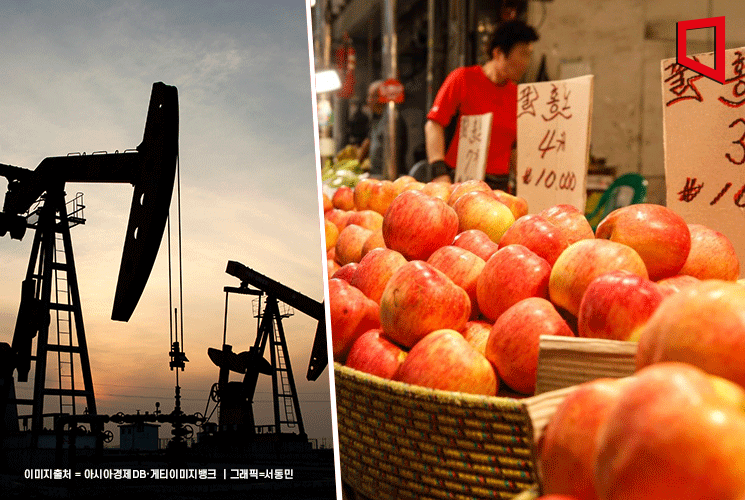
According to the 'August Producer Price Index' data released by the Bank of Korea on the 20th, producer prices last month rose 0.9% compared to the previous month. The increase in August was the largest since April last year (1.6%).
Producer prices had fallen consecutively in April (-0.1%), May (-0.4%), and June (-0.2%), then rebounded by 0.3% in July after 4 months, and continued the upward trend for two months through August.
Producer prices also rose 1.0% compared to the same month last year, marking an increase after 3 months.
Looking in detail, agricultural, forestry, and fishery products rose sharply by 7.3% month-on-month, mainly due to agricultural products (13.5%) and livestock products (1.5%). This is the largest increase in 5 years since August 2018.
This is interpreted as due to particularly poor crop yields caused by concentrated heavy rains and heatwaves this summer. By item, the increase was large for napa cabbage (112.7%) and spinach (56.7%). Prices of beef (10.2%) and pork (1.6%) also rose significantly compared to the previous month.
Yoo Sung-wook, head of the Bank of Korea's price statistics team, explained, "Spinach is a cold-temperature plant, so its crop yield worsens in summer, causing prices to rise," and "Beef and pork prices seem to have risen slightly due to increased demand during holidays."
Manufactured goods also rose 1.1% month-on-month, with coal and petroleum products (11.3%) and chemical products (1.4%) increasing.
The sharp rise in international oil prices was influenced by production cuts by major oil-producing countries such as Saudi Arabia and Russia. Both Brent crude and West Texas Intermediate (WTI) crude oil prices have soared well above $90 per barrel, showing the highest levels this year.
In addition, services rose 0.3% month-on-month, with transportation services (0.8%) and restaurant and accommodation services (0.4%) increasing. On the other hand, electricity, gas, water, and waste services fell 0.5%, led by a 5.8% decline in industrial city gas.
 On the 28th of last month, a citizen visiting Gyeongdong Market in Dongdaemun-gu, Seoul, is purchasing apples. Photo by Jinhyung Kang aymsdream@
The domestic supply price index, which measures price changes including imported goods, rose 1.4% month-on-month. This was due to price increases in raw materials (5.1%), intermediate goods (0.9%), and final goods (1.2%).
The total output price index, which adds export goods to domestic shipments, also rose 1.6% month-on-month. Manufactured goods (2.1%), agricultural, forestry, and fishery products (7.1%), and services (0.3%) all increased.
Since producer prices affect consumer prices with a time lag, they can act as a factor driving future consumer price increases.
Amid concerns over global oil supply disruptions, there are forecasts that international oil prices could rise to $100 per barrel in the future, and with the Chuseok holiday in September, there are worries that inflationary pressures will intensify.
However, Team Leader Yoo explained, "While producer prices may be affected by rising international oil prices, it is difficult to make a definitive judgment because producer prices include various items."
© The Asia Business Daily(www.asiae.co.kr). All rights reserved.


















