Growing Vulnerable Youth Population but Lack of Related Policies
33.09 Billion Won Budget Allocated for Next Year
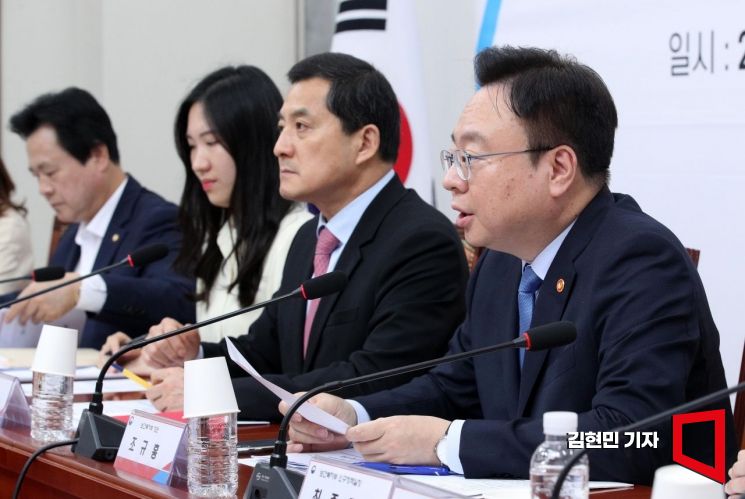 Minister of Health and Welfare Cho Kyu-hong is speaking at the Party-Government Council on the Five Major Tasks of Youth Welfare Policy held at the National Assembly on the 19th. Photo by Hyunmin Kim kimhyun81@
The government and ruling party have decided to focus support on family caregiving youth (young carers) and isolated/reclusive youth starting next year. To this end, a budget of 330.9 billion KRW will be allocated next year, representing a 43% increase compared to the previous year.
On the 19th, the Ministry of Health and Welfare announced the "Strategy for a Young Korea and Youth Future - Five Major Tasks for Youth Welfare" after consultations with the People Power Party and government-party discussions at the National Assembly. This decision was made based on the judgment that although difficulties for vulnerable youth groups are increasing due to reduced corporate hiring and rising housing prices, related policies are lacking. According to the Ministry, there are approximately 100,000 young carers and about 560,000 isolated/reclusive youth nationwide.
First, in the coming year, four "Youth Future Centers" will open across four metropolitan cities and provinces to provide integrated support for family caregiving youth and isolated/reclusive youth. In cooperation with schools, hospitals, and local communities, these centers will proactively identify young carers and assist them in various ways including caregiving, household chores, psychological, and economic support. A new self-care allowance of 2 million KRW per year will be established for low-income young carers, with about 960 people expected to benefit next year. Additionally, support applications will be encouraged through online platforms, the main communication channel for isolated/reclusive youth, and customized services will be provided. The Youth Future Centers will be piloted and then expanded nationwide starting in 2026.
Support for youth preparing for independence after leaving child welfare facilities and foster families will also be strengthened. The independence allowance will be increased by 100,000 KRW from 400,000 KRW this year to 500,000 KRW next year, reflecting inflation and other factors. The amount of the 10 million KRW settlement fund given to youth preparing for independence within five years after leaving care will also be increased.
Support for asset building among low-income youth will be expanded as well. The income eligibility criteria for the "Youth Tomorrow Savings Account," which adds government support to personal savings, will be relaxed. The age range for the poverty youth work incentive, targeting youth recipients of basic livelihood security, will be adjusted from under 24 to under 30 years old, and deductions will be increased.
A Ministry of Health and Welfare official stated, "Through these five major tasks, we aim to provide vulnerable youth with a fair starting opportunity so that they can have dreams and hope and grow into healthy adults."
© The Asia Business Daily(www.asiae.co.kr). All rights reserved.

















