Livelihood Benefit Eligibility Criteria Expanded to 32% of Median Income
Targeting 1.8 Million Livelihood Benefit Recipients by 2026
Improvements Also Made to Housing, Education, and Medical Benefit Standards
The government will expand the eligibility criteria for livelihood benefits, which guarantee the basic living of low-income households, from 30% to 32% of the median income next year. This is the first increase in the livelihood benefit eligibility criteria in seven years since 2017. Additionally, various requirements for receiving livelihood benefits will be relaxed to prevent the ‘blind spots of poverty’ where actual low-income individuals fail to receive benefits. Furthermore, plans have been presented to improve the standards for housing benefits, education benefits, and medical benefits to effectively guarantee the basic living of beneficiaries.
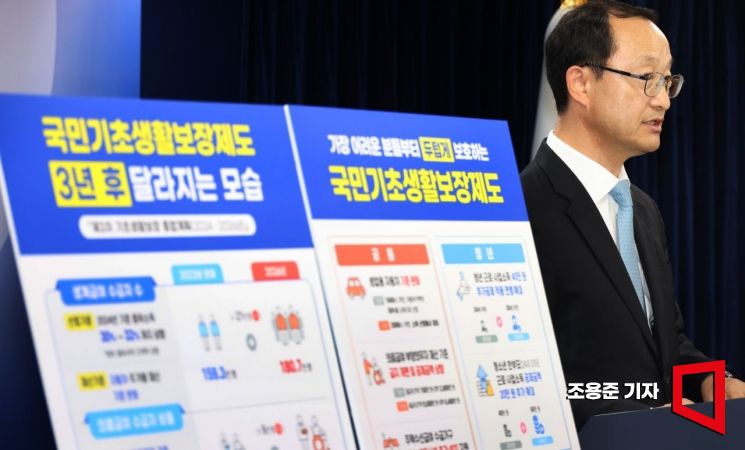 On the 19th, Jeon Byeong-wang, Director of the Social Welfare Policy Office at the Ministry of Health and Welfare, announced the 3rd Comprehensive Plan for National Basic Livelihood Security at the Government Seoul Office in Jongno-gu, Seoul. Photo by Jo Yong-jun jun21@
On the 19th, the Ministry of Health and Welfare announced the 3rd Comprehensive Plan for Basic Livelihood Security (2024?2026) containing these details. This third comprehensive plan includes measures to eliminate poverty blind spots and strengthen the level of benefit guarantees for basic living. Although the poverty rate in South Korea is on a declining trend, it still ranks 6th among OECD countries, and especially the elderly poverty rate for those aged 65 and over (37.6%) is the highest among OECD countries.
Livelihood Benefits: “Supporting More Beneficiaries with Greater Amounts”
According to this Basic Livelihood Security Comprehensive Plan, more beneficiaries will be able to receive larger amounts of livelihood benefits than before. The Ministry of Health and Welfare has decided to raise the 2024 median income to the highest level ever. For a four-person household, it will increase by 6.09% (5,400,964 KRW → 5,729,913 KRW), and for a single-person household, by 7.25% (2,077,892 KRW → 2,228,445 KRW). In addition, the eligibility criteria for livelihood benefits will be improved to 32% of the median income next year.
The Ministry plans to gradually raise the livelihood benefit eligibility criteria to 35% of the median income. Also, the criteria excluding beneficiaries if their supporting obligor’s annual income exceeds 100 million KRW or general assets exceed 900 million KRW will be relaxed.
The livelihood benefit eligibility criteria are based on the beneficiary household’s recognized income amount (income evaluation amount + income conversion amount). The income conversion amount of assets is calculated by applying 4.17% monthly for general assets, 1.04% monthly for residential assets, 6.26% monthly for financial assets, and 100% monthly for automobile assets. The Ministry plans to lower the income conversion rate of 1.04% applied to residential assets to an appropriate level.
The criteria for automobile assets will also be relaxed. The government aims to adjust the automobile assets, which are currently calculated as 100% of the asset value as income, to an appropriate level. The standard for automobiles to which the general asset conversion rate (4.17%) applies (currently under 1600cc) will be lowered to under 2000cc. Automobiles used for livelihood purposes (currently under 1600cc) will be excluded from the 100% asset valuation for automobile assets. Also, for beneficiary households with multiple children, the automobile engine displacement standard for applying the general asset conversion rate will be significantly expanded to under 2500cc.
A Ministry of Health and Welfare official stated, “Over the next three years, an additional 210,000 beneficiaries will be able to receive livelihood benefits, increasing the total to 1.8 million by 2026.”
Next Year’s Housing Benefit Eligibility Criteria: From 47% to 48% of Median Income
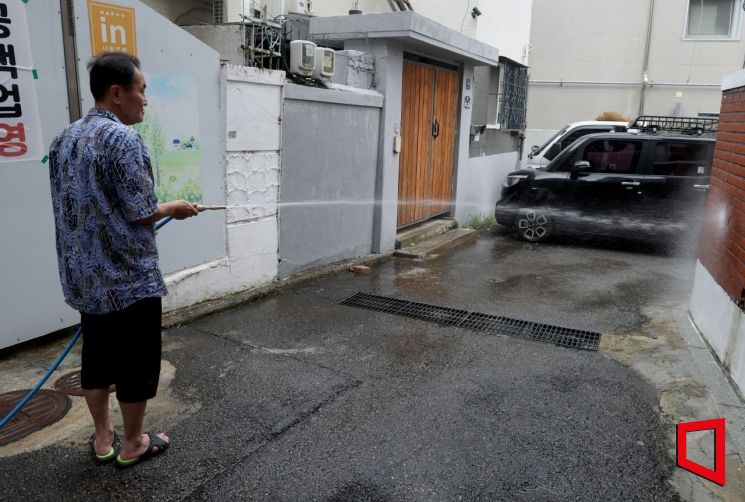
The eligibility criteria for housing benefits for low-income households will be raised from 47% to 48% of the median income in 2024. Currently, the housing benefit eligibility for a three-person household is 2.08 million KRW per month. With the relaxation of criteria, next year’s eligibility will expand to 2.26 million KRW per month. Low-income households falling within this range will also be included as beneficiaries and will be able to receive about 200,000 KRW per month in rental support. The government stated that “the goal is to gradually raise the criteria to 50% of the median income.”
With private education expenses becoming a burden on household finances, education benefits will also be increased to guarantee the educational rights of children in low-income families. The increase will be to 100% of the minimum education expenses. For example, this year’s education benefits were 415,000 KRW for elementary students, 589,000 KRW for middle school students, and 654,000 KRW for high school students, but next year, these will rise to 461,000 KRW, 654,000 KRW, and 727,000 KRW respectively. The Ministry plans to continuously consider expanding education benefits to actively guarantee educational opportunities for low-income households.
The eligibility criteria for medical benefits will also be gradually relaxed. Starting next year, the supporting obligor criteria for severely disabled persons will be revised. Additionally, adjustments to the supporting obligor asset criteria and improvements to the support cost imposition system will be made to eliminate blind spots in medical benefits.
Livelihood support funds provided to the near-poor will also be increased reflecting inflation. For a single-person household, the amount will rise from 620,000 KRW this year to 710,000 KRW next year, and for a four-person household, from 1,620,000 KRW to 1,830,000 KRW during the same period.
A Ministry of Health and Welfare official emphasized, “Through the 3rd Comprehensive Plan, we will raise the minimum living standards of the poor by one step and actively eliminate poverty blind spots such as non-beneficiary poor households.”
© The Asia Business Daily(www.asiae.co.kr). All rights reserved.


















