Following the United States, Canada's largest auto union is moving towards a strike. Earlier, a strike authorization vote was approved after wage negotiations broke down, putting the union in strike-ready status. As the historic first simultaneous strike by the U.S. auto union against the 'Big Three' automakers enters its third day, the companies have responded with plant shutdowns, escalating labor relations to their worst point. With the union intensifying its strike efforts, the likelihood of a shift towards reconciliation currently appears low.
According to major foreign media on the 18th (local time), Canada's largest auto union, Unifor, announced that if a new agreement is not reached by 11:59 p.m. that day, it will initiate a strike at Ford plants. The expected number of striking workers is 5,600, encompassing all Ford union members affiliated with Unifor. In the strike authorization vote held on the 28th of last month, the strike proposal was approved with support rates of 98.9% for Ford, 99% for General Motors (GM), and 98.1% for Stellantis. However, the number of union members who participated in the vote was not disclosed.
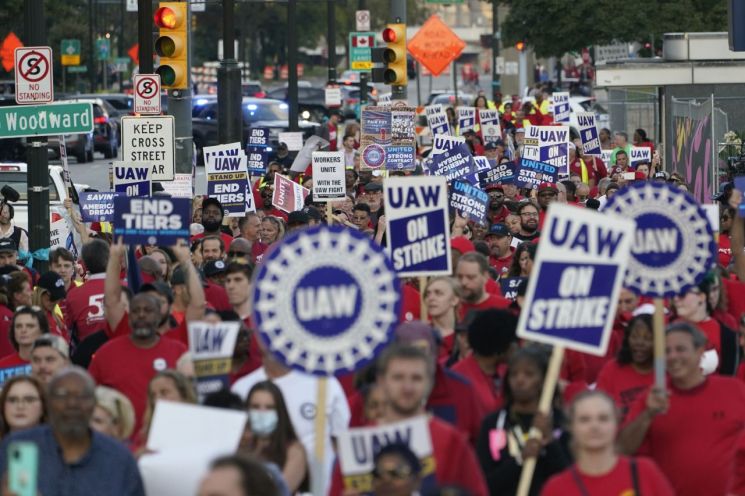
Unifor President Lana Payne expressed the union's intention to strike, stating that "significant differences in perspectives with (Ford) management have been confirmed." Ford operates two engine plants in Windsor, Ontario, Canada, and one assembly plant in Oakville. GM and Stellantis were excluded from the strike after reaching agreements ahead of their existing contracts' expiration.
Canada serves as a kind of "forward base" for Ford's electric vehicle (EV) production. In April, Ford announced plans to transform its existing internal combustion engine vehicle plants in Canada into EV plants, aiming to establish Canada as an EV hub. To this end, Ford planned to invest a total of 1.8 billion Canadian dollars (approximately 1.8 trillion Korean won) and begin converting existing internal combustion engine vehicle plants into EV plants starting in April next year.
The expansion of Ford's strike to Canadian plants is closely related to this trend. Previously, the Big Three automakers, including Ford, undertook workforce restructuring to secure funds necessary for transitioning to the EV business. Since declaring its EV transition, Ford has reduced its workforce by 3,000 in the U.S. alone over the past year, while GM and Stellantis have cut 5,000 and 33,500 employees respectively this year. Although the union cites "wage normalization and improved working conditions" as the justification for the strike, in reality, it is urging that the paradigm shift to EVs should not be resolved through workforce restructuring that causes employment insecurity.
The union is expected to intensify its aggressive tactics by expanding the strike scale around plants producing high-profit models and holding large-scale street rallies to maximize the strike's impact. The companies are countering with plant shutdowns, so labor-management conflicts are expected to continue in a confrontational phase for the time being. Sean Payne, UAW President leading the strike, indicated in interviews with NPR and MSNBC that "there is still a long way to go," forecasting a prolonged strike.
When asked whether the strike scale would be expanded, he replied, "If we determine that more pressure (on management) is needed, we will do so," adding, "We are prepared to take necessary measures." Additional UAW strike targets include production plants of high-profit models such as Ford's large electric pickup truck F-150, GM's Chevrolet Silverado, and Stellantis' Ram.
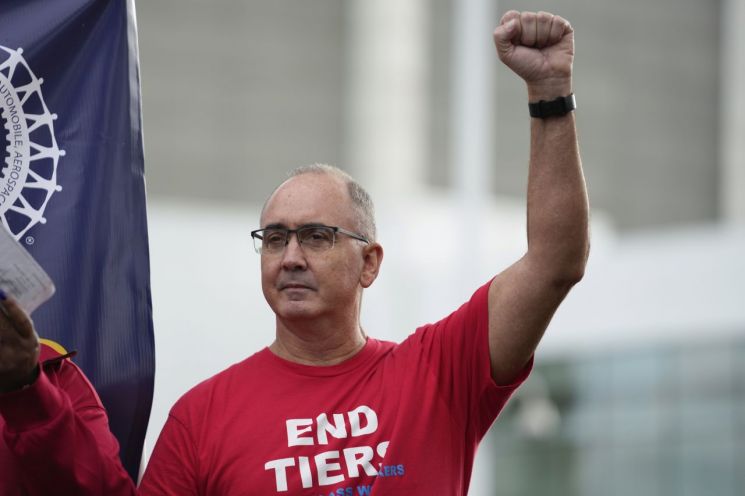
As the UAW is expected to escalate its struggle, concerns about the social and economic impact of this strike are growing inside and outside the industry. U.S. Treasury Secretary Janet Yellen expressed caution in an interview with CNBC, saying, "It is premature to predict the economic impact of the strike," adding, "It will depend on how long the strike lasts and what effects it has." President Joe Biden, on the first day of the UAW's simultaneous strike, delivered an urgent speech highlighting that automakers are making record profits and urged management to make additional concessions.
Earlier, the UAW, representing workers from the U.S. Big Three automakers, initiated a simultaneous strike at GM, Ford, and Stellantis plants starting at 11:59 p.m. on the 14th. This is the first simultaneous strike by the UAW against the Big Three automakers since its founding. The strike involves 12,700 workers, about 9% of the total UAW membership. The union demands a 36% wage increase over the next four years, along with guarantees of employment stability amid the EV paradigm shift. Due to the strike, production of popular, profitable models including GM's Chevrolet Colorado mid-size pickup truck, Ford's Bronco sport utility vehicle (SUV), and Stellantis' Jeep Wrangler has been halted.
© The Asia Business Daily(www.asiae.co.kr). All rights reserved.


















