Office of Rep. Yang Iwonyoung Cites Analysis by Energy Economics Institute
Must More Than Double 2021's 8% to Be Achievable
A study has found that expanding the share of renewable energy such as solar and wind power, which currently accounts for 8% of South Korea's energy generation, to 20% by 2030 would reduce the unemployment rate of unskilled workers by 0.54 percentage points (p).
On the 19th, Yang Yi-won-young, a member of the National Assembly's Industry, Trade, Energy, Small and Medium Enterprises Committee from the Democratic Party of Korea, cited the Korea Energy Economics Institute's report titled "Analysis of the Macroeconomic Effects of Expanding Renewable Energy" to make this claim.
According to statistics from the Korea Energy Agency's "New and Renewable Energy Supply Performance Survey," the share of renewable energy in South Korea's power generation was 8.29% in 2021. The Korea Energy Economics Institute's research results showed that expanding this share to 20% by 2030 could reduce the unemployment rate of unskilled workers by 0.54%p and that of skilled workers by 0.14%p.
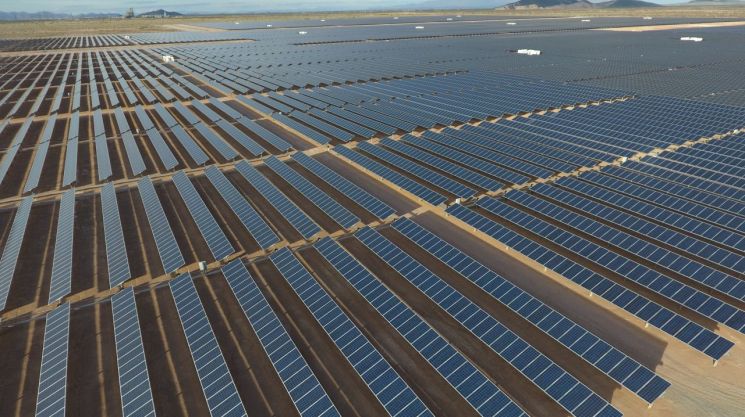
The Korea Energy Economics Institute expects that increasing renewable energy will generate an import substitution effect. It also analyzed that the relatively labor-intensive nature of the renewable energy industry would positively contribute to employment growth.
The institute further analyzed that improving renewable energy productivity would mitigate the economic shocks caused by carbon regulations. If the greenhouse gas reduction target is set to reduce emissions by 32.5% compared to the current Business-As-Usual (BAU) projection by 2030, the Gross Domestic Product (GDP) is expected to decrease by 3.13% compared to the baseline projection. However, by achieving the reduction target relative to BAU, increasing the share of renewable energy to 20%, and improving renewable energy productivity, the GDP decline could be limited to 2.59%.
Representative Yang said, "If the renewable energy share reaches 20% as analyzed by the national research institute, it will have a positive impact on the economy and employment," adding, "The slowdown in growth and increase in unemployment caused by international carbon regulations could also be reduced."
© The Asia Business Daily(www.asiae.co.kr). All rights reserved.
![User Who Sold Erroneously Deposited Bitcoins to Repay Debt and Fund Entertainment... What Did the Supreme Court Decide in 2021? [Legal Issue Check]](https://cwcontent.asiae.co.kr/asiaresize/183/2026020910431234020_1770601391.png)