Hyundai Motor Temporary Agreement on Labor-Management Negotiations Approved by Vote
Approval Exceeds Majority with 58.8% Support
Decision on Retirement Age Extension Postponed... Basic and Performance Bonuses Proposed at Record Levels
Hyundai Motor's Q3 Earnings Outlook 'Clear' as Strike Risk Eased
The tentative wage and collective agreement prepared by the Hyundai Motor Company labor and management was approved with more than half of the union members voting in favor. With the passage of this agreement, which is the result of prolonged negotiations, Hyundai Motor narrowly avoided a large-scale strike. The potential strike risk has been resolved, alleviating concerns about a 'peak-out' in Hyundai Motor's third-quarter performance this year.
 The Hyundai Motor Union is counting the votes of union members for and against the tentative agreement on this year's wages and collective bargaining at the union office inside the Ulsan plant on the 18th. [Image source=Yonhap News]
On the 19th, the Hyundai Motor union announced that in a vote held on the 18th among approximately 44,000 union members regarding this year's tentative wage and collective agreement, about 22,000 members (58.8%) voted in favor, passing the proposal.
According to this year's tentative agreement, Hyundai Motor will increase the base salary by 111,000 KRW (including seniority increments) and provide a performance bonus amounting to 300% of the base salary plus 8 million KRW. Both the base salary and performance bonus increases are the largest ever. Additionally, a special incentive payment of 2.5 million KRW, a year-end business goal achievement bonus equivalent to 100% of the base salary, and stock and gift certificates will be provided.
The approval of this agreement was influenced by the high voter turnout among technical workers. Compared to general and research staff, the older age group of technical workers prioritized discussions on extending the retirement age, which labor and management agreed to revisit in the future. Previously, management had firmly opposed extending the retirement age, but in the agreement, they stepped back, proposing to continue discussions considering government policies. Furthermore, the proposal to newly recruit 800 technical workers and offer the highest-ever levels of base salary and performance bonuses also garnered support.
The agreement also includes the introduction of the advanced manufacturing method called 'Hypercasting' starting in 2026. Hypercasting is a process that stamps out the entire vehicle body at once instead of welding and assembling each body part individually. This is significant as labor and management have accepted an external new manufacturing method to ultimately reduce the cost of electric vehicles.
With the approval of this agreement, Hyundai Motor has eliminated the biggest risk in this year's business. The industry had been concerned about a 'peak-out' in Hyundai Motor's third-quarter performance this year due to a slowdown in electric vehicle sales and the looming threat of a strike. There were analyses suggesting that a large-scale strike similar to those in 2016-2017 could result in operating losses of up to 1 trillion KRW.
However, with labor and management reaching an agreement before Chuseok, Hyundai Motor's third-quarter performance is expected to continue its strong trend. Although it may be difficult to achieve record-breaking results like the previous second quarter, the annual performance is expected to surpass last year's.
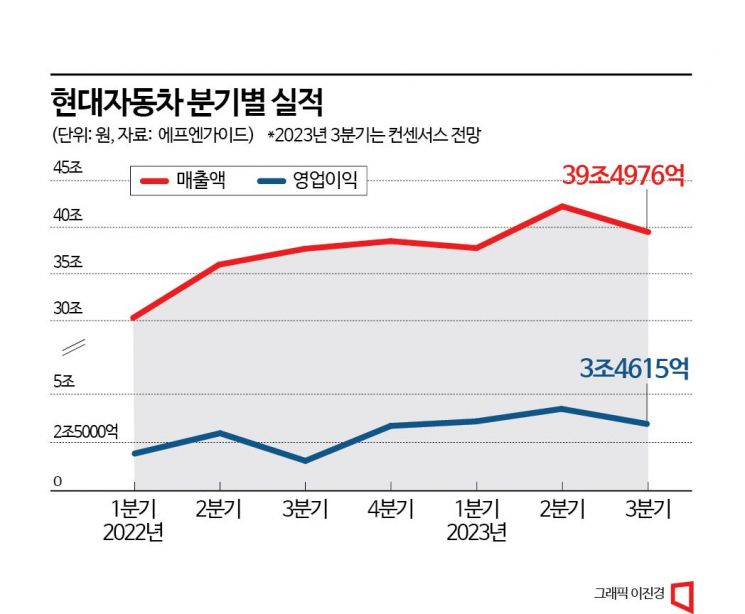
According to the FnGuide consensus, Hyundai Motor's third-quarter sales are projected to increase by 4% year-on-year to 39 trillion KRW, and operating profit is expected to rise by 123% to 3.4 trillion KRW. Although operating profit is lower than the record high of 4.2 trillion KRW in the previous quarter, it is about 1 trillion KRW higher than the average of 2.4 trillion KRW in the same quarter last year.
Globally, while electric vehicle sales are slowing down, more profitable hybrid vehicles are filling the gap. Despite expectations of sluggishness in the U.S. electric vehicle market due to the Inflation Reduction Act (IRA), Hyundai Motor and Kia maintained an 8% market share in the first half of this year.
Jung Yong-jin, a researcher at Shinhan Investment Corp., said, "It is true that the backlog demand has decreased compared to the end of last year, but the models with remaining backlog demand are mainly high-profit hybrid vehicles," adding, "Profitability is expected to continue soaring in terms of mix (model composition ratio) until the end of the year."
© The Asia Business Daily(www.asiae.co.kr). All rights reserved.


















