Forum on Institutional Improvements to Strengthen K-Content Competitiveness
Domestic OTT Facing Growth Slowdown, Fierce Competition, and Revenue Decline
Promotion Needed Over Regulation... "Only Domestic Operators Bear the Burden"
A suggestion has been made that policy support is needed before regulation to ensure the survival of domestic online video services (OTT). OTT subscription fee income deductions were also mentioned as a means to secure a solid subscriber base before expanding overseas.
On the 18th, the 'Forum 7 for Institutional Improvement to Strengthen K-Content Competitiveness' was held at the National Assembly Members' Office Building under the theme of 'Policy Improvement Measures for the Sustainable Survival of Domestic OTT.'
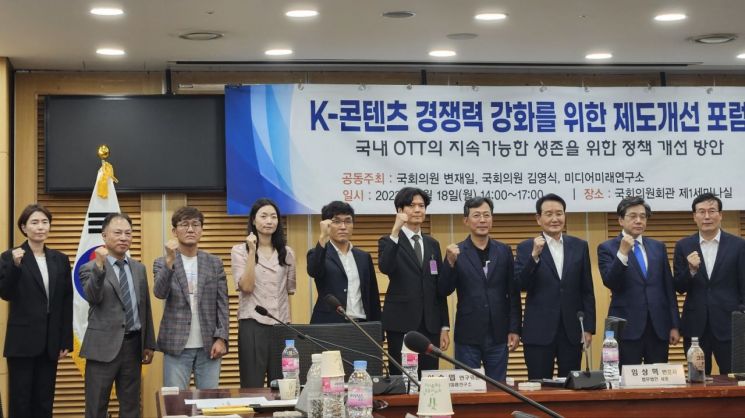 Participants of the '7th Forum on Institutional Improvements to Strengthen K-Content Competitiveness' held on the 18th are taking a commemorative photo.
 [Photo by Oh Su-yeon]
Lee Su-yeop, a research fellow at the Media Future Research Institute, stated that although the OTT market growth is slowing down, competition is intensifying and profits are not improving, so policy support is necessary for the survival of domestic OTTs. He said, "Global OTTs have the capacity to respond to growth slowdowns by securing overseas markets based on their domestic markets. However, in Korea, where a narrow market is dominated by global operators, domestic OTT operators need to be supported through policy. It is necessary to strengthen the domestic market to increase the value of domestic operators and expand into the global market."
As a way to expand the domestic market and increase subscribers, Lee proposed the introduction of an OTT subscription fee income deduction system. "Unlike performances, museums, and movie theaters, OTTs are not based on specific facilities, so there is no regional concentration. Considering the crisis OTTs face, there is sufficient need to protect the industry," he said.
He also suggested expanding investment tax benefits and financial support, which are currently focused on production companies, to OTT platforms, and indirect entry through partnerships and cooperation with various operators. Lee said, "We should promote the global expansion of domestic OTTs by providing opportunities for content, platform, and device cooperation, as seen in cases like Samsung TV Plus and CJ ENM brand halls."
Next, lawyer Lim Sang-hyuk from the law firm Sejong presented on 'Measures to Protect Broadcasting Content IP, Including Responses to Copyright Infringement.' Lim estimated that by August, videos illegally distributed through Nunutv had been viewed 1.8 billion times, with damages exceeding 4.9 trillion won. Nunutv's monthly users number about 10 million, approximately 2.7 times that of Wavve (3.76 million).
Lim pointed out that although substantive legal sanctions against copyright infringement by illegal streaming site operators have been established, they are difficult to apply when overseas servers are used. He emphasized the need to devise effective measures to block illegal distribution itself. He noted that regulations on Internet Service Providers (ISPs) are insufficient if they only block access to domestic ISPs. Introducing a partial amendment to the Information and Communications Network Act, proposed by Representative Byun Jae-il, he argued that illegal content distribution through Content Delivery Networks (CDNs) must be blocked. He also stated that advertising placements and ad revenues are causes of the increase in illegal streaming operators and should be regulated.
In the subsequent comprehensive discussion, major domestic OTT operators expressed concerns that regulations could shrink only domestic platforms. Labor Hwan, leader of Wavve, said, "Regulations arise due to unfair practices by foreign companies, but after legislation, domestic operators are subject to them while foreign operators are not effectively regulated. Regulation and promotion of the OTT industry must be harmonized." He added, "Platforms and content have a symbiotic relationship. If only one side is empowered or regulated, synergy is difficult to achieve. There is content accumulating that cannot be distributed in the market, and with domestic companies lacking investment capacity, there is a possibility it will be sold cheaply to global OTTs."
Park Jong-hwan, director of Tving, said, "As OTT becomes mainstream, regulations that burden domestic platforms emerge, which stifles investment and growth. We need to create an atmosphere that allows subscriber growth and diversification of business models to occur organically."
© The Asia Business Daily(www.asiae.co.kr). All rights reserved.

















