Significant Reduction in Grants Linked to Domestic Taxes
Regarding 'Fund Shortage' Concerns: "Adjusting Nonessential Projects"
The government projects that the tax revenue shortfall will reach 60 trillion won by the end of this year, and the Local Education Finance Grants, which are linked to domestic taxes, are also expected to be reduced by around 11 trillion won.
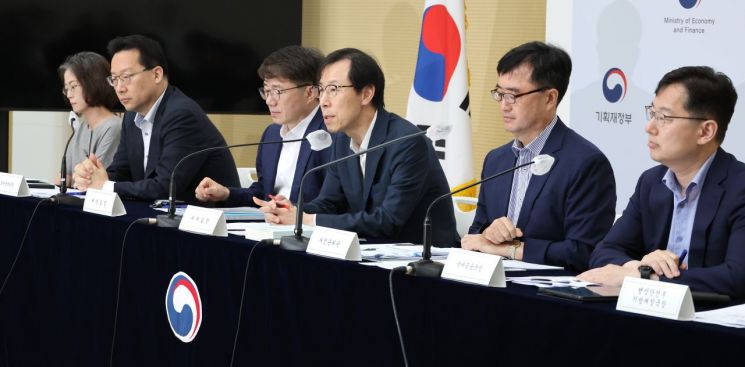
On the 18th, the Ministry of Economy and Finance announced this during a briefing on the "2023 Tax Revenue Re-estimation Results and Fiscal Response Direction" at the Government Complex Sejong. In this regard, the Ministry of Education also explained in a press release on the same day that "the Local Education Finance Grants, which are allocated in proportion to a certain percentage of domestic taxes, are also expected to be adjusted downward in the second half of this year."
The specific amount of reduction is currently being estimated by the fiscal authorities. Since the Local Education Finance Grants are funded by 20.79% of domestic taxes, they inevitably decrease when the tax revenue shortfall is large. With domestic tax revenue expected to decrease by about 55 trillion won compared to the original budget this year, local grants are also projected to be reduced by around 23 trillion won.
The Ministry of Education plans to utilize the reserve funds held by metropolitan and provincial offices of education. The Ministry stated, "We will use the reserve funds and other resources held by metropolitan and provincial offices of education to ensure that the planned curriculum operations, educational activity support, and educational environment improvement projects for 2023 proceed as originally targeted," adding, "We plan to actively cooperate with metropolitan and provincial offices of education to ensure smooth fiscal execution in consumption and investment areas."
According to the Ministry of Education, as of the end of last year, the total reserve funds held by metropolitan and provincial offices of education nationwide amounted to 21.3 trillion won, of which 11.6 trillion won is the Fiscal Stabilization Fund and about 8.8 trillion won is the Facility Fund.
However, depending on the situation of each metropolitan and provincial office of education, the availability of usable funds may not be ample. Regarding this, the Ministry of Education's Local Education Finance Division responded to related questions during the regular briefing at the Government Complex Sejong this morning, stating, "Since the resources themselves are insufficient, we judged that each office of education can sufficiently respond by restructuring expenditures and adjusting execution on unnecessary projects," and added, "We will hold weekly meetings to check the status of fund allocations and executions by region, and as this is an emergency situation, we will identify difficulties together and provide support."
They continued, "Since each office of education operates special accounts and funds, the relationship with local councils is important," adding, "If supplementary budgets are needed or if fund operations require approval from city councils, we (the Ministry of Education) will also play a role."
Regarding expenditure restructuring plans by metropolitan and provincial offices of education, they explained, "Unused funds generated annually can be the first priority for unnecessary projects," and "There are fund transfers, but since situations vary by office of education, adjustments are made autonomously."
© The Asia Business Daily(www.asiae.co.kr). All rights reserved.

















