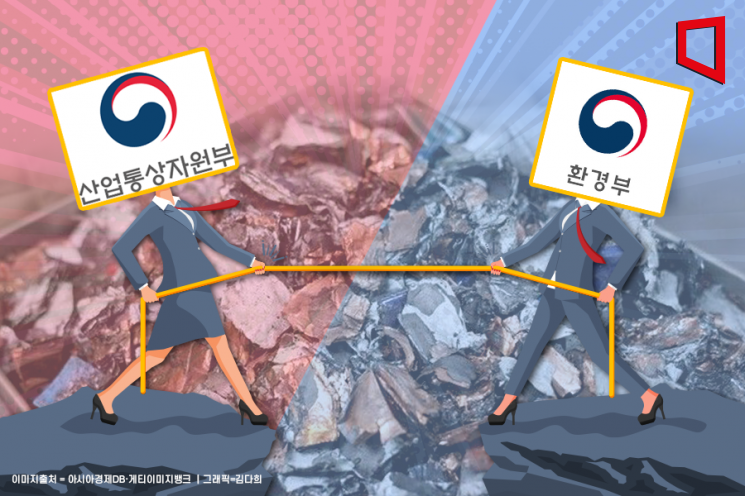
The Ministry of Trade, Industry and Energy and the Ministry of Environment are engaged in a tense standoff over the rapidly growing electric vehicle (EV) used battery market. South Korea currently classifies used batteries as waste. The Ministry of Trade, Industry and Energy, which oversees the battery industry, insists that "to revitalize the industry, the collection, distribution, and utilization of used batteries should be decided proactively by the private sector." On the other hand, the Ministry of Environment, responsible for waste management, counters that "used batteries are hazardous waste with flammability and explosiveness, so they must be subject to tracking management within regulatory frameworks."
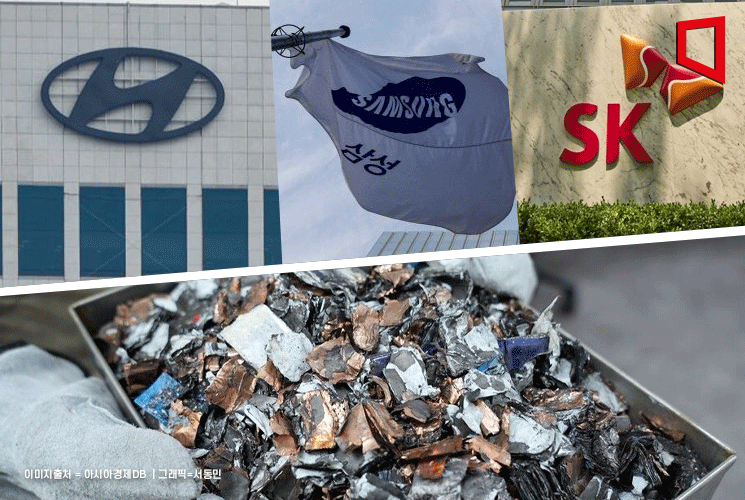
The Battery Alliance, composed of the three major battery companies LG Energy Solution, Samsung SDI, SK On, as well as battery-related industries such as Hyundai Motor Company and POSCO Future M, along with public institutions like the Korea Trade Insurance Corporation and the Korea Mining Industry Promotion Agency, plans to submit a proposal for improving the used battery recycling system to the government after a final meeting next month.
Previously, in November last year, the Ministry of Trade, Industry and Energy established a private-sector-led Battery Alliance at the '3rd Industrial Strategy Roundtable' and decided to prepare industry proposals on an integrated management system and support measures for used batteries through the alliance, with a view to legislative enactment.
With the amendment of the Air Quality Preservation Act eliminating the obligation to return used batteries to local governments for EVs registered after January 1, 2021, measures are being prepared to handle the influx of used batteries expected in the future. In September last year, during the joint inter-ministerial process to devise a circular economy activation plan, the Ministry of Trade, Industry and Energy strongly requested that the private sector take the lead in collecting, distributing, and utilizing used batteries.
The Ministry of Trade, Industry and Energy believes a separate integrated management system for used batteries should be established. Currently, used batteries are subject to complex multi-ministerial regulations throughout the entire process from installation in EVs to dismantling. There are about six relevant laws, including the Automobile Management Act, Air Quality Preservation Act, and Waste Management Act. The terminology used also differs.
While the Ministry of Environment defines them as used batteries, the Ministry of Trade, Industry and Energy prefers the term post-use batteries. A ministry official said, "The industry's demand for a special law on used batteries means that new legislation is necessary amid the rapidly changing industrial environment."
Conversely, the Ministry of Environment argues that since used batteries contain large amounts of hazardous substances, they must be managed as 'designated waste' during recycling to ensure public safety. Currently, used battery packs are classified as 'general waste,' while scrap (defective products) generated during battery production is managed as designated waste. The used battery recycling industry complains, "Licenses and management must be obtained separately for general and designated waste. Although used battery packs and defective products can be processed through the same recycling procedures, the legal separation increases investment costs and causes confusion."
The Ministry of Environment explains, "Defective products from the process that are incomplete, such as those injected with electrolyte containing toxic substances like waste acid or those containing only cathode materials, are irregular in condition and thus classified as designated waste." Once designated as such, they are subject to safety regulations regarding sealing and storage and are monitored in real time regarding their location and movement. The Ministry of Environment considers that intact used battery packs themselves have a low risk of exposure to hazards.
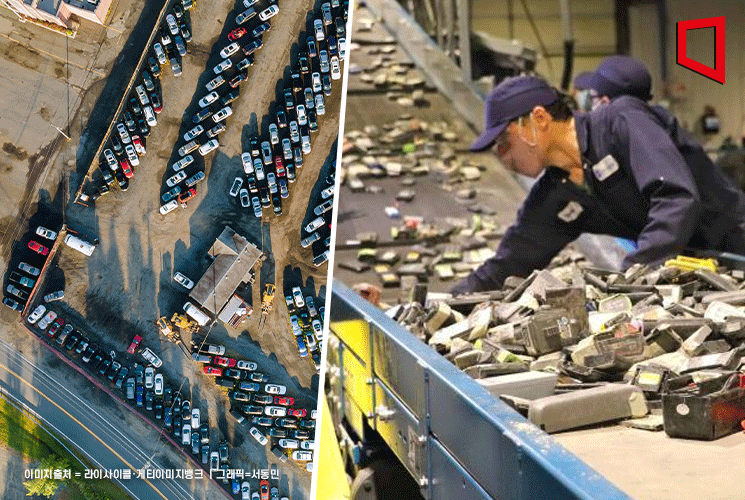
Used battery utilization is broadly divided into three categories: remanufacturing, reuse, and recycling. Remanufacturing refers to separating battery cells from used batteries in good condition, reassembling them, and using them again in EVs. Reuse means using them for other purposes such as energy storage systems (ESS). Recycling involves crushing or melting used batteries at high temperatures to extract raw metals.
An official from the Ministry of Environment said, "Remanufacturing and reuse do not involve crushing the battery cells themselves, so a certain level of safety is guaranteed. Recycling, however, involves toxic substances contained in the electrolyte inside the cells, posing significant risks of hazardous substance leakage and fire or explosion." For these reasons, the Ministry of Environment exempted reused used batteries from waste regulations under the soon-to-be-enforced Resource Circulation Act amendment, but still regulates recycled batteries as waste.
The official added, "If used batteries are managed under a special law rather than the Waste Management Act, tracking management would be impossible, raising safety and environmental concerns." They also explained that if used batteries are excluded from 'waste' and classified as 'products,' the raw materials derived from recycling would not be recognized as recycled raw materials, making it difficult to acknowledge them as such.
However, whether the black powder produced by grinding used batteries (black powder) should be classified as waste or a product is still under review. The official said, "We are addressing unreasonable issues raised by the industry regarding recycling through consultation meetings." They added, "Regarding whether to apply the Extended Producer Responsibility (EPR) system to used batteries, industry opposition is so strong that active consideration is not currently underway."
If used batteries are included under EPR, the three battery manufacturers would be responsible for collecting and recycling a certain amount. Failure to comply would require payment exceeding the recycling costs.
© The Asia Business Daily(www.asiae.co.kr). All rights reserved.
![Clutching a Stolen Dior Bag, Saying "I Hate Being Poor but Real"... The Grotesque Con of a "Human Knockoff" [Slate]](https://cwcontent.asiae.co.kr/asiaresize/183/2026021902243444107_1771435474.jpg)


















