Gaya Tumuli, Inscribed as a UNESCO World Heritage Site
The 'Gaya Tumuli,' a collection of seven Gaya archaeological sites, has been designated as a UNESCO World Heritage site. With the inscription of the Gaya Tumuli as a cultural heritage, South Korea has listed 14 cultural heritages and 2 natural heritages on the World Heritage list since 1995, starting with Seokguram Grotto and Bulguksa Temple, Haeinsa Temple Janggyeong Panjeon, and Jongmyo Shrine.
On the 17th (local time), the UNESCO World Heritage Committee decided to inscribe the Gaya Tumuli on the World Heritage list at a meeting held in Riyadh, Saudi Arabia. The committee evaluated that it is recognized for its "Outstanding Universal Value" (OUV) as it maintains a unique autonomous and horizontal system with neighboring countries and serves as important evidence demonstrating the diversity of ancient East Asian civilizations.
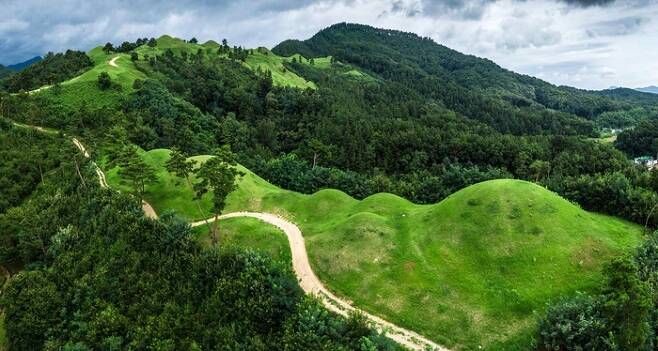 The "Gaya Tumuli," consisting of seven burial sites of the Gaya Tumuli Group, has been inscribed as a UNESCO World Heritage Site. The photo shows the "Jisandong Tumuli" in Goryeong, Gyeongbuk. Provided by the Cultural Heritage Administration.
Gaya refers to a collective term for small states that flourished mainly around the Nakdong River basin from around the beginning of the Common Era until 562 AD. The Gaya Tumuli, recognized for their value as a World Heritage, are a serial heritage consisting of seven burial mound clusters that existed in the Yeongnam and Honam regions from the 1st to mid-6th centuries.
They consist of the Goryeong Jisandong Tumuli Cluster, Gimhae Daeseongdong Tumuli Cluster, Haman Malyisan Tumuli Cluster, Changnyeong Gyodong and Songhyeondong Tumuli Clusters, Goseong Songhakdong Tumuli Cluster, Hapcheon Okjeon Tumuli Cluster, and Jeonbuk Namwon Yugok-ri and Durak-ri Tumuli Clusters.
Gaya is highly valued historically as evidence demonstrating the Gaya civilization, which coexisted with surrounding centralized ancient states while maintaining a unique political system called a 'confederacy.' Choi Eung-cheon, Commissioner of the Cultural Heritage Administration, emphasized the significance by stating, "The inscription of the Gaya Tumuli as a World Heritage is a remarkable achievement accomplished over more than ten years since it was placed on the tentative list in 2013, through the united efforts of the public, private, and academic sectors."
When deciding on the inscription, the World Heritage Committee also urged efforts to protect the heritage. The committee recommended mitigating the impact of the road passing between the Changnyeong Gyodong and Songhyeondong Tumuli Clusters on the heritage and securing privately owned land within the seven tumuli clusters to ensure stable preservation of each heritage site. Commissioner Choi, who visited Saudi Arabia, stated, "We will protect the value of the Gaya Tumuli recognized worldwide and promote it widely to make it a World Heritage site that receives much interest and love."
With the inscription of the Gaya Tumuli, the number of World Heritage sites held by South Korea has increased to 16. World Heritage sites are designated through evaluation of heritage with outstanding universal value that must be protected for all humanity, according to the 'Convention Concerning the Protection of the World Cultural and Natural Heritage' adopted in 1972.
© The Asia Business Daily(www.asiae.co.kr). All rights reserved.
![User Who Sold Erroneously Deposited Bitcoins to Repay Debt and Fund Entertainment... What Did the Supreme Court Decide in 2021? [Legal Issue Check]](https://cwcontent.asiae.co.kr/asiaresize/183/2026020910431234020_1770601391.png)
















