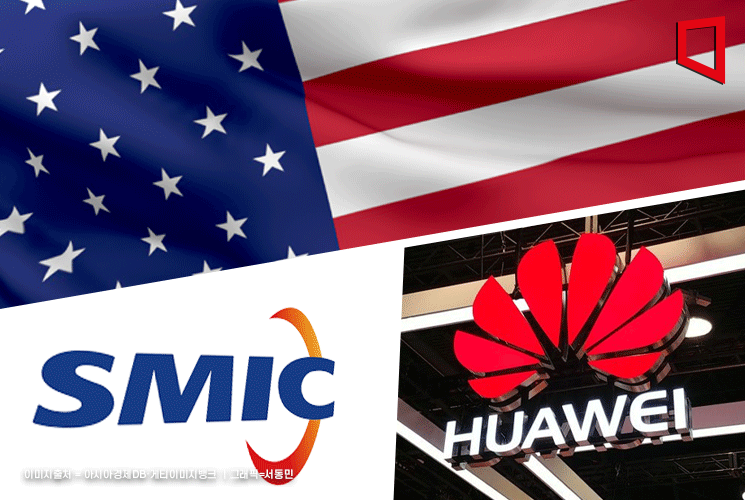
As Chinese tech giant Huawei breaks through U.S. sanctions barriers to launch a smartphone equipped with advanced 7-nanometer (nm) class semiconductors, the U.S. Congress is pushing for a comprehensive expansion of sanctions, including criminal prosecution of executives from related companies.
On the 14th (local time), Bloomberg reported that Michael McCaul, Chairman of the House Foreign Affairs Committee, along with 10 Republican lawmakers, urged the Biden administration to fully expand export controls on Huawei and semiconductor foundry company SMIC.
In an open letter sent to Alan Estevez, Under Secretary of Commerce for Industry and Security, the lawmakers pointed out that Huawei's launch of a smartphone equipped with 7nm (nanometer, one billionth of a meter) semiconductors confirmed that existing U.S. regulations against China are ineffective.
They stated, "Given the widespread use of U.S. technology throughout the global semiconductor supply chain, Huawei's release of a 7nm smartphone constitutes a violation of U.S. export control regulations," adding, "We express deep frustration and serious concern over the Bureau of Industry and Security's failure to effectively enforce export controls against China."
They further accused the Commerce Department of allowing companies under the control of the Chinese Communist Party to import prohibited items, causing this situation, and demanded comprehensive sanctions against SMIC and Huawei, including a ban on U.S. imports of semiconductors produced by SMIC. They also urged the Commerce Department to place Huawei, SMIC, and all their subsidiaries on the Department's Entity List and apply the Foreign Direct Product Rule (FDPR).
According to this rule, if products are produced overseas using U.S. technology or equipment, the U.S. Commerce Department can impose export controls on those products. The lawmakers also called for the cancellation of all previously issued export licenses to SMIC and Huawei and for criminal prosecution of the two companies' executives.
The lawmakers requested that the Biden administration, including the Bureau of Industry and Security, the Department of Defense, the Department of State, and the Department of Energy, hold a congressional briefing on this matter by the 28th. Bloomberg reported that the letter was signed by Chairman McCaul, Military Committee Chairman Mike Rogers, China Strategic Competition Special Committee Chairman Mike Gallagher, Energy and Commerce Committee Chair Cathy Rogers, among others.
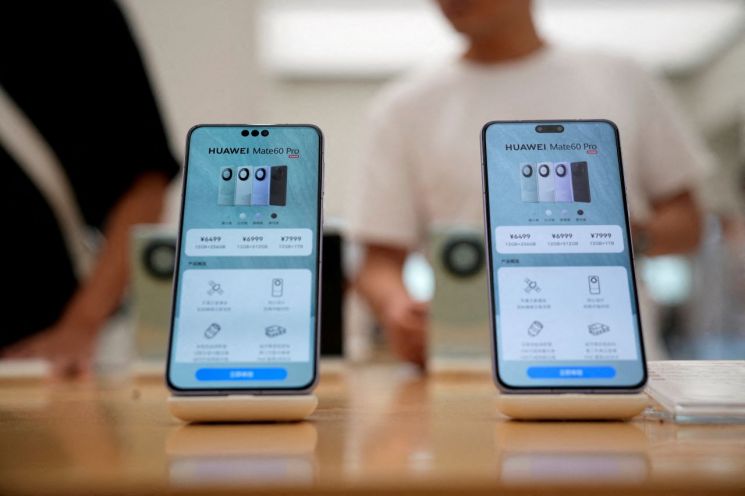
Earlier, Huawei unveiled the 5G smartphone 'Mate 60 Pro' equipped with semiconductors manufactured using a 7nm process at the end of last month and officially began sales on the 3rd of this month. After U.S. sanctions in 2020 blocked Huawei's procurement of application processors (AP), the launch of this new product has led to assessments that Chinese companies have circumvented U.S. export controls. Semiconductor research firm TechInsights, commissioned by Bloomberg, disassembled and analyzed Huawei's Mate 60 Pro, confirming that it is equipped with the 'Kirin 9000s' AP produced by Chinese foundry SMIC using the 7nm process.
This incident is expected to lead to further strengthening of U.S. sanctions against China. The U.S. Commerce Department stated, "We are working to obtain more information about the characteristics and composition of the semiconductor known as 7nm," and began an investigation into Huawei's 7nm chip on the 7th. U.S. investment bank Jefferies noted, "Huawei's new smartphone has sparked debate within the U.S. about the effectiveness of China regulations," and predicted, "The China regulation bill being prepared by Congress may include stricter technological sanctions."
© The Asia Business Daily(www.asiae.co.kr). All rights reserved.


















