Lee Dong-gwan, Chairman of the Korea Communications Commission, Meets with CEOs of 3 Major Telecom Companies on the 15th
Official First Meeting... Focus Likely on Household Communication Cost Measures
Discussion Possible on '30,000 Won 5G Plans' and 'Device Subsidies'
Lee Dong-kwan, Chairman of the Korea Communications Commission, will meet with the representatives of the three major telecommunications companies. This will be the first meeting since his inauguration last month. On the 15th at 2:30 PM, he is scheduled to hold talks with Yoo Sang-yang, CEO of SK Telecom, Kim Young-seop, CEO of KT, and Hwang Hyun-sik, CEO of LG Uplus, at the Government Complex Gwacheon. As this is their official first meeting, attention is focused on what topics will be discussed. A telecommunications industry insider said, "Since he is meeting all three companies, common issues will be discussed," adding, "Measures to reduce household communication expenses are expected to be the main focus."
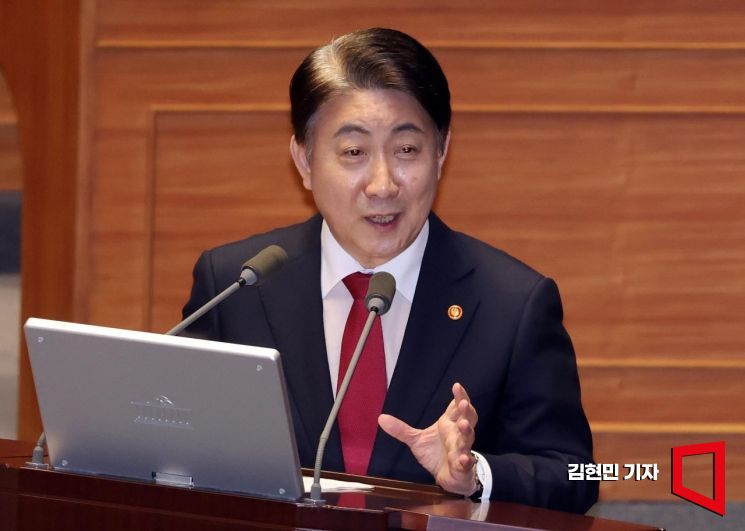 Lee Dong-kwan, Chairman of the Korea Communications Commission, is responding to a lawmaker's question during the Education, Social, and Culture government questioning session held at the National Assembly plenary session on the 8th. Photo by Hyunmin Kim kimhyun81@
The Presidential Office, the government, and the Korea Communications Commission all share the stance that household communication costs must be reduced. President Yoon Suk-yeol instructed in February to reduce the burden of household communication expenses, and Park Yoon-kyu, the 2nd Vice Minister of the Ministry of Science and ICT, frequently mentions this issue. It also regularly appears as a "staple topic" in the political arena. Household communication expenses mainly consist of two components: device prices and communication fees. In particular, the burden of device costs has increased significantly. According to recent data released by Park Wan-joo, a member of the National Assembly's Science, Technology, Broadcasting and Communications Committee (Independent), the average price of mobile phone devices in Korea is 873,597 KRW, which is 41% higher than the price nine years ago.
During his confirmation hearing, Chairman Lee Dong-kwan stated, "I agree that device prices need to be lowered and will consider various methods," adding, "There are side effects of the Device Distribution Act (DDA), so improvements are necessary." The best way to reduce the device burden is to increase subsidies. Chairman Lee also said, "We will amend the law to maintain competition so that those who can provide more subsidies can do so." In fact, the government attempted to revise the DDA in 2021 to increase additional subsidies from the existing 15% to 30%, but the bill did not pass the National Assembly.
Communication fees are also a core part of communication expenses. Since March, the three major telecom companies have successively launched 5G "mid-tier plans," but there are criticisms that these have not resulted in substantial reductions in communication costs. There is also a growing trend of customers switching to cheaper "MVNO" (Mobile Virtual Network Operator) services that use LTE instead of 5G. In response, the Ministry of Science and ICT is practically reviewing plans to lower the minimum 5G fee from the 40,000 KRW range to the 30,000 KRW range per month. Since the government and the Korea Communications Commission operate as one entity in communication policy, they are expected to align on this issue as well.
Increasing official subsidies and lowering communication fees are both unwelcome issues for telecom companies because they directly affect profits. Telecom companies secretly hope that the issue of "network usage fees" will be raised at this meeting. Their position is that content providers generate massive traffic but avoid paying network usage fees. SK Broadband and Netflix are still engaged in legal battles over network usage fees. Although nothing has been resolved yet, public interest has somewhat waned.
© The Asia Business Daily(www.asiae.co.kr). All rights reserved.

















