Head Speed 2.75 Yards per Mile Formula
Hoblan Long Drive Show with 45.75-Inch Shaft
Instant Effect by Adjusting Loft and Face Angle
This year, the longest driver on the U.S. Professional Golfers' Association (PGA) Tour is Rory McIlroy (Northern Ireland), who averaged 326.3 yards. An impressive 93 players on the PGA Tour, where the best compete, have driven over 300 yards. The average driving distance for all players this season is 299.9 yards. There are growing calls to limit driving distances.
Can amateur golfers also achieve the 'dream 300 yards' with their drivers? It is not easy, but not impossible. To drive the ball over 300 yards, it is important to understand one’s swing and equipment. The distance formula is simple: it is related to clubhead speed. Generally, one mile per hour (mph) corresponds to about 2.75 yards. To hit 300 yards, a clubhead speed of 109 mph (approximately 175.42 km/h) is required. The average clubhead speed for amateur golfers is 93.4 mph (about 150.31 km/h). According to TrackMan, the percentage of amateurs who can drive over 300 yards is at most 8% (6% for 106?110 mph, 2% for 111?115 mph).
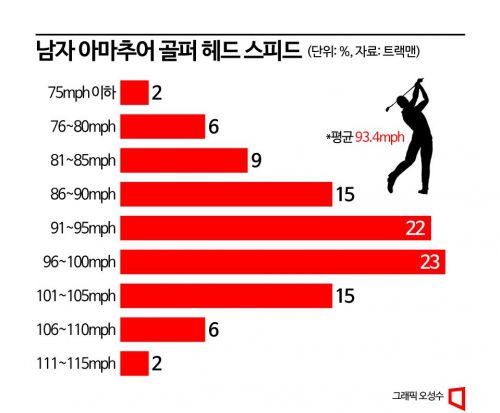
Clubhead speed is ultimately related to ball speed. Without an increase in clubhead speed, distance cannot be increased. Although training can improve this number, it takes a long time. Clubhead speed is not everything. Increasing the launch angle and reducing spin also increase distance. Weekend golfers find it difficult to increase clubhead speed quickly. First, it is necessary to build a solid foundation for tee shots with the help of experts on golfers and equipment.
Amateur golfers currently cannot create perfect launch conditions with their swing and driver. However, it is possible to optimize through equipment adjustments. There are several ways to increase ball speed without increasing clubhead speed. First, choose a driver with excellent forgiveness. Select a product that minimizes head twisting even when the ball is not struck on the sweet spot, maintaining ball speed. This secures both distance and accuracy.
Maximum distance can also be achieved through simple equipment adjustments. The answer can be found through Viktor Hovland (Norway), who became this year’s FedEx Cup champion. Tour players use shafts shorter than 45 inches. This is a common length that allows hitting the center of the clubface. Longer shafts can produce longer drives but reduce accuracy. Conversely, shorter shafts ensure shot consistency.

Hovland switched from a 44.75-inch shaft to a 45.75-inch one. He said, "Amateur golfers worried about short drivers need a lot of time to build strength in the gym to increase clubhead speed," and recommended, "If you want immediate results, using a longer shaft can be an option." Hovland’s plan was successful. Even with the longer shaft, his ball speed increased from 168?169 mph at his pro debut to 177?178 mph this year. Regarding the drawbacks of a longer shaft, Hovland pointed out, "It can cause increased spin and reduced dispersion."
Distance can also be increased by adjusting loft and face angle. Equipment manufacturers provide sleeves that can be easily adjusted in a short time. The best way to maximize carry is to increase the static loft. This leads to a higher launch angle and lower spin. It is a necessary adjustment on courses where roll is limited.
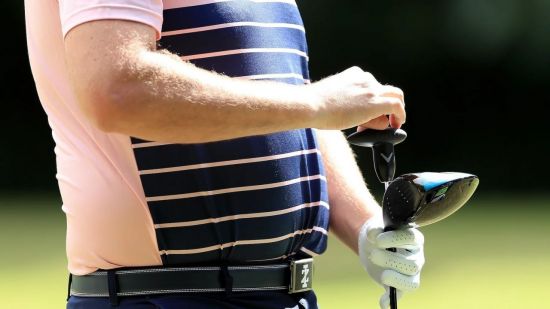 Weekend golfers can achieve maximum carry distance by adjusting their driver settings using a wrench.
 [Photo by Golf.com]
More loft can also produce excellent distance. In fact, golfers with slower swings sometimes hit their 3-wood farther than their driver. Adjusting the sleeve does not guarantee an increase of 10?15 yards. However, it is certain that a higher launch angle and lower spin can add a few extra yards. Amateur golfers should visit fitting centers equipped with the latest equipment to find the optimal combination that suits them.
© The Asia Business Daily(www.asiae.co.kr). All rights reserved.
![User Who Sold Erroneously Deposited Bitcoins to Repay Debt and Fund Entertainment... What Did the Supreme Court Decide in 2021? [Legal Issue Check]](https://cwcontent.asiae.co.kr/asiaresize/183/2026020910431234020_1770601391.png)