City Council Passes 5 Euro Admission Fee Bill
Up to 420,000 Won Fine Without QR Code
However, No Admission Fee During Winter Off-Season
Starting next year, day-trip tourists visiting the northern Italian water city of Venice will have to pay an entrance fee of 5 euros (about 7,000 won).
According to Italy's ANSA news agency on the 12th (local time), the Venice City Council passed a bill to charge an entrance fee to tourists visiting Venice for the day without staying overnight.
The city council announced that it plans to introduce the entrance fee system on a trial basis around major holidays in the spring and summer next year. The plan aims to encourage tourists to visit on less crowded weekdays to disperse the tourist flow. No entrance fee will be charged during the low season in winter.
Venice Hit Hard by 'Revenge Tourism' After the Endemic

This entrance fee measure targets day-trip tourists who only cause overcrowding and do not contribute to the local economy. Tourists staying overnight in Venice will receive a separate QR code and will not have to pay the entrance fee.
Residents of the Veneto region, to which Venice belongs, and visitors under 14 years old are also exempt from the fee. Those visiting for study or work reasons are also exempt.
Venice city police and authorized inspectors will randomly check people, and those without the relevant QR code will be fined between 50 euros (about 70,000 won) and 300 euros (about 420,000 won). Venice residents do not need a QR code and only need to show proof of residence.
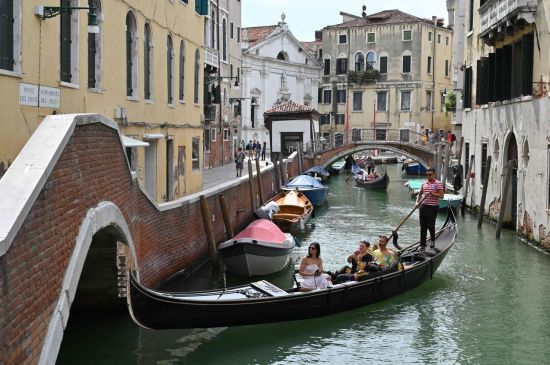
Simone Venturini, a Venice city councilor, said, "This is a measure to find a new balance between the rights of people living in Venice and those visiting the city."
ANSA reported that about 200 citizens protested during the city council's deliberation of the bill that day. The protesters shouted, "The entrance fee cannot save us. We want homes, jobs, and low rent."
'Overtourism' Plaguing Venice
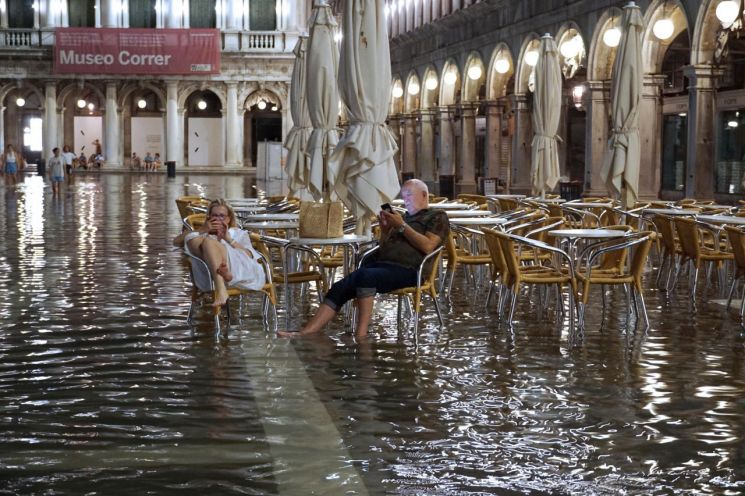 On the night of August 2nd (local time), people sat in St. Mark's Square in northern Italy's Venice, which was submerged due to rising sea levels.
 [Photo by EPA·Yonhap News]
Venice, considered one of the most famous tourist destinations in the world, has been suffering from 'overtourism' since the end of the COVID-19 emergency.
In particular, 5 million tourists visited Venice this year alone. As a result, housing prices and living costs have soared, causing native residents to gradually leave Venice. In fact, the population within Venice's historic district was over 130,000 in 1961 but dropped to less than 50,000 by August last year.
Additionally, climate change and the impact of many tourists have damaged the city and its architecture, threatening the cultural value of its heritage. As these problems persisted, UNESCO recommended at the end of July that Venice, Italy's water city, be added to the list of 'World Heritage Sites in Danger.'
Venice, a water city made up of over 120 islands and 177 canals, has recently faced ongoing problems due to abnormal weather.
In mid-July, when the entire Italy suffered from a severe heatwave nicknamed the 'week of hell,' temperatures in Venice soared to 38 degrees Celsius.
Frequent exposure of cultural assets to the heatwave increased the risk of secondary hazards such as fires. In February, Venice also experienced a severe drought that made it impossible for gondolas and water taxis to pass through the canals.
Venice is considered a representative city likely to suffer serious damage if sea levels rise due to climate change.
© The Asia Business Daily(www.asiae.co.kr). All rights reserved.
!["The Woman Who Threw Herself into the Water Clutching a Stolen Dior Bag"...A Grotesque Success Story That Shakes the Korean Psyche [Slate]](https://cwcontent.asiae.co.kr/asiaresize/183/2026021902243444107_1771435474.jpg)


















