August Employment Up by 268,000... Employment Rate Hits All-Time High, Unemployment at All-Time Low
Total Employment Rate Up 0.3%P, Women in Their 30s Up 3.1%P
Last month, the number of employed people increased by about 270,000 compared to a year ago, indicating that the employment market continues to show resilience despite the sluggish economy. The employment rate recorded an 'all-time high,' while the unemployment rate hit an 'all-time low.' Even though the youth (ages 15?29) employment rate has been declining for seven consecutive months, the employment rate for people in their 30s, especially women, rose by more than 3 percentage points in August. This suggests that women in their 30s, who have postponed marriage and continued economic activities, are driving the positive trend in the employment market.
According to the 'August 2023 Employment Trends' released by Statistics Korea on the 13th, the number of employed people last month was 28,678,000, an increase of 268,000 (0.9%) from the same period last year, marking the second consecutive month with an increase of over 200,000. The upward trend in employment numbers has continued for 30 months since March 2021 (314,000).
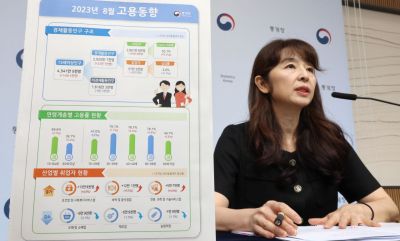 Seo Un-ju, Director of the Social Statistics Bureau at Statistics Korea, is briefing on the "August 2023 Employment Trends" on the morning of the 13th at the Government Sejong Complex. [Image source=Yonhap News]
Youth Employment Declines, Employment Increases Among Those Aged 60+, 40s, and 30s
By age group, the number of employed youth was 3,931,000, a decrease of 103,000, marking a decline for 10 consecutive months. However, the rate of decrease has somewhat slowed compared to June (117,000) and July (138,000). Seounju Seo, Director of the Social Statistics Bureau at Statistics Korea, explained, "In a situation where the population is declining, the proportion of students in their early 20s attending school has increased." On the other hand, employment increased by 304,000 among those aged 60 and over, 73,000 among those in their 50s, and 64,000 among those in their 30s.
The employment rate rose to 63.1%, up 0.3 percentage points from the previous year. The employment rate for ages 15?64, the OECD comparison standard, was 69.6%, up 0.7 percentage points from a year ago. This is the highest August figure since related statistics began being compiled in January 1989. The unemployment rate was 2.0%, down 0.1 percentage points from the same month last year. This is the lowest August figure since June 1999, when the job-seeking period criterion was changed from one week to four weeks.
The increase in the employment rate was led by women in their 30s. Their employment rate recorded 68%, up 3.1% from the same period last year, showing the steepest increase among all age groups.
'A Facet of Low Fertility'... Employment Rate of Women in Their 30s Exceeds Expectations
The increase in the number of employed women in their 30s and the rise in their employment rate have been continuously observed this year. The number of new employed people in the first half of this year exceeded initial forecasts by surpassing 370,000. At the end of last year, research institutions predicted that the increase in employment in the first half of this year would be around 100,000 due to economic sluggishness caused by tight monetary policy and high external uncertainties. The Korea Development Institute (KDI) and the Bank of Korea expected the increase in employment in the first half of this year to be 50,000 and 80,000, respectively. The Korea Labor Institute, the only national research institute in the employment and labor field, also forecasted 140,000, less than half of the actual figure.
Experts point to factors such as ▲ women in their 30s ▲ the correlation and lag between manufacturing production and employment as reasons why the increase in employment in the first half of this year greatly exceeded forecasts. Ji-yeon Kim, Associate Research Fellow at KDI, said, "Although further analysis is underway, the main reason for the large gap between employment forecasts and actual figures is currently judged to be the 'increase in women's economic participation rate.' In particular, the economic participation rate and employment rate of women in their 30s have risen more steeply than expected."
According to Statistics Korea, the female employment rate rose from 53.8% in June last year to 55.1% this June. In contrast, the male employment rate slightly decreased from 72.4% to 72.1% during the same period. Women thus raised the overall employment rate from 62.9% to 63.5%.
Especially, the employment rate of women in their 30s (ages 30?39) rose sharply. The employment rate, which was only 64.0% in June last year, increased by 3.8 percentage points to 67.8% this June. This contrasts with men in their 30s, whose employment rate remained similar, from 89.1% to 89.2% during the same period.
Associate Research Fellow Kim said, "Until now, women in their 30s experienced a decline in economic participation due to marriage and childbirth, but recently this phenomenon has weakened," adding, "The more significant reason is the increase in unmarried women." According to Kim's analysis, the proportion of women in their 30s without children increased from 39.7% in 2017 to 51.9% last year. Moreover, the economic participation rate of childless women in their 30s rose from 77.6% in 2017 to 78.7% last year, and the participation rate of women with children also increased from 51.3% to 53.5%. While the rise in the proportion of childless women was a major factor in increasing the economic participation rate of women in their 30s, the participation rate also increased among those with children.
Shinhyuk Kang, Director of Trend Analysis at the Korea Labor Institute, also cited 'low fertility' as a reason why the employment market has remained resilient. The total fertility rate, which is the average number of children a woman is expected to have during her reproductive years (ages 15?49), fell below 1 (0.98) in 2018 and hit a record low of 0.7 in the second quarter of this year. Director Kang said, "The female unemployment rate was 3.5% in the first quarter of this year, 0.5 percentage points higher than that of men, but by June, the gap narrowed to 0.1 percentage points, approaching the male unemployment rate. Especially, the fact that the unemployment rate of women in their 30s shows almost no fluctuation means that they are entering employment within one month of job seeking, indicating that employment among women in their 30s is occurring relatively quickly."
Director Kang also pointed out the lag between manufacturing production and employment and the weakening correlation between the two as reasons why the number of employed people exceeded forecasts. In the second quarter, real GDP in manufacturing decreased by 0.5%, while the service sector increased by 1.9%. Kang said, "In the first half of this year, the number of new employed people in manufacturing decreased by only 43,000, whereas the service sector increased by 474,000. The correlation between manufacturing employment and production has weakened, and while employment lags production by 6 to 12 months, the service sector shows immediate increases in employment."
© The Asia Business Daily(www.asiae.co.kr). All rights reserved.


















