4th Generation Lung Cancer Treatment Candidate Substance
Bridge Biotherapeutics announced on the 12th that it disclosed follow-up data from the Phase 1 clinical trial of 'BBT-176,' a 4th-generation epidermal growth factor receptor tyrosine kinase inhibitor (EGFR TKI) candidate drug for non-small cell lung cancer, in an oral presentation format at the 2023 World Conference on Lung Cancer.
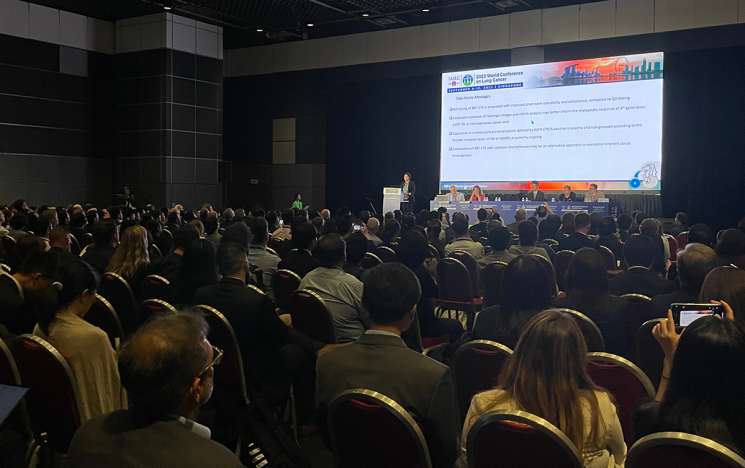 On the 11th (local time) at the World Lung Cancer Conference held in Singapore, Professor Lim Sun-min of the Yonsei Cancer Hospital Lung Cancer Center presented follow-up data from Phase 1 clinical trials of Bridge Biotherapeutics' 4th generation EGFR inhibitor 'BBT-176'.
 [Photo by Bridge Biotherapeutics]
The follow-up data from the Phase 1 trial of BBT-176 was revealed through a presentation by Professor Sunmin Lim of Yonsei Cancer Center’s Lung Cancer Department at the conference held in Singapore. The presentation introduced new patient cases showing partial response (PR), where tumor size was reduced by more than 30%, in the dosing group that changed from once daily to twice daily administration, along with improved tolerability and medication adherence of BBT-176 under the revised dosing regimen.
Additionally, alongside the clinical study of BBT-176, liquid biopsy-based analysis was conducted to continuously monitor genetic mutations in patients’ blood samples, presenting molecular genetic responses and patterns of the clinical trial participants.
The disclosed content included selected case data from the clinical trial evaluating the safety and efficacy of the twice-daily dosing regimen of BBT-176, which has been ongoing since the second half of last year, based on data compiled as of the end of May. Among these, data on the correlation between radiological responses and molecular genetic responses of the clinical trial subjects were specifically revealed.
In the data, patients harboring the DTC triple mutation including C797S, targeted by BBT-176, showed up to an 83% reduction in the fraction of circulating DNA including EGFR in the blood under the twice-daily dosing regimen. Radiologically, a significant reduction in tumor density was also confirmed.
The presentation also mentioned drug safety, the primary efficacy endpoint of the Phase 1/2 trial. The clinical results to date confirmed a dose-proportional pharmacokinetic profile, and the major adverse reactions were consistent with predictable side effects observed in drugs of the same class.
Jungkyu Lee, CEO of Bridge Biotherapeutics, stated, "Since there are no approved treatments for mutations arising after 3rd-generation EGFR inhibitor therapy in non-small cell lung cancer, we will accelerate development to become a global leader in the development of new 4th-generation EGFR inhibitors capable of effectively addressing various resistance mutations."
Bridge Biotherapeutics is developing 'BBT-176' and 'BBT-207' as 4th-generation targeted lung cancer therapies for patients showing resistance to existing EGFR inhibitors for non-small cell lung cancer. Simultaneously, the company continues companion diagnostic research related to genetic mutations and advances drug development in the non-small cell lung cancer field. BBT-176 was selected as a supported project under the 'New Drug Clinical Development' category of the National New Drug Development Project in 2021 and is receiving support from the National New Drug Development Project Group.
© The Asia Business Daily(www.asiae.co.kr). All rights reserved.
![Clutching a Stolen Dior Bag, Saying "I Hate Being Poor but Real"... The Grotesque Con of a "Human Knockoff" [Slate]](https://cwcontent.asiae.co.kr/asiaresize/183/2026021902243444107_1771435474.jpg)
















