2050 Jeonji Boguk National Report Meeting Held
Expectations to Become the World's No.1 Secondary Battery City
Pohang City, which has achieved the great success of being selected as a national advanced strategic industry secondary battery cathode material specialized complex, is starting a new leap forward from steel patriotism to battery patriotism.
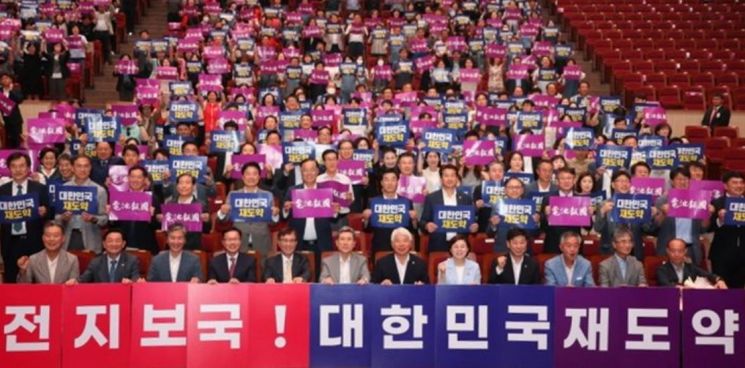
On the 11th, Pohang City held the ‘2050 Battery Patriotism Grand Citizen Report’ at the Pohang Culture and Arts Center Grand Theater, attended by about 1,000 citizens.
The report meeting was attended by Mayor Lee Kang-deok, City Council Chairman Baek In-gyu, National Assemblyman Kim Jeong-jae, Vice Chairman Park Yong-seon of the Gyeongbuk Provincial Council, city and provincial council members, POSTECH President Kim Seong-geun, EcoPro Materials CEO Kim Byung-hoon, Pohang Accelerator Laboratory Director Kang Heung-sik, Pohang Chamber of Commerce and Industry Chairman Moon Chung-do, and other local industry, academia, research, government organizations, as well as civic and social groups.
The event proceeded in the order of ▲ screening of videos containing citizens’ voices and future visions ▲ presentation of plaques of appreciation and commendation ▲ 2050 Battery Patriotism Grand Citizen Report ▲ performance wishing for the success of battery patriotism, with citizens also participating to support Pohang’s new leap forward.
Mayor Lee Kang-deok of Pohang presented plaques of appreciation and commendation to nine individuals including Team Leader Son Jeong-min, Chairman Kwon Hyuk-su of the Energy Industry Promotion Agency, POSTECH Professor Kang Byung-woo, POSTECH Deputy Director Song Wan-heup, and Pohang Metal Materials Industry Promotion Agency Director Park Byung-ho, expressing gratitude for their efforts and contributions based on the foundations of EcoPro, POSCO Future M, and Gyeongbuk Province’s 4th industrial base.
Mayor Lee said, “I am confident that Pohang will once again lead Korea’s innovative growth through battery patriotism following steel patriotism,” adding, “Together with 500,000 citizens, we will strive for Pohang’s second leap forward as well as regional balanced development and national progress.”
On the same day, Kwon Hyuk-won, Director of Pohang City’s Job and Economy Bureau, explained Pohang’s excellent industrial conditions such as world-class differentiated infrastructure and corporate investment environment, the process and results of future food industry development policies including the nation’s first secondary battery industry promotion, and presented ‘the future image of Pohang in 2050 reborn through battery patriotism following steel patriotism.’
Pohang will strengthen national industrial competitiveness and secure global leadership in the secondary battery industry by designating the Yeongilman Industrial Complex and Blue Valley Industrial Complex as secondary battery specialized complexes serving as innovation hubs.
Efforts will focus on securing national funding to promptly expand core infrastructure such as water supply and wastewater treatment, power facilities, and roads, and by continuously cooperating with relevant central government departments and related organizations for early completion and new establishment of infrastructure, full efforts will be made to expand infrastructure for attracting corporate investment including regulatory exemptions, tax benefits, and industrial complex expansion.
In addition, the ‘Battery Patriotism Committee’ composed of a battery patriotism expert TF including domestic secondary battery scholars, experts, and leading companies who held their first meeting last month, along with practical TF and industrial complex base TF, was launched to actively promote the fostering and support of the specialized complex. The ‘Secondary Battery Corporate Council,’ consisting of about 30 secondary battery companies forming one team, will be launched in October to establish a system of mutual growth and cooperation among companies.
Following the ‘Secondary Battery Expert Grand Debate’ on the 18th to gather expert opinions, the ‘Battery International Conference’ will be held in November to open a forum for discussion with domestic and international secondary battery companies and academic experts, further enhancing Pohang’s status as a leading secondary battery city.
At the same time, efforts will be made to upgrade the existing regulatory free zone and promote designation as a global innovation zone applying comprehensive minimum regulations for global market entry, while also attracting opportunity development zones that open a new local era through corporate relocation and investment inducement, thereby expanding a national investment attraction platform that promotes innovative growth.
Accordingly, Pohang aims to become the world’s number one cathode material production city by 2030 with goals of producing 1 million tons of cathode materials, achieving sales of 70 trillion won, total secondary battery material sales exceeding 100 trillion won, and creating 15,000 jobs through sustainable specialized complex infrastructure construction, super-gap technology development, professional workforce training, and internalization of secondary battery raw materials and materials.
After passing the preliminary feasibility study for the hydrogen fuel cell cluster, Pohang City established the Hydrogen Fuel Cell Cluster Promotion Team within Pohang Technopark to establish detailed promotion strategies and formed an expert advisory group under it. A corporate council to devise corporate attraction strategies and promote cooperation among companies will also be organized, accelerating corporate investment and the creation of industry-academia-research collaboration environments starting next year.
Furthermore, following the secondary battery specialized complex, Pohang is working with Gyeongbuk Province to establish a strategy for designating a hydrogen specialized complex centered on hydrogen fuel cells.
The Pohang hydrogen fuel cell cluster is expected to lead the global market through standard preemption in the fuel cell field and localization of core materials and components, attract domestic and international hydrogen-related companies including hydrogen fuel cells, and create about 3,600 new jobs and an annual economic effect of 26.56 billion won, injecting new vitality into the regional economy.
© The Asia Business Daily(www.asiae.co.kr). All rights reserved.

















