KIST Research Team
Domestic researchers have developed artificial olfactory technology that can quickly and accurately distinguish and detect odors similarly to the human nose. By counting the number of oxygen vacancies within material molecules, it can identify odors with up to 93% accuracy, making it promising for use in healthcare and chemical process safety devices.
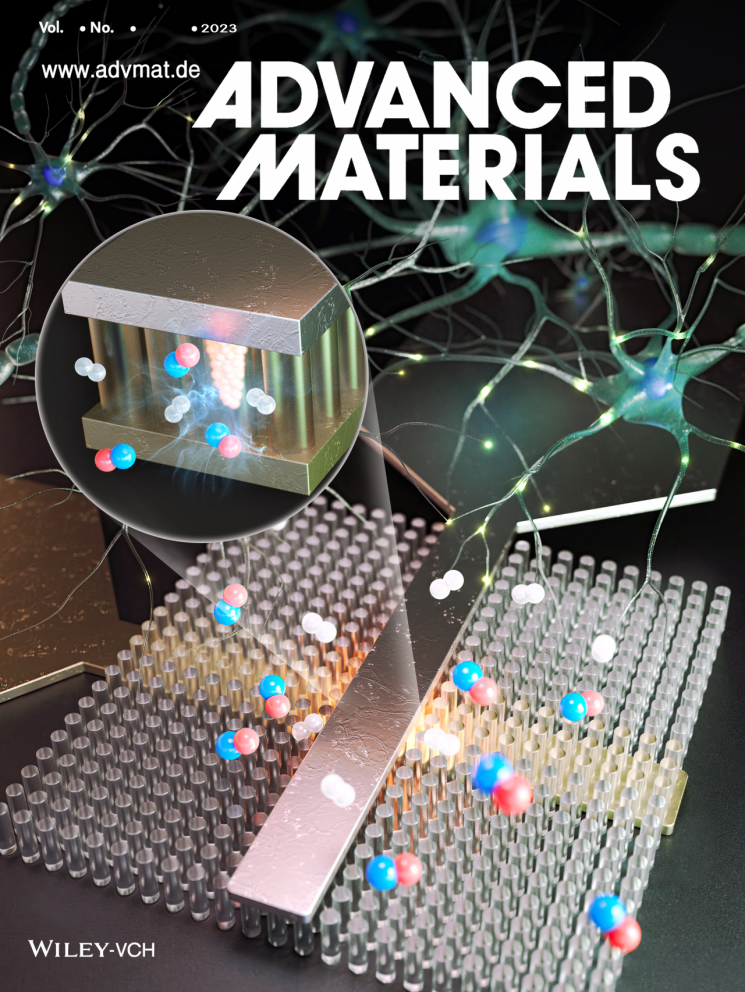 Conceptual diagram of KIST artificial olfactory device featured on the cover of the international academic journal 'Advanced Materials'. Photo by KIST
The Korea Institute of Science and Technology (KIST) announced on the 11th that a team led by Kang Jong-yoon, head of the Advanced Materials Technology Research Division, and Dr. Yoon Jung-ho of the Electronic Materials Research Center developed an electronic device using a neuromorphic semiconductor electronic component called a memristor. This device mimics the human olfactory neural system by easily converting and processing external gas stimuli into electrical signals. The electronic device developed by the research team can convert external gas stimuli into electrical signals and store the history within a single device.
With the rise of artificial intelligence and humanoids, research on electronic devices that detect various human-like senses is active. Artificial olfaction is one such area, useful for detecting gas leaks in industrial sites and quickly identifying harmful elements such as bacteria and viruses. However, compared to physical stimuli detection like vision, hearing, and touch, olfaction, which requires detecting chemical stimuli, involves a more complex information processing process, resulting in slower progress until now.
The human olfactory synapse transforms information about external stimuli and transmits it to the next neuron. The degree to which the synapse modifies the stimulus is called the ‘weight.’ To mimic this, it is necessary to control information about external gas stimuli in an analog manner, which was impossible with oxide semiconductor gas sensors mainly studied in the artificial olfaction field until now.
The research team simulated the human olfactory synapse by utilizing the phenomenon where electrical resistance decreases as oxygen vacancies occur in the memristor device. By finely adjusting the number of oxygen vacancies, which respond differently depending on the type of external gas (oxidizing or reducing gases), they gradually changed the device’s conductivity, thereby mimicking the analog characteristics of an artificial olfactory synapse.
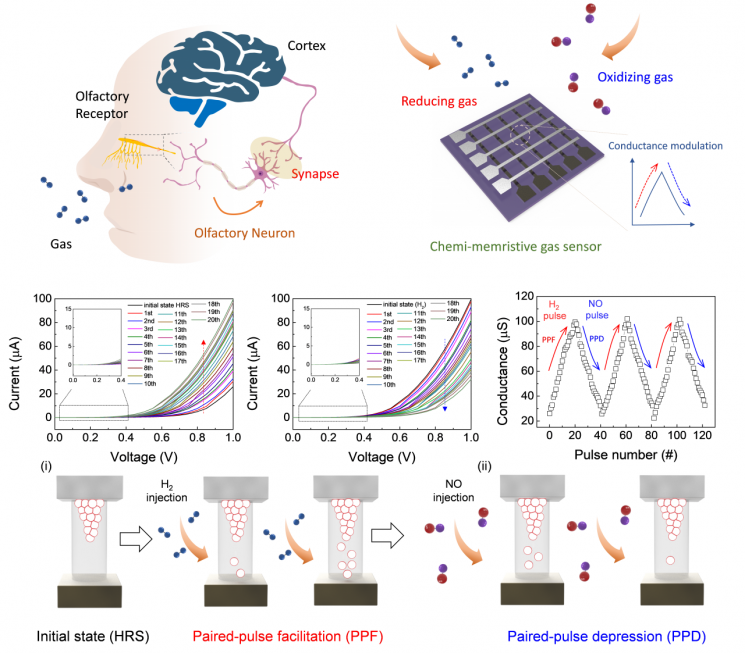 Schematic diagram of the artificial olfactory device developed by KIST. Image source=Provided by KIST
When the artificial olfactory synapse device developed by the research team was configured in an array form, they conducted neural network simulations to detect specific patterns of gas leaks by observing how the sensing characteristics varied with distance from the gas leak point. The developed neuromorphic artificial olfactory synapse device demonstrated excellent performance with an inference accuracy of up to 92.76%. Additionally, by connecting the artificial olfactory synapse device with the same structure in series with a risk-level controller, they developed an alarm system that monitors gas exposure concentration and alerts when the danger level is exceeded. Conventional semiconductor gas sensors cannot store hazardous gas exposure history on their own, requiring additional memory, which complicates the system and increases power consumption. In contrast, the device developed by the research team can inherently remember the absolute amount of hazardous gas exposure over time, enabling continuous monitoring and offering high energy efficiency.
Director Kang stated, “This research outcome overcomes the limitations of existing gas sensors by using a new mechanism that finely controls the number of oxygen vacancies, allowing a single device not only to detect external gas stimuli but also to remember them, leading the future of artificial olfaction.” Dr. Yoon added, “It is expected to contribute to in-sensor computing research that processes real-time biometric data, such as healthcare sensors that can diagnose diseases from chemical substances exhaled by humans or emitted from the skin.”
The research results were published online in the international materials science journal Advanced Materials (IF: 32.086, top 2.17% in JCR category) and appeared as a cover paper (inside back cover) in the latest issue.
© The Asia Business Daily(www.asiae.co.kr). All rights reserved.
![User Who Sold Erroneously Deposited Bitcoins to Repay Debt and Fund Entertainment... What Did the Supreme Court Decide in 2021? [Legal Issue Check]](https://cwcontent.asiae.co.kr/asiaresize/183/2026020910431234020_1770601391.png)

















