Discussion on Joint Statement Centered on Russia-Ukraine War
"US and Europe 'Check China', Mind Modi's Status"
The G20 summit held in New Delhi, India, concluded on the 10th (local time) with the release of a joint statement. It was reported that behind the scenes, there were 200 hours of nonstop meetings and as many as 15 drafts created during this difficult process.
Although the joint statement did not directly condemn Russia's invasion of Ukraine, raising concerns about possible divisions within the G20, attendees reportedly made efforts to avoid the worst-case scenario of failing to produce a joint statement for the first time in history.
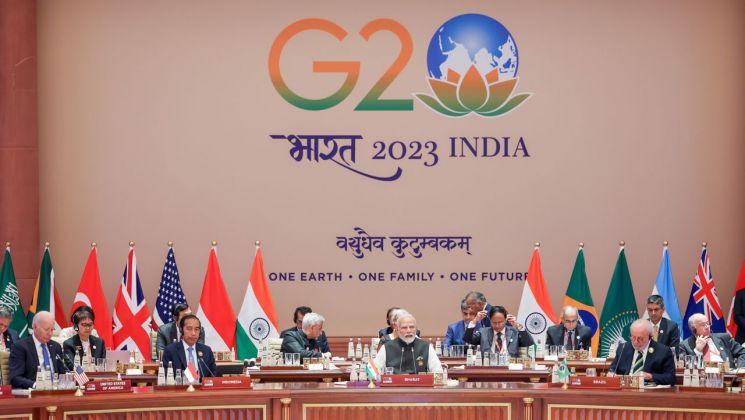
Eased War References Prevented First-Ever Failure to Produce Joint Statement
CNN and The Guardian cited Indian government officials and anonymous diplomats, reporting that the process of drafting the G20 summit joint statement was arduous. Since no joint statement had ever been produced during ministerial-level talks before the summit, there was speculation that the G20 summit, which began in 2008, might fail to produce a joint statement for the first time.
The biggest obstacle in the negotiations was the wording related to the Ukraine war. The West reportedly sought to include strong language holding Russia responsible for the invasion. They aimed to reach the level of the declaration adopted at the G20 summit held in Bali, Indonesia, last November, which "strongly condemned the Ukraine war in the strongest terms."
However, CNN reported that Russia and China clearly opposed this. Additionally, some pro-Russian G20 member countries expressed unease about including such language in this year’s statement, making it difficult to find a consensus.
Ultimately, just before midnight on the 8th, a day before the final negotiation deadline, the G20 delegations reached a dramatic compromise. After 200 hours of nonstop negotiations and over 300 bilateral talks, exchanging as many as 15 drafts, the final outcome was achieved. CNN explained that the wording related to the Ukraine war was eventually "watered-down."
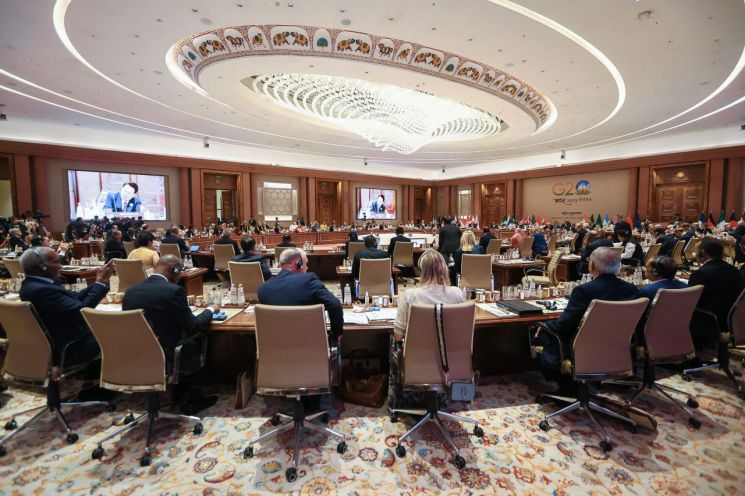 On the 9th (local time), a meeting was held in New Delhi, India, attended by government officials from the Group of Twenty (G20). [Image source=TASS Yonhap News]
The member countries called for a "just and lasting peace in Ukraine" in the joint statement but moderated the language by not explicitly linking it to Ukraine's territorial integrity or condemning Russia's invasion. Instead, it only mentioned that "all countries must refrain from the threat or use of force to acquire territory in violation of the territorial integrity, sovereignty, and political independence of any state, in accordance with the United Nations (UN) Charter."
A European official who sat at the negotiation table reportedly said, "This is a statement that would not have been drafted by the Group of Seven (G7) or the North Atlantic Treaty Organization (NATO)."
Immediately after the joint statement was released, Ukraine reacted with outrage, while Russia welcomed it as a "voice of conscience," showing contrasting responses.
Oleh Nikolenko, spokesperson for the Ukrainian Ministry of Foreign Affairs, criticized on Facebook, "Ukraine thanks the cooperating countries that tried to include strong language in this document, but there is nothing for the G20 to be proud of regarding Russia's invasion of Ukraine." He added, "Clearly, if Ukraine had participated in this G20 summit, the participants would have had a better understanding of the situation."
Sergey Lavrov, Russian Foreign Minister, called the meeting an "unconditional success," stating, "We were able to prevent the Western attempt to Ukraine-ize the summit agenda."
"With Upcoming Election, Biden Prioritizes Containing China Over Ukraine War"
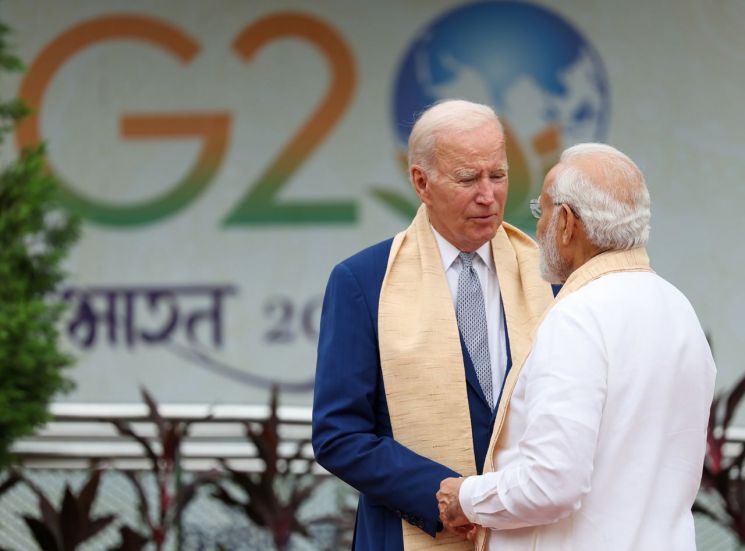 President Joe Biden of the United States (left) and Prime Minister Narendra Modi of India
 [Image source=UPI Yonhap News]
Regarding the West, which had actively supported Ukraine, agreeing to produce a G20 joint statement without mentioning Russia's aggression, foreign media assessed that there was an effort to elevate Indian Prime Minister Narendra Modi as a global leader who led this summit. Since the U.S. and Europe have been nurturing Modi as a global partner to counter China and raise his stature, they sought to prevent the failure of the joint statement.
Pramit Pal Chaudhuri, South Asia expert at Eurasia Group, told BBC, "While not a direct cause, the West, especially the U.S., is aware that China is trying to create an anti-Western alternative international order. It is clear that Western countries see India as a balancing force against China, and Modi would not have wanted the summit to end without a joint statement."
In fact, immediately after the joint statement was announced, Jake Sullivan, U.S. National Security Advisor, praised it, saying, "It includes a series of significant paragraphs on the Ukraine war" and "also plays a good role in supporting the principle that countries cannot use force to acquire territory."
The Guardian evaluated the joint statement by saying, "In some respects, the outcome is unrelated to the war, and nothing has changed," noting that the war continues. At the same time, it pointed out, "The softened language means that, from the perspective of U.S. President Joe Biden, who faces an election year and the growing need to expand alliances to contain China in the Indo-Pacific, the Ukraine war has become a lower priority in foreign policy."
© The Asia Business Daily(www.asiae.co.kr). All rights reserved.



















