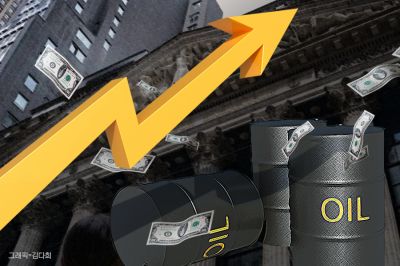
International oil prices have surged sharply, breaking above $90 per barrel once again. Alongside this, the value of the US dollar is also soaring amid growing expectations of a prolonged tightening cycle by the US Federal Reserve (Fed). Concerns over domestic inflation and the economy are intensifying due to high oil prices and a strong dollar.
On the 8th (local time), the November Brent crude futures contract closed at $90.65 per barrel on the London ICE Futures Exchange, up 73 cents (0.81%) from the previous session. This is the highest closing price in 10 months since November 16 last year ($92.86).
Meanwhile, the October West Texas Intermediate (WTI) crude futures contract on the New York Mercantile Exchange closed at $87.51 per barrel, rising 64 cents (0.74%) in one day. Dubai crude, which South Korea mainly imports, is priced around $91.37 per barrel.
Brent and WTI crude prices had slightly declined on the 7th (local time) due to short-term correction pressure after a rapid surge but rebounded the following day.
The rise in oil prices appears to have been stimulated by a sharp increase in LNG prices, triggered by a strike on the same day by workers at major liquefied natural gas (LNG) production facilities owned by the US energy company Chevron in Australia.
There is an analysis that if inflation concerns caused by rising international oil prices grow again, it will lead to a prolonged tightening stance by major countries including the US. As concerns over additional Fed tightening spread in the market, US Treasury yields are also on the rise.
According to the Chicago Mercantile Exchange (CME) FedWatch, the federal funds (FF) rate futures market reflects a 93.0% probability that the Fed will keep rates unchanged at the September Federal Open Market Committee (FOMC) meeting.
However, for the November FOMC meeting, the probability of a rate hold is 53.1%, while a 25 basis points (bp) increase (1 bp = 0.01 percentage points) stands at 43.6%, showing little difference. For the December meeting, the hold probability is 52.7%, and a 25 bp hike is 42%.
Concerns over prolonged US tightening have fueled the rise in the dollar’s value, pushing the dollar index to its highest level in six months.
The dollar index, which reflects the value of the dollar against six major currencies, recorded 105.078, marking an eight-week consecutive rise.
In the Seoul foreign exchange market, the won-dollar exchange rate closed at 1,333.4 won the previous day. Although it fell 2.0 won from the previous trading day, it rose nearly 15 won compared to the closing price on the 1st (1,318.8 won).
If the strong dollar and high oil price situation persist, it could increase inflationary pressure in South Korea. This would lead to tighter monetary policy, negatively impacting economic recovery.
Generally, international oil prices raise domestic petroleum product prices with a lag of about 2 to 3 weeks. Since international oil prices have already risen to the $90 per barrel range, inflationary pressure is expected to spread to domestic gasoline, diesel, and industrial products.
The International Finance Center explained on the same day, "Against the backdrop of strong US growth, the dollar has maintained its longest period of strength since 2005," adding, "There are mixed views, with some saying the market is overbought and others expecting the strong dollar to continue into next year, signaling the return of the 'King Dollar' era."
© The Asia Business Daily(www.asiae.co.kr). All rights reserved.

















