Jung Woo-taek "2.8 million people 10 years ago, 800,000 people until July this year"
The number of visitors to Seoul Grand Park Zoo has nearly halved over the past eight years. This has led to calls for thorough animal management and other changes.
According to data submitted by Seoul Grand Park to Jeong Woo-taek, a member of the National Assembly's Public Administration and Security Committee from the People Power Party, the number of visitors to the zoo (including the theme garden) has consistently declined from 2,828,277 in 2014 to 2,750,195 in 2015, and 2,591,163 in 2016.
Last year, the number was 1,549,955, which is a decrease of 1,278,322 visitors (about 45.2%) compared to 2014.
Even this year, after the end of the COVID-19 pandemic, only 873,872 visitors had come to the zoo by July. If this trend continues, the total number of visitors this year is expected to be around 1,498,066, which would be fewer than last year.
Assemblyman Jeong said, "Ten years ago, there were over 2.8 million visitors, but this year, by July, the number has dropped to the 800,000 range."
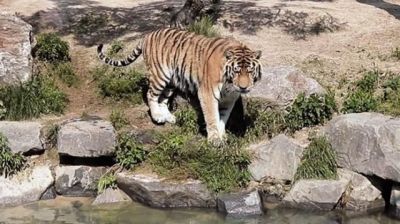 The living image of the tiger 'Suho' that lived in Seoul Grand Park. Suspicions of mismanagement arose after Suho suddenly died in June this year. [Image source=Provided by Seoul Grand Park]
As the number of visitors decreases, the annual deficit of around 10 billion won has not diminished. Looking at Seoul Grand Park’s annual revenue and expenditure, in 2014, income was 18.145 billion won, while expenses were 33.025 billion won, resulting in a deficit of 14.88 billion won. The deficit was 11.984 billion won in 2015 and 9.811 billion won in 2016.
Last year, although revenue was 17.65 billion won, expenses amounted to 35.476 billion won, leading to a deficit of 17.871 billion won.
In June 2021, Seoul Grand Park experienced an outbreak of bovine tuberculosis, a legally designated Class 2 livestock infectious disease and zoonosis, in the South America Pavilion of the zoo. By October of the following year, 44 animals had been euthanized, sparking controversy over poor management. Additionally, in June this year, it was belatedly revealed that a male Siberian tiger, a first-class endangered wild animal, had died.
Considering that animal welfare has become a global issue, these successive animal deaths may be a factor causing visitors to turn away.
Therefore, to overcome the decline in visitors, there are calls for stronger efforts in animal management and structural improvements to attract citizens who have turned away.
© The Asia Business Daily(www.asiae.co.kr). All rights reserved.
!["The Woman Who Threw Herself into the Water Clutching a Stolen Dior Bag"...A Grotesque Success Story That Shakes the Korean Psyche [Slate]](https://cwcontent.asiae.co.kr/asiaresize/183/2026021902243444107_1771435474.jpg)
















