Seoul City is drawing attention to the potential effects as it considers introducing a commuter pass that allows unlimited use of buses and subways in the metropolitan area.
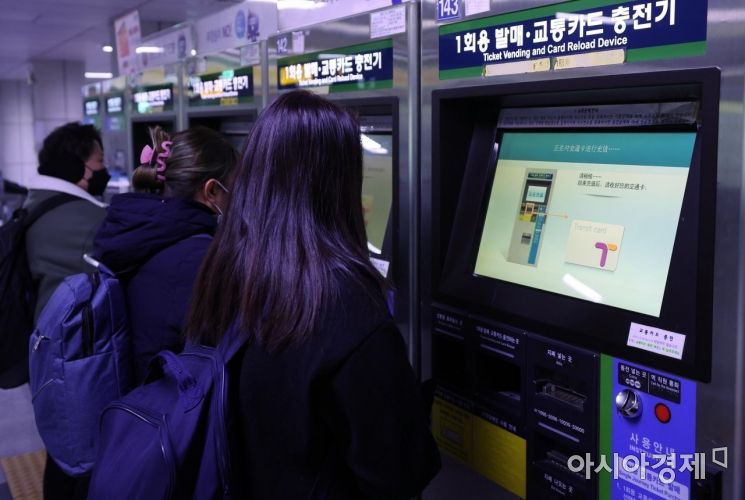 On the 29th, when Seoul announced plans to raise public transportation fares by 300 won each for the subway, city buses, and village buses at the end of April next year, foreign tourists were purchasing transportation cards at City Hall Station on Seoul Subway Line 1. The city decided to increase fares, judging that it could no longer endure the severe accumulated deficits of the subway and buses, especially since the government will not provide budget support for losses from free rides for the elderly next year. Photo by Kim Hyun-min kimhyun81@
In Germany, a €9 (about 12,000 KRW) ticket was implemented for three months last year, and from May, the Deutschland Ticket priced at €49 (about 69,000 KRW) per month was launched. According to Yonhap News and the Korea Trade-Investment Promotion Agency (KOTRA), after the launch of the Deutschland Ticket, the number of passengers in Berlin and the surrounding Brandenburg area increased by 20%. The number of passengers traveling more than 30 km by train increased by more than a quarter, and the public transportation user population rose by 2.5 percentage points. According to the German Transport Association (VDV), 9.6 million passengers used public transportation with the Deutschland Ticket in June alone. There were 11 million purchase contracts for the Deutschland Ticket. VDV expects the number of Deutschland Ticket users to increase to 17 million.
Previously, the German government introduced the €9 ticket from June to August last year. The €9 ticket allowed unlimited use of buses, subways, trams, and other public transportation nationwide in Germany for just €9 per month. Theoretically, with this ticket, one could travel from Hamburg to Konstanz, the southernmost German city bordering Switzerland. This distance of about 850 km could be covered in 14 to 15 hours using the €9 ticket. Recently, some European travel communities have gained popularity with reviews of tours around Germany using this ticket. According to VDV, a total of 52 million €9 tickets were sold during the three months last year. Sixty percent of the entire German resident population purchased this ticket.
The German government announced this extraordinary measure only for the summer months (June to August) to alleviate consumer burdens caused by global inflation and steep fuel price increases following the Ukraine crisis. Satisfaction was high. However, there were criticisms regarding insufficient consideration of various aspects such as the number of users exceeding capacity and the applicable range of the €9 ticket. It was also pointed out that, contrary to expectations, many people did not give up their cars to use public transportation but rather continued to use cars while using public transportation only for additional travel such as vacations.
The KOTRA Hamburg Trade Center suggested in a report last September that "if a similar policy is introduced domestically in the future, it should be accompanied by an understanding of various stakeholders as well as considerations for maintaining service quality."
© The Asia Business Daily(www.asiae.co.kr). All rights reserved.


















