Suspicion of Non-Disclosure to Reduce Contaminated Water Discharge
National Assembly Inspection Office "Not Involved in Non-Disclosure Decision"
On the 8th, the government stated that it “did not participate in the decision to keep confidential” regarding the controversy over the non-disclosure of the research report by the Korea Institute for Advancement of Technology (KIAT) related to the contaminated water from the Fukushima Daiichi Nuclear Power Plant.
Park Gu-yeon, First Deputy Director of the Office for Government Policy Coordination, said at a daily briefing on the response to the discharge of contaminated water from the Fukushima Daiichi Nuclear Power Plant held at the Government Seoul Office Building that morning, “I want to make it clear that the government was not involved at all in the decision-making process to keep the report confidential.”
Recently, when Kang Hoon-sik, a member of the Democratic Party of Korea, disclosed the contents of the previously confidential report from the Korea Institute for Advancement of Technology, questions arose as to whether the government had kept the document confidential to downplay the problems of the contaminated water discharge.
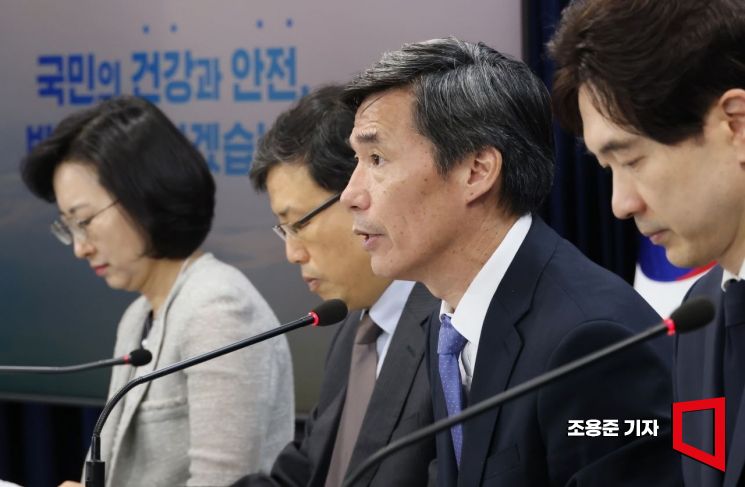 Park Gu-yeon, First Deputy Minister of the Office for Government Policy Coordination, is briefing on future plans regarding the discharge of nuclear power plant contaminated water at the Government Seoul Office in Jongno-gu, Seoul on the 4th. Photo by Jo Yong-jun jun21@
The report included the statement that “The plan to discharge nuclear power plant contaminated water over 30 to 40 years starting from 2023 could pose actual and potential threats to marine biodiversity and ecosystems, which are common heritage that all humanity must preserve and use sustainably.”
The opposition parties criticized the government for keeping the report confidential to downplay the risks of contaminated water discharge. In relation to this, Han Duck-soo, Prime Minister, who attended the government questioning session at the National Assembly plenary meeting held the day before, responded, “I recently learned about the non-disclosure of the research report,” and added, “I will investigate why it was not disclosed.”
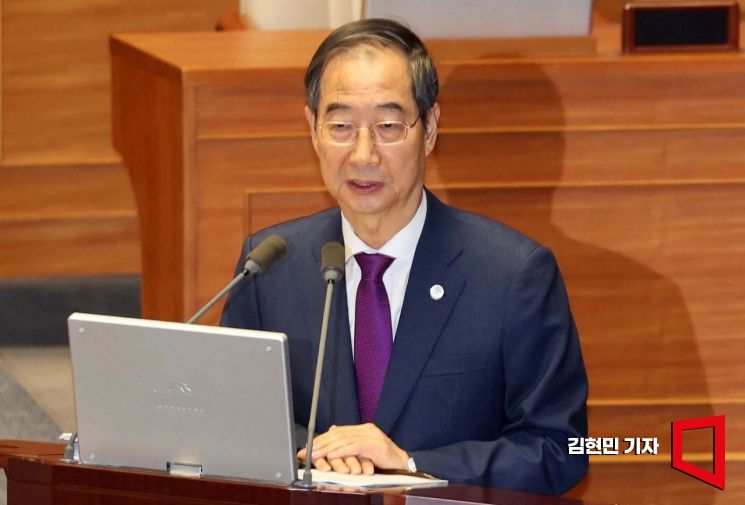 Prime Minister Han Duck-soo is responding to a lawmaker's question during the government-wide economic inquiry held at the National Assembly on the 7th. Photo by Hyunmin Kim kimhyun81@
Deputy Director Park said, “The need for the research was initially raised by a specialist committee member of the Democratic Party’s Policy Committee,” and added, “The report did not include an in-depth natural science analysis of the impact of the contaminated water discharge.” He also said, “The research was conducted before the timing of Japan’s discharge and the review results from the International Atomic Energy Agency (IAEA) and our government were available,” and “The government referred to the recommendations of the research report only as a rough guideline in policy decisions.”
The controversial research report was a 10 billion KRW project proposed to the Korea Maritime Institute (KMI) after the 2020 National Assembly audit to assess the impact of the contaminated water discharge. Later, as it became difficult to reflect new budgets, it was converted into a collaborative research project with the Korea Institute for Advancement of Technology, and the first research results were released in November 2022.
At that time, KMI judged that disclosing the report while the timing of the contaminated water discharge was undecided could cause policy confusion and requested non-disclosure. The Korea Institute for Advancement of Technology accepted this, and the report was ultimately kept confidential. It is also known that the report included content stating that if Japan re-submits its ban on Japanese seafood imports to the World Trade Organization (WTO), it would be difficult for the Korean government to win the case.
© The Asia Business Daily(www.asiae.co.kr). All rights reserved.


















