[China Finding Loopholes in US Sanctions]③
Concerns are spreading within the U.S. semiconductor industry, which is expected to suffer damage to its business in China due to the U.S. government's broad semiconductor export restrictions. China, seizing this opportunity, has retaliated by leveraging its strong 'buying power' to ban sales of U.S. Micron's semiconductors and to derail Intel's mergers and acquisitions (M&A), striking at critical points. This time, as Huawei released a smartphone equipped with its self-developed 7nm (nanometer, one billionth of a meter) class semiconductor, China immediately issued a 'ban on iPhone usage,' expanding its retaliation targets from semiconductors to smartphone companies. This move also appears aimed at attacking a weak link to amplify domestic opposition within the U.S. against the Biden administration's export control measures.
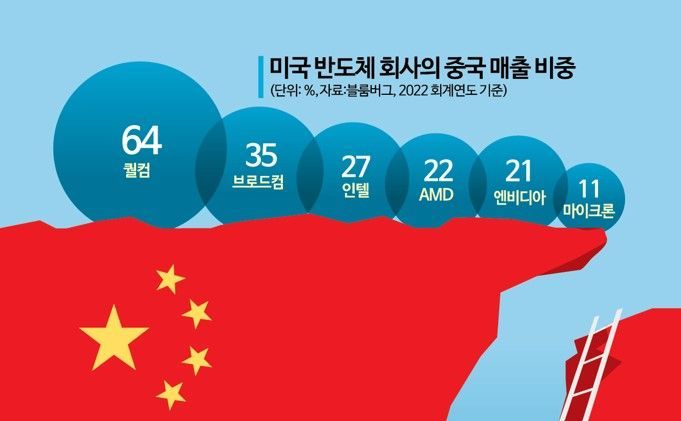
According to major foreign media including Bloomberg on the 8th, many U.S. semiconductor companies derive double-digit percentages of their sales from the Chinese market. Qualcomm's sales in China account for 64% of its total revenue. Broadcom follows with 35%, then Intel (27%), AMD (22%), Nvidia (21%), and Micron (11%).
The market expects that if the U.S. raises the level of semiconductor export controls on China, China will expand its ban on U.S.-made semiconductor sales and impose additional retaliatory measures. Earlier, in May, China banned sales of Micron products within China and continuously delayed approval of Intel's acquisition of an Israeli semiconductor company, ultimately forcing Intel to abandon the acquisition. Paula Penkal, Senior Semiconductor Analyst at Bloomberg Intelligence (BI), Bloomberg's economic research division, said, "China accounts for 10.8% of Micron's sales, but the sales proportion in China for several other companies is even higher," adding, "If China really wants to hurt (U.S. companies), it can expand its (sales ban) portfolio."
As China's retaliatory measures materialize, dissatisfaction is already pouring out within the U.S. semiconductor industry. CEOs of Intel, Nvidia, and Qualcomm met with the U.S. administration in July to urge a halt to export controls targeting China. They expressed concerns that U.S. sanctions could undermine semiconductor leadership and only accelerate China's technological development. Intel CEO Pat Gelsinger reportedly warned that if Intel cannot receive semiconductor orders from China, the need to build new Intel factories in the U.S. would disappear. The Semiconductor Industry Association (SIA), which counts global semiconductor companies as members, also requested restraint on additional sanctions in the same month, stating, "Repeated broad, ambiguous, and unilateral sanctions raise concerns about weakening U.S. semiconductor industry competitiveness and disrupting supply chains."
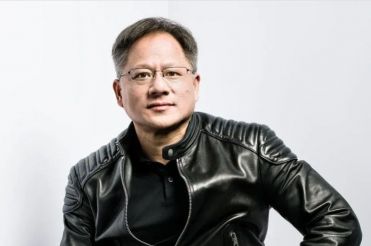
Nvidia, which holds 90% of the AI semiconductor market, is also critical of the Biden administration's export controls on China. Nvidia CEO Jensen Huang has repeatedly stated in interviews, "We will comply with regulations, but in my view, China will use this opportunity to nurture its local companies. If China cannot purchase U.S. semiconductors, they will make them themselves," expressing skepticism about the effectiveness of the sanctions. Previously, the U.S. government banned exports of Nvidia's advanced semiconductors, the A100 and H100, to China in August last year.
The U.S. semiconductor industry is making every effort to minimize the impact on sales in China. After the U.S. blocked exports of advanced semiconductors to China last year, Nvidia separately developed the A800, a semiconductor compliant with U.S. export restrictions, specifically for the Chinese market. Micron, one month after China’s semiconductor sales ban, announced in June that it would invest an additional 4.3 billion yuan in China, attempting to appease the Chinese government. While the U.S. is gradually increasing pressure on China, U.S. semiconductor companies are instead seeking detours and opening their investment purses to defend their position in the Chinese market.
© The Asia Business Daily(www.asiae.co.kr). All rights reserved.