Near 30°C Midday Heat Continues Next Week
Department Store Fashion Faces Challenges with FW New Arrivals
Growth Rate Limited to 2-5% from August 21 to September 6
Late September During Chuseok Marks Turning Point for Improvement
Although we have entered the full-fledged autumn season, the persistent heatwave is preventing the department store fashion category, revamped with fall/winter (F/W) new products, from shining. With forecasts predicting autumn heatwaves approaching a daytime high of 30 degrees Celsius next week as well, the point at which sales of the fashion category?expected to be a turning point for improving department store performance in the second half of the year, including high-priced winter outerwear?will fully kick in is projected to be after late September.
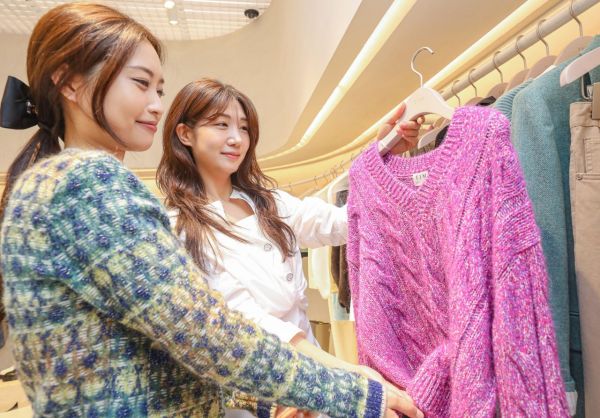 Employees are introducing the new fall products at the 'Time' store on the 3rd floor of The Hyundai Seoul.
 [Photo by Hyundai Department Store].
According to the department store industry on the 8th, from last month 21st to the 6th of this month, the sales growth rate of fashion stores in each department store, newly revamped with fall/winter new products, was limited to a single-digit increase of about 2-5%. Shinsegae Department Store’s fashion category sales increased by 2.3% during this period, and Hyundai Department Store saw relatively high growth in young fashion sales (9.4%) centered on major stores such as The Hyundai Seoul. However, women’s fashion and men’s fashion only grew by 4.3% and 2.8%, respectively.
Since Cheoseo (the end of heat) on the 23rd of last month, cool breezes have started blowing in the mornings and evenings, leading some customers who prepared early for autumn to purchase brightly colored knitwear and the like. However, due to the persistent daytime heat, demand for major fall/winter products such as high-priced outerwear was lower than expected, which affected sales, according to explanations.
Last year, the department store performance surge was led by the fashion category. With the lifting of social distancing and the full-scale onset of the endemic (periodic outbreak of infectious diseases), official outdoor activities increased, boosting the purchase of new clothes that had slowed during the COVID-19 period. As a result, fashion sales surged significantly each time the season changed. According to the Ministry of Trade, Industry and Energy, sales in the women’s and men’s fashion categories increased sharply by 14-41% from August to September last year. Women’s suits rose 27.5%, women’s casual wear 41.9%, and men’s clothing 31.2% in August last year, followed by increases of 31.3%, 14.1%, and 20.2%, respectively, in September.
However, this year, the monthly growth rate of the fashion category has often recorded negative figures. This is due to the high base effect from last year, weakened consumer sentiment amid recession concerns, and consumption dispersion caused by the full resumption of overseas travel. Women’s suits shrank by 3.4%, 0.8%, 0.6%, and 2.8% in January, May, June, and July, respectively, while men’s clothing recorded negative growth rates of 2-6% in January, April, May, June, and July.
In the first half of this year, domestic department stores struggled, with operating profits declining year-on-year, affected by poor performance in fashion. The industry expects a "low in the first half, high in the second half" performance trend, hoping for improvement in the second half. For this, improving the performance of the fashion category, which has a high profit margin, is essential.
However, the unexpected autumn heatwave is delaying the confirmation of fashion performance improvement. According to the Korea Meteorological Administration, temperatures are expected to rise further after the 11th due to the influence of hot and humid air from the south. With higher minimum temperatures, autumn heat approaching 30 degrees Celsius is forecasted to continue into mid-September. Additionally, the later-than-usual Chuseok (Korean Thanksgiving) this year adds to the effect. Major domestic department stores saw existing store sales growth rates drop by about 3% due to the timing of Chuseok last month. In particular, the fashion category experiences weakened consumer sentiment before Chuseok and concentrated sales after Chuseok, so this year’s later Chuseok cannot be ignored as a factor.
Accordingly, the industry views whether the fashion category’s performance will rebound in earnest after late September as a turning point for department stores’ second-half performance. This is because consumption using Chuseok bonuses and allowances will begin in earnest, and the weather, which remains hot until mid-September, will become distinctly cooler. Seohyun Jeong, a researcher at Hana Securities, said, "If the September figures, when the burden of last year’s performance base decreases and fall new product sales begin in earnest, come out higher than expected, it could mark the starting point of a trend recovery in consumption," adding, "We need to pay attention to the situation after September."
© The Asia Business Daily(www.asiae.co.kr). All rights reserved.

















