Apple, the company with the largest market capitalization, faces negative news from China ahead of the launch of the new iPhone. Reports related to the 'iPhone ban' in China have been continuously emerging, causing Apple's stock price to fall sharply for two consecutive days.
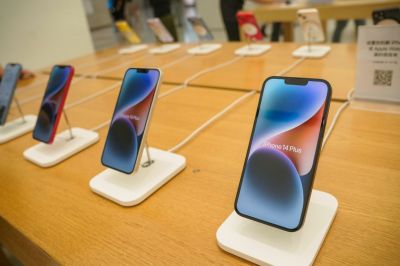
On the morning of the 7th (local time) at the New York Stock Exchange, Apple's stock price was trading at around $177.06 per share, down 3.2% from the previous close. Following a nearly 4% plunge the day before when the iPhone ban report first surfaced, the stock continued to decline, falling below the 100-day moving average. In particular, the weakness of Apple, the company with the largest market cap, is acting as a negative factor for the overall technology sector amid tightening concerns. The Nasdaq index, which is technology-stock heavy, is currently trading down more than 1%.
It is very unusual for Apple's stock price to drop sharply for two consecutive days just before the launch of a new iPhone. Typically, Apple's stock tends to show strength ahead of new iPhone releases, but this time, negative news from China is having a sensitive impact. This follows additional reports that Chinese authorities are planning to expand the iPhone ban, initially imposed on some sensitive departments, to state-owned enterprises and other public institutions.
Bloomberg News, citing sources, reported that multiple Chinese public institutions have instructed employees not to bring iPhones to work, and that the authorities plan to broadly extend this iPhone ban to state-owned enterprises and other public institutions. This follows the Wall Street Journal's (WSJ) initial report the previous day about the iPhone ban on Chinese government officials, indicating that the ban is now expanding to state-owned enterprises and public institutions.
This has dealt an immediate blow to Apple, which is about to launch the iPhone 15 this month. China is both a global production base and a strategically very important market for Apple. Currently, about one-fifth of Apple's revenue is generated in China. Additionally, most of the iPhone series are produced in China. According to market research firm TechInsights, based on second-quarter shipment volumes, iPhone sales in China are estimated to surpass those in Apple's home market, the United States.
Chinese authorities have not yet issued an official order regarding this measure. It is also unclear how many institutions will be affected. However, even if the ban is limited to 'workplace prohibition,' analysts suggest that the impact will inevitably be relatively large due to China's characteristics. Tom Forte, an analyst at DA Davidson, said, "There is a possibility that Apple's sales growth in China will slow down," and predicted, "The difficulties will increase." Edward Moya, senior market analyst at OANDA, noted, "Apple's growth story heavily depends on China," adding, "If sanctions intensify, it will be a major problem for other big tech companies that rely on China."
Major U.S. media outlets interpret this measure as part of China's efforts to reduce technological dependence on foreign companies and as a form of retaliation against the U.S. government, which is engaged in a technological hegemony battle with China. Some analysts also view the recent visit of U.S. Commerce Secretary Gina Raimondo to China as evidence that it had no impact on thawing trade relations between the two countries. Previously, the U.S. expanded sanctions against Chinese tech companies such as Huawei and TikTok citing national security concerns, and China responded by sanctioning U.S. companies like Micron.
Some experts and media have also focused on the timing of the iPhone ban news in China. Recently, despite U.S. advanced technology sanctions, Huawei attracted attention by launching the new smartphone 'Mate 60 Pro' equipped with a 7nm (nanometer, one billionth of a meter) process processor. Wamsi Mohan, an analyst at Bank of America (BoA), commented that considering Huawei's recent launch of a 5G smartphone, the "potential timing of the iPhone ban is interesting."
Barron's expressed concern that "if China's iPhone ban expands, it could have a long-lasting negative impact on Apple's stock price even after the new iPhone launch." The publication cited Citi's analysis showing that since 2016, Apple's stock price has typically risen by an average of 8% between the June quarterly earnings announcement and the September new iPhone announcement, adding that "a miracle would be needed for history to repeat itself this year," and forecasted a continued downward trend.
However, there are also assessments that the market is overreacting. Daniel Ives, a strategist at Wedbush, predicted that even if the worst-case scenario of an iPhone ban materializes, the impact on iPhone sales in China next year will be limited.
© The Asia Business Daily(www.asiae.co.kr). All rights reserved.

















