Hwaeomsa Temple's Wooden Four Heavenly Kings Statues and Other Mid-to-Late 17th Century Works
"Historically Important as They Contain the Mission of Buddhist Revival"
The Four Heavenly Kings are guardian deities who protect the teachings of the Buddha and the Buddhist paradise from the mid-slope of Mount Sumeru (須彌山). In temples, they are positioned at the Cheonwangmun Gate between the main gate, Iljumun (一柱門), and the main Buddha hall, Daeungjeon. They wear armor and hold a precious sword (寶劍), glaring fiercely. This is to protect the temple from evil spirits and other living beings.
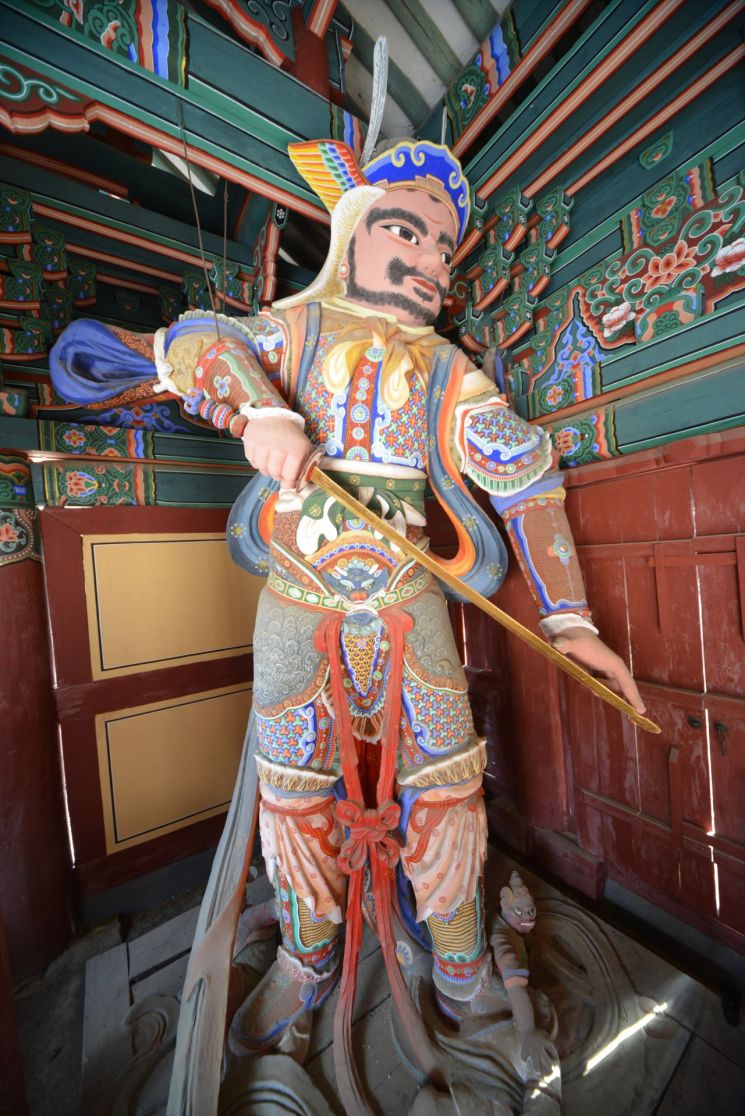
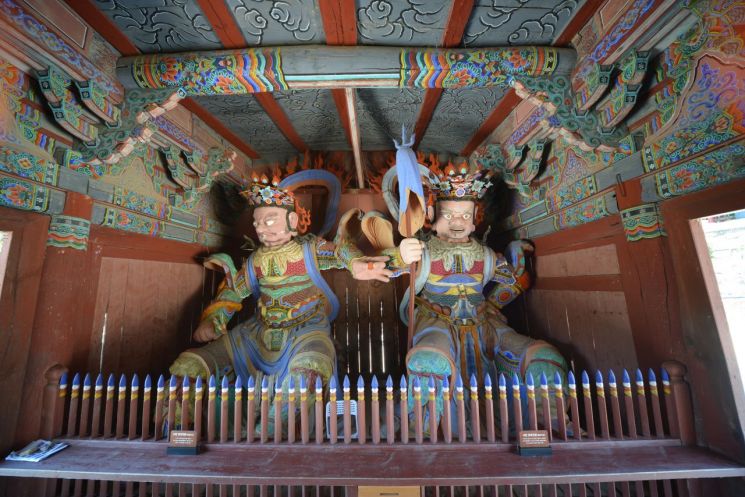
The Cultural Heritage Administration announced on the 7th that the Four Heavenly Kings statues at eight temples?Hwaeomsa in Gurye, Heungguksa in Yeosu, Beopjusa in Boeun, Jikjisa in Gimcheon, Neunggasa in Goheung, Bulgapsa in Yeonggwang, Sutasa in Hongcheon, and Magoksa in Gongju?have been preliminarily designated as Treasures. It was judged that they hold historically significant meaning as they embody the mission of Buddhist revival during the reconstruction of temples after wars. The subjects are works from before the mid-17th century related to temple reconstruction or Buddhist revival, and late 17th-century works that are complete in composition with minimal alteration or distortion. Opinions from various sectors will be gathered for a month, and the final designation will be decided after review by the Cultural Heritage Committee.
About twenty Four Heavenly Kings statues remain in Korea, including three designated Treasures: the wooden Four Heavenly Kings statues at Borimsa in Jangheung, the small-scale Four Heavenly Kings statues at Songgwangsa in Suncheon, and the small-scale Four Heavenly Kings statues at Songgwangsa in Wanju. The small-scale Four Heavenly Kings statues at Hwaeomsa in Gurye and Heungguksa in Yeosu, preliminarily designated as Treasures, were created during the restoration of temples by monks such as Byeokam Gakseong (1575?1660) and Daesa Gye-teuk after the Japanese invasions of Korea. They reflect early 17th-century styles, characterized by seated postures on chairs, large square wrinkled faces, and wide, thickly expressed nostrils. Another notable feature is the absence of living beings beneath their feet.
The small-scale Four Heavenly Kings statues at Beopjusa in Boeun were also made after wartime, estimated to be from the mid-17th century. They are rare standing statues among domestic Four Heavenly Kings statues, reaching a height of 5.7 meters. Beneath their feet are living beings representing Qing dynasty and Joseon officials. The Cultural Heritage Administration explained, "This is the first sculpture created to overcome the humiliation of the 1636 Byeongjahoran (Second Manchu invasion) and to provide a lesson."
The small-scale Four Heavenly Kings statues at Jikjisa in Gimcheon are confirmed through a vow inscription to have been created in 1665 by a sculptor monk active mainly at Songgwangsa in Wanju. Manuscripts were discovered that identify the directional positions of each Heavenly King. The Cultural Heritage Administration stated, "It also contains information about the production and exchange activities of sculptor monks from Honam and Yeongnam regions, greatly aiding the study of Buddhist sculpture history in the late Joseon period."
The wooden Four Heavenly Kings statues at Neunggasa in Goheung are notable for having the order of the Eastern Guardian King Dhritarashtra, Northern Guardian King Virudhaka, Southern Guardian King Virupaksa, and Western Guardian King Vaishravana switched. The wooden Four Heavenly Kings statues at Bulgapsa in Yeonggwang show transitional characteristics from small-scale to wooden statues. While the overall form is made by joining wooden carvings, details such as hair and decorations are intricately modeled with clay. The Cultural Heritage Administration will cancel the designation of relics found inside the Four Heavenly Kings statues among the Treasure "Bulgapsa Buddhist Relics in Yeonggwang." They plan to manage them collectively under the name "Wooden Four Heavenly Kings Statues and Relics of Bulgapsa in Yeonggwang."
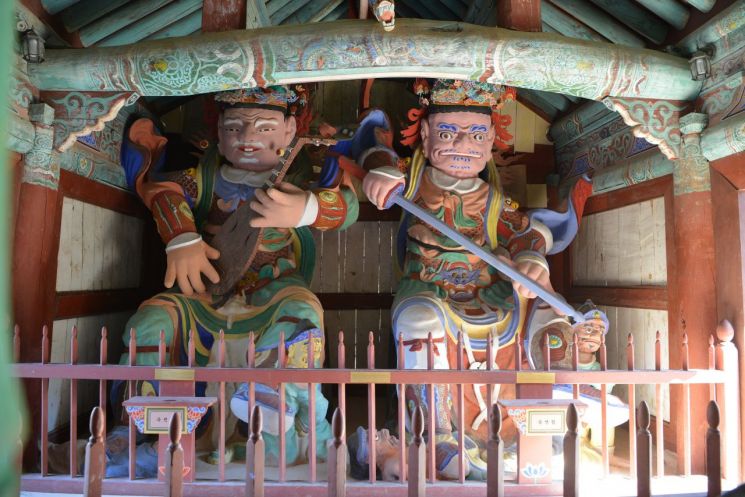
The small-scale Four Heavenly Kings statues at Sutasa in Hongcheon, the only ones transmitted in Gangwon Province, were evaluated as having sufficient research value due to being the northernmost Four Heavenly Kings statues in Korea. The small-scale Four Heavenly Kings statues at Magoksa in Gongju, created in 1683, were also judged to have high academic value as they allow research into the iconography and sculptural schools of the 17th-century Four Heavenly Kings, as well as the methods and sequences of Buddha statue production.
© The Asia Business Daily(www.asiae.co.kr). All rights reserved.
!["The Woman Who Threw Herself into the Water Clutching a Stolen Dior Bag"...A Grotesque Success Story That Shakes the Korean Psyche [Slate]](https://cwcontent.asiae.co.kr/asiaresize/183/2026021902243444107_1771435474.jpg)


















