[China Finding Loopholes in US Sanctions]③
China Seizes Mineral Hegemony... Holds Export Control Meeting to Defy US
Likely to Counterattack with 'Battery Weaponization'
The semiconductor war between the United States and China has expanded into a 'mineral war.' China, which controls key materials for semiconductors and electric vehicle batteries, has pulled out the mineral export restriction card against the U.S., which is attempting to control semiconductor technology targeting China. While the U.S. blocked semiconductor equipment exports to China based on its overwhelming 'technological superiority,' China has launched a counterattack by asserting 'mineral hegemony' and striking the U.S. and its allies. Concerns over resource weaponization have grown as the Chinese government ordered a halt to urea exports this month, following restrictions on gallium and germanium last month.
China Seizes Mineral Hegemony... Holds Export Control Meeting to Show Off to the U.S.
China's Ministry of Commerce held its first-ever 'National Export Control Work Meeting' on June 1-2 in Xiong'an New Area, Hebei Province. This followed last month's restrictions on the export of gallium and germanium, semiconductor materials, and the market interpreted it as a signal that China might designate additional minerals for export control. Notably, the meeting was held just four days after U.S. Secretary of Commerce Gina Raimondo's visit to China ended, openly warning of the possibility of escalation by targeting the U.S. with export controls. China did not hide this intention. The Global Times, affiliated with the Chinese Communist Party's official newspaper People's Daily, described the meeting as something that "should be viewed in the context of Western abuse of export controls against China," and stated, "If some countries continue to abuse unilateral sanctions targeting China, China will have considerable means of retaliation."
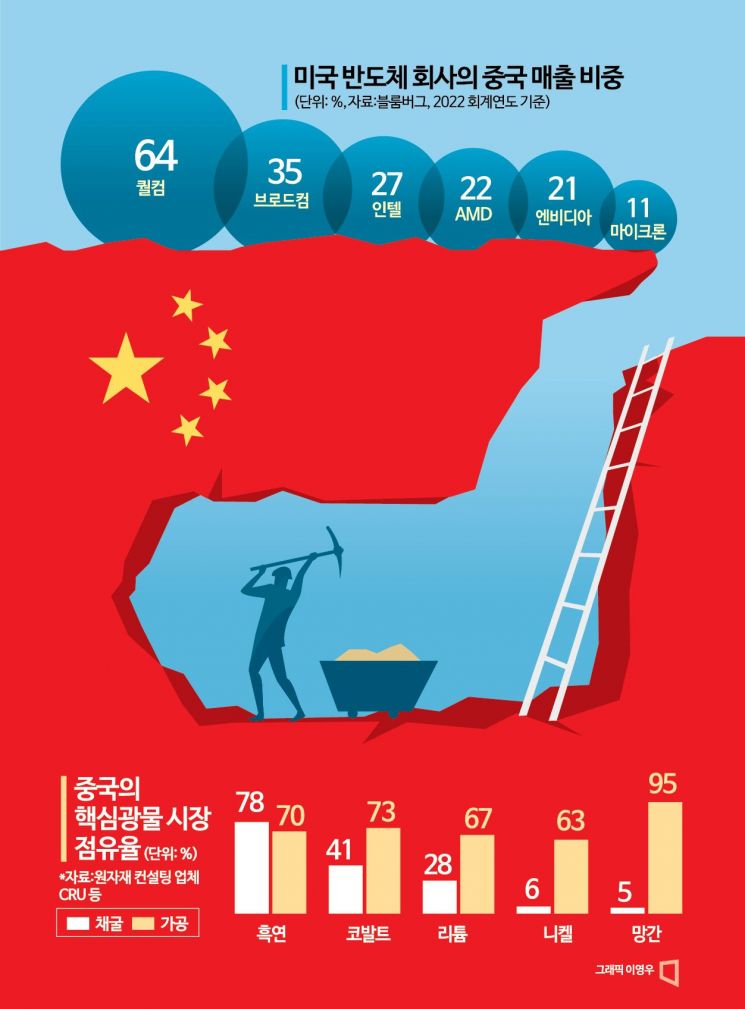
The background to China's brazen handling of the mineral export control card lies in its strong dominance of the global mineral market. According to the European Union (EU), among 51 key raw materials including 15 rare earth elements, China has the highest market share in 33 minerals, accounting for 64.7% of all key raw materials. Looking at key minerals individually, based on estimates from the raw materials consulting firm CRU Group, China accounts for 41% of the world's cobalt mining, 28% of lithium, 6% of nickel, and 5% of manganese. Graphite mining reaches as high as 78%.
China's influence in mineral processing is even greater. It refines 95% of manganese, 73% of cobalt, 70% of graphite, 67% of lithium, and 63% of nickel. China tightly controls the entire mineral supply chain, from mining key minerals to processing and supply.
Moreover, China has continued large-scale investments in mines in South America, Africa, and other countries, continuously securing mineral resources. This means China can continue to inflict damage on the U.S. and its allies, who impose comprehensive sanctions on China by adding export-controlled minerals one by one. China's restriction on the export of rare metals gallium and germanium for semiconductors since last month is also a direct measure targeting the U.S. The U.S. imports 53% of its gallium and 54% of its germanium from China.
China Likely to Counterattack with 'Battery Weaponization'
China's resource weaponization is expected to focus more on batteries than semiconductors. As the U.S., the European Union (EU), and others ramp up efforts to transition to electric vehicles, dependence on China, which controls the core minerals market for batteries, is inevitably increasing. The more the U.S. tightens semiconductor technology controls, the more China is likely to expand the scope of export controls on key battery minerals in response.
The market expects that the U.S. will not be able to reduce its dependence on China for at least the next 10 years. According to the report "IRA and the U.S. Battery Supply Chain: Background and Key Drivers" released by Columbia University's Global Energy Policy Center, China accounts for 75% of the supply of anode and cathode materials, key components of electric vehicle batteries. North America's production of anode and cathode materials accounts for only 18% and 8% of demand, respectively, making imports from China, the largest supplier, unavoidable. Although the Biden administration has set a goal to have 50% of new car sales be electric or other eco-friendly vehicles by 2030, the more efforts are made to achieve this goal, the more paradoxically dependent the U.S. becomes on China. The report states, "Supply chain bottlenecks such as shortages of anode and cathode materials increase U.S. dependence on China," and "China leads in technology and supply chain security, and it will be very difficult to overturn this within 10 years. The current situation regarding import dependence on China will not change." Scott Kennedy, senior adviser at the U.S. think tank Center for Strategic and International Studies (CSIS), also said, "There is no way to succeed in electric vehicles without cooperating with China, either directly or indirectly."
On the other hand, some analyses suggest that China's resource weaponization could reduce dependence on China for key minerals in the mid to long term, thereby diminishing China's influence. Recently, there has been active movement in the West, centered on the U.S., to diversify mineral supply chains. The Group of Seven (G7) has agreed to discuss and set specific import share targets for key minerals with high import dependence on certain countries. The plan is to increase mineral imports from countries other than China to achieve the final goal. The European Union (EU) also plans to reduce the proportion of key raw materials imported from third countries to below 65% of regional consumption by 2030. Japan and the United Kingdom have decided to secure stable mineral supply chains by jointly developing mines in Africa and other mineral-rich regions.
© The Asia Business Daily(www.asiae.co.kr). All rights reserved.

















