Electric Vehicles and Others to Have Tariffs Removed Within 5 Years
Philippine Bananas to See Tariffs Drop from 30% to 0% Within 5 Years... However, Safeguards Possible
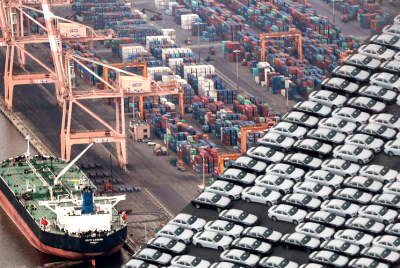
The governments of Korea and the Philippines have officially signed a Free Trade Agreement (FTA). Upon the FTA's enforcement, tariffs on Korean-made internal combustion engine vehicles will be eliminated immediately, and tariffs on eco-friendly vehicles such as electric cars will be removed within five years.
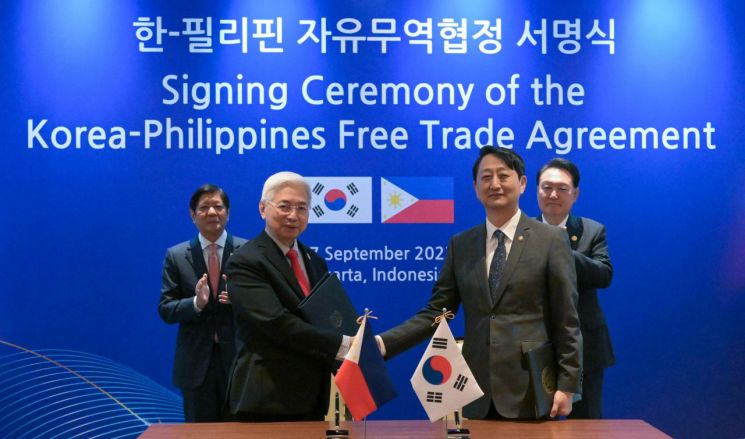
The Ministry of Trade, Industry and Energy announced that on the 7th, Ahn Duk-geun, Chief Negotiator for Trade, and Alfredo Espinosa Pascual, Philippine Secretary of Trade and Industry, officially signed the Korea-Philippines Free Trade Agreement (FTA) in Jakarta, Indonesia, where the ASEAN Summit is being held, in the presence of the leaders of both countries.
The Korea-Philippines FTA had a principle agreement on the basic framework centered on concession levels in October 2021. Since then, through several rounds of intensive negotiations between both sides on detailed schedules for tariff elimination and reduction, procedures for implementing agricultural safeguards, and regulations on the operation of the goods committee, a final agreement on all contents of the Korea-Philippines FTA was reached in June last year.
With this signing, Korea has concluded 22 FTAs with 59 countries worldwide. The Philippines is a contracting party to multilateral FTAs such as the Regional Comprehensive Economic Partnership (RCEP) and the ASEAN Free Trade Area, and in terms of bilateral FTAs, Korea is the second after the Philippines-Japan Economic Partnership Agreement (EPA) that came into effect in 2008.
Korea has expanded its FTA network with ASEAN countries by participating in multilateral FTAs involving all ASEAN countries such as the Korea-ASEAN FTA and RCEP, as well as with major individual trading partners within ASEAN. With the addition of the Philippines to the existing FTAs with Singapore, Vietnam, Cambodia, and Indonesia, Korea now has FTA relations with five ASEAN countries. The trade volume between Korea and these five countries accounted for 91% of Korea's total trade with ASEAN in 2022.
The Philippines has a population of 110 million (12th in the world, 2nd among ASEAN countries) and possesses significant consumption potential, with consumption accounting for 70% of its Gross Domestic Product (GDP). In 2022, trade between Korea and the Philippines amounted to $17.5 billion, making the Philippines Korea's 5th largest trading partner among ASEAN countries. Of this, exports were $12.3 billion, ranking 3rd among ASEAN countries, and imports were $5.2 billion. The Ministry of Trade, Industry and Energy expects that the Philippines, rich in resources such as nickel and cobalt designated as Korea's top 10 strategic core minerals, holds great value and potential for future cooperation.
Through the existing Korea-ASEAN FTA, RCEP, and the newly signed Korea-Philippines FTA, Korea has ultimately eliminated tariffs on 94.8% of all items for the Philippines, and the Philippines has eliminated tariffs on 96.5% of items for Korea.
Key beneficiary items of the Korea-Philippines FTA include automobiles and automobile parts. The Philippines is the largest importer of automobiles among ASEAN countries. As of 2022, the market share by brand in the Philippines was Japan 82.5%, the United States 7.0%, China 6.4%, and Korea 2.5%, with Japanese brands maintaining dominance. Japan has lowered tariffs on automobiles and automobile parts, except passenger cars (tariff rate 20%), to 0% through its Economic Partnership Agreement (EPA) with the Philippines.
With the signing of the Korea-Philippines FTA, tariffs on Korean-made automobiles (previous tariff rate 5%) will be eliminated immediately upon enforcement, and tariffs on automobile parts (3-30%) will be removed within five years. Additionally, eco-friendly vehicles such as electric and hybrid cars (previous tariff rate 5%), which have significant potential alongside the Philippines' economic growth (6.5% in 2022), will also have tariffs eliminated within five years.
An official from the Ministry of Trade, Industry and Energy stated, "With the 15-year tariff elimination on processed foods (5-10%), ginseng (5%), chili peppers (5%), pears (7%), and mackerel (5%), we have strengthened the export base of our major agricultural and marine products, which are gaining popularity along with the Korean Wave, in the Philippine market." He added, "For sensitive agricultural, marine, and forestry products on our side, most concessions were made within the scope of previously concluded FTAs such as the Korea-ASEAN FTA and RCEP, maintaining the existing level of market openness."
Bananas (30%), a product of interest to the Philippines, will be opened with tariff elimination over five years, but agricultural safeguard measures have been put in place to prevent a sudden surge in imports. For the next ten years, if imports exceed the annual quota based on recent import volumes from the first year of FTA enforcement, tariffs of up to 30% can be re-imposed.
The government plans to ensure thorough procedures, including parliamentary ratification, aiming for the Korea-Philippines FTA to come into effect in the first half of next year.
© The Asia Business Daily(www.asiae.co.kr). All rights reserved.
![Clutching a Stolen Dior Bag, Saying "I Hate Being Poor but Real"... The Grotesque Con of a "Human Knockoff" [Slate]](https://cwcontent.asiae.co.kr/asiaresize/183/2026021902243444107_1771435474.jpg)

















