As Chinese tech giant Huawei has launched its latest smartphone, the 'Mate 60 Pro,' made with advanced semiconductor processes despite U.S. export controls, the U.S. Congress is calling for an investigation into possible violations of sanctions against China.
On the 6th (local time), Michael McCaul, chairman of the U.S. House Foreign Affairs Committee, stated regarding Huawei's new smartphone equipped with 7nm (nanometer, one billionth of a meter) chips produced by China's SMIC, "It appears certain that (SMIC) has violated U.S. sanctions."
While visiting the Netherlands, Chairman McCaul held a press conference at the U.S. Embassy in The Hague and emphasized, "An investigation (into SMIC) is necessary," adding that "SMIC has been striving to acquire U.S. intellectual property." He further noted, "China is trying to monopolize the low-end semiconductor chip market," and stressed the need to also examine legacy chips (older semiconductors), not just advanced semiconductors, highlighting the importance of related regulations.
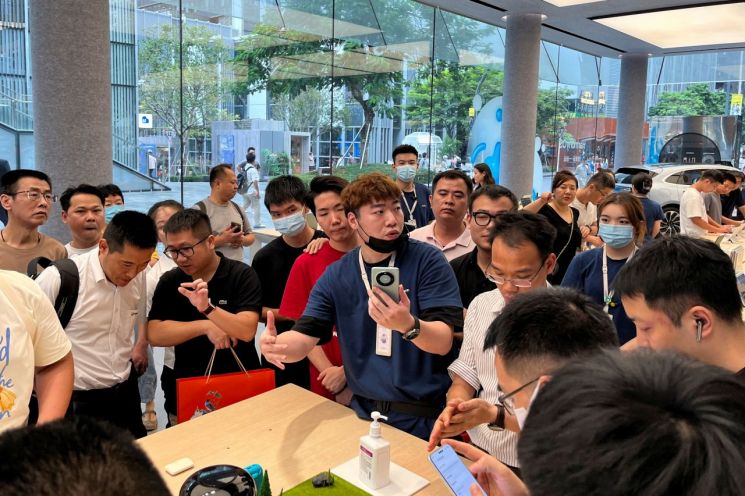
Not only China but also Western media have evaluated that while the U.S. is raising the level of technology sanctions against China by involving its allies, China has overcome U.S. restrictions through independent technological development. A British media outlet reported, "Huawei has set an important milestone by releasing the Mate 60 Pro, four years after halting its smartphone business due to U.S. sanctions."
The U.S. Washington Post (WP) pointed out, "Concerns are emerging that U.S. sanctions have failed to block China's core technological advancements," while Bloomberg News noted, "SMIC uses U.S. technology throughout its processes, and it is unclear whether SMIC holds a U.S. government license to supply products to Huawei."
Bloomberg, citing TechInsights, reported that a teardown of Huawei's new smartphone confirmed it is equipped with the 7nm semiconductor 'Kirin 9000s.' The Kirin 9000s is a semiconductor developed by Huawei's subsidiary HiSilicon in partnership with SMIC, and this is the first confirmation that this chip has been used in a smartphone.
However, Huawei has not disclosed details about the processor used in the smartphone or which generation of mobile communications it supports, nor has it revealed the procurement channels for the semiconductors, according to a report by the South China Morning Post (SCMP) at the end of last month.
The media's attention to the fact that the Mate 60 Pro is equipped with 7nm semiconductors is evidence that U.S. semiconductor sanctions against China are not working effectively. Jake Sullivan, U.S. National Security Advisor, responded to reporters' questions about whether export controls on advanced semiconductor technology are functioning properly by stating, "More information is needed about the exact nature and composition of the semiconductors powering the Mate 60 Pro."
© The Asia Business Daily(www.asiae.co.kr). All rights reserved.

















