EU Big Tech Platform Regulation Begins in Earnest
Apple, Amazon, MS Among 6 Confirmed Targets
Concerns Raised Over Preemptive Regulation Limits in Korea
Six major companies including Apple, Google, and Amazon, targeted by the European Union (EU)'s proposed 'Big Tech Regulation Act,' are struggling to find ways to respond. Opposing the regulation that could impose fines worth trillions of won for legal violations, some companies have even announced plans for legal battles, showing varying degrees of response intensity by company.
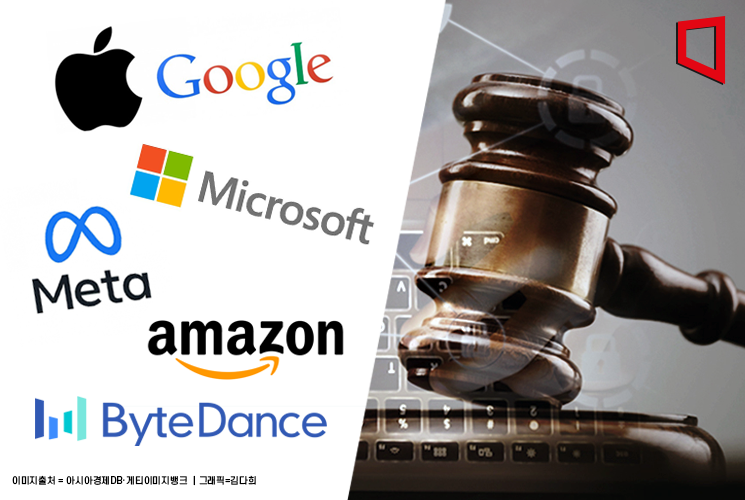
On the 6th (local time), the EU Commission confirmed six companies subject to the Digital Markets Act (DMA), which will take effect from March next year: Alphabet (US), Amazon, Apple, Meta, Microsoft (MS), and ByteDance (China). A total of 22 major services they provide, including social media platforms, app stores, and operating systems (OS), are subject to regulation.
Companies targeted by the DMA, which is being promoted to prevent the monopolistic harms of giant platform businesses, are deeply concerned about a significant contraction of their business within the EU region. The DMA designates dominant platform operators as 'gatekeepers' who use their market dominance to lock users into their own services like fish in a cage, and applies special regulations to these companies.
From March next year, companies designated as gatekeepers will be prohibited from engaging in business practices favorable to their own services or exclusive business activities using personal data and other information within the EU region. If these business practices are not corrected and violations are confirmed, they will face fines of up to 10% of their annual revenue, and up to 20% for repeated violations. For Apple, which recorded $390 billion in global sales last year and about $97 billion in sales within Europe alone, this could mean a fine of $9.7 billion (approximately 13 trillion won).
Some companies, such as Apple and MS, have expressed willingness to accept the EU's regulatory proposal. Apple stated, "We are deeply concerned about the privacy invasions and data security risks that the DMA imposes on users," adding, "We will focus on how to minimize these impacts." After the law takes effect, Apple will have to allow users of competing smartphones to download apps that were previously only available through the Apple Store.
MS welcomed the fact that its search engine Bing and browser Edge were excluded from this decision and that the EU will conduct a detailed review, saying, "(These services) welcome the EU's investigation as challengers in the market."
Others are showing caution, worried about the repercussions of the law's implementation. Google and Meta said they would "review the decision" without making any special remarks, while Amazon responded that it is "committed to providing services that meet customer needs within Europe's evolving regulatory environment."
Google will be prohibited from prioritizing its internal database in search result exposure, Amazon, the world's largest e-commerce company, will not be allowed to prioritize its own brand over third-party sellers' products in product searches, and Meta will not be able to combine user information across its social media platforms such as Facebook and Instagram without user consent.
ByteDance, the only Chinese company included in the regulation, hinted at a tough response. ByteDance said, "While we support the DMA's goal of creating a level playing field for fair competition in Europe, we fundamentally disagree with this decision," adding, "It is very disappointing that no market investigation was conducted prior to this decision, and we are reviewing our options," suggesting the possibility of legal battles.
Bloomberg reported, "The EU also expects this decision could lead to lawsuits, and it may take years for court rulings to be issued."
Meanwhile, in South Korea, the Fair Trade Commission has announced plans to introduce platform regulation laws similar to the DMA, raising concerns that strengthening preemptive regulations like the DMA could hinder innovation in the digital market.
At the 'International Seminar on Online Platform Regulation Trends' held at the National Assembly Members' Office Building the day before, Tivolt Shrepel, a professor at Vrije Universiteit Amsterdam, pointed out that the DMA has a fundamental limitation in not reflecting the industrial ecosystem, as generative artificial intelligence (AI), which is a game-changer in the Big Tech industry, is excluded from the regulation.
Shin Young-sun, a legal advisor at Yulchon Law Firm and former vice chairman of the Fair Trade Commission, also noted, "As generative AI, represented by ChatGPT, expands services from shopping and reservations to finance, academia, and software, the platform industry is undergoing a turbulent environment, so preemptive regulation should be approached with caution."
© The Asia Business Daily(www.asiae.co.kr). All rights reserved.
![Clutching a Stolen Dior Bag, Saying "I Hate Being Poor but Real"... The Grotesque Con of a "Human Knockoff" [Slate]](https://cwcontent.asiae.co.kr/asiaresize/183/2026021902243444107_1771435474.jpg)


















