Seoul City's 'Comprehensive Plan to Reduce Single-Use Plastics'
Plastic Use Down 10%, Recycling Rate from 69% to 79%
Starting this year with the area around Jamsugyo Bridge, the use of disposable delivery containers will be banned throughout Hangang Park by 2025. Additionally, the use of reusable containers will be mandatory for all food trucks at events and festivals hosted by Seoul public institutions, and the use of reusable cups and containers will be promoted at funeral homes and other venues.
Seoul City announced the "Comprehensive Plan to Reduce Disposable Plastics" containing these measures on the 7th.
Seoul City will introduce a ‘Disposable Cup Deposit System’ from 2025, charging a 300 KRW deposit when using disposable cups at coffee shops and similar establishments. Starting this month, the ‘Additional Discount for Personal Cups’ will also be implemented, where Seoul City offers a 300 KRW discount when ordering drinks with personal cups at cafes. Multi-use cups will be encouraged at multi-use facilities such as movie theaters and stadiums, and cafes in large buildings producing over 300kg of daily waste will be actively encouraged to adopt reusable cups. Through these efforts, the goal is to reduce the use of disposable cups by 100 million units by 2026.
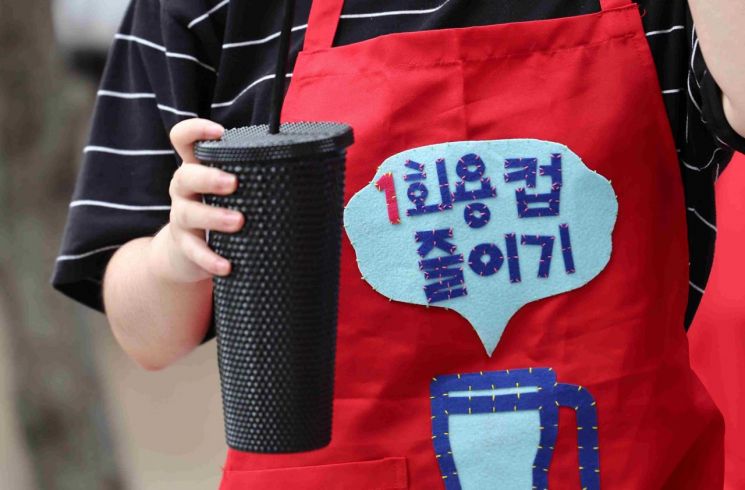
Funeral homes, events·festivals, and sports facilities, which have traditionally used large amounts of disposable items, will be converted into ‘Zero Plastic’ hubs using reusable cups and containers. As a result of fully introducing reusable containers at the Seoul Medical Center funeral home in July this year, waste output was reduced by about 80%. Based on this success, the city plans to expand the use of reusable containers to 64 private funeral homes in Seoul, including large general hospitals, starting next year. Also, all food trucks at events·festivals hosted by public institutions will be required to use reusable containers. Hangang Park will be operated as a ‘No Disposable Delivery Container Zone (Zero Plastic Zone).’ Starting with the area around Jamsugyo Bridge this year, the ban will expand to Ttukseom·Banpo next year, and to the entire Hangang Park by 2025.
Additionally, the number of recycling separation points in ‘detached house and urban residential complex dense areas,’ where door-to-door mixed waste collection is currently practiced, will be increased from 13,000 locations to 20,000 by 2026, and local ‘resource managers’ will be appointed. The ‘Transparent PET Bottle and Waste Vinyl Separation Collection Day System,’ implemented since 2021 in detached houses and commercial buildings, will be expanded and firmly established, and a ‘Recyclable Waste Collection Reward System’ exchanging recyclables for volume-based waste bags will also be supported.
Since 60% of the nation’s sewing factories are concentrated in Seoul, ‘sewing fabric waste’ will also be recycled into solid fuel, textile yarn, and other resources. Daily discarded fabric scraps amount to 127 tons, 60% of which are incinerated or landfilled. The city plans to establish a system by 2026 linking autonomous districts, SR Centers, and companies to provide about 100 tons of fabric daily as recycled resources such as textile panels and building materials.
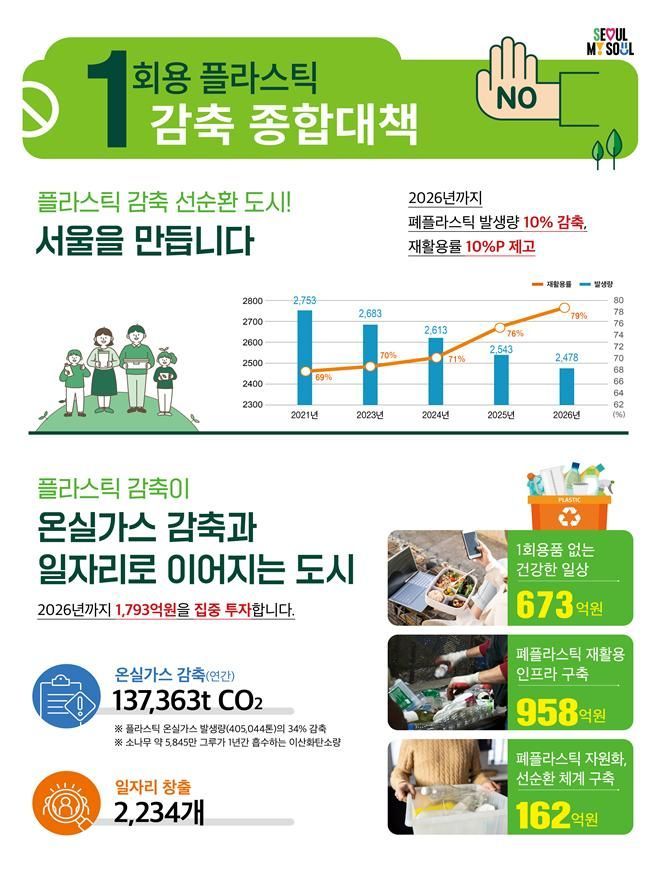
The current daily plastic waste generation in Seoul has increased by more than 200% over seven years, from 896 tons in 2014 to 2,753 tons in 2021. If this trend continues, it is expected to increase by up to 40% within the next three years (by 2026). Through this plan, the city aims to reduce daily plastic waste from the current 2,753 tons to 2,478 tons by 2026, a 10% reduction (275 tons), and increase the recycling rate from the current 69% to 79%.
Lee In-geun, head of Seoul City’s Climate and Environment Headquarters, said, “The plastic problem is now an urgent issue for the survival of cities and humanity that can no longer be delayed,” adding, “We ask for the interest and participation of citizens so that Seoul can become a global ‘model city for a circular economy’ by recycling waste resources, including plastics, to create high added value.”
© The Asia Business Daily(www.asiae.co.kr). All rights reserved.


















