Announcement of EtoosEdu Analysis Results
The Korean History section of the September mock test for the 2024 College Scholastic Ability Test (CSAT) was analyzed by the admissions industry to have been similar to the June mock test this year. The Social Studies section was easier in Social and Culture, but more difficult in Korean Geography. The Science section was generally of moderate difficulty.
At around 4:40 PM on the 6th, the 4th session of the September mock test for the 2024 CSAT, organized by the Korea Institute for Curriculum and Evaluation, ended, covering Korean History and the Social, Science, and Vocational Studies sections.
Immediately after the test, Etoos Edu distributed an analysis report. Regarding the Korean History section, Etoos Edu stated, "The questions were evenly distributed across all areas, focusing on core content emphasized in the curriculum," and evaluated the difficulty as "similar to last year's CSAT and the June mock test held this year."
They added, "Both pre-modern and modern history questions were generally easy, focusing on frequently tested topics," and analyzed that "the question about the activities of the Shinhan Youth Party might have felt difficult as it has not been recently tested."
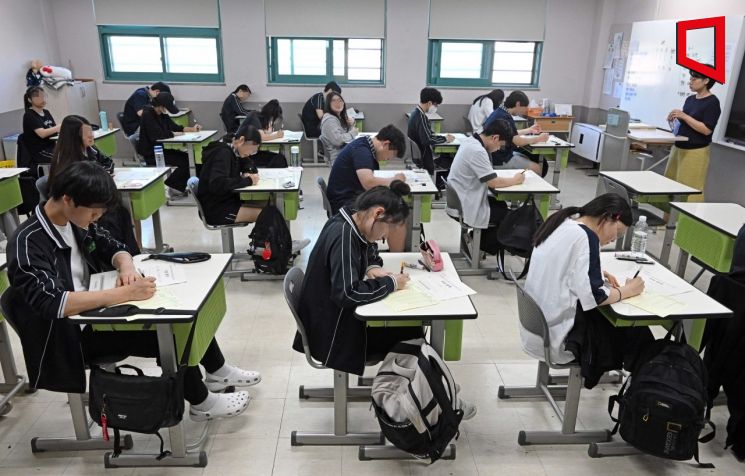 On the 6th, students are preparing for the exam at Bangsan High School in Songpa-gu, Seoul, where the September mock test for the 2024 College Scholastic Ability Test was held. Photo by Joint Press Corps
Regarding the Social Studies section, they analyzed, "Compared to last year's CSAT, Life and Ethics and Social and Culture were slightly easier, while Korean Geography was more difficult." Compared to the June mock test, Life and Ethics was at a similar level, Korean Geography was slightly more difficult, and Social and Culture was at a similar level.
For Life and Ethics, "It was unusual that a question type reconstructing syllogisms, which had not appeared in recent years, was included again," and explained, "The difficulty was generally moderate, but questions on Rawls' civil disobedience (No. 7), Beccaria and Kant's corrective justice (No. 9), and Rawls and Nozick's distributive justice (No. 15) were designed to differentiate examinees."
Regarding Korean Geography, "The overall difficulty was high," and they said, "High-difficulty questions that could distinguish grades were composed of unfamiliar materials such as the climate of North Korea in physical geography (No. 15), industry in the Chungcheong region in human geography (No. 12), and South Korea's territorial waters (No. 20)."
For Social and Culture, "The most notable feature was the reduction to two data analysis and calculation questions, which were high difficulty in last year's CSAT and this June's mock test," and added, "The high-difficulty question on gender inequality was not included, and the question on social class structure (No. 11) was moderately easy."
Regarding the Science section, they summarized, "Compared to last year's CSAT, Physics I, Chemistry I, and Earth Science I were slightly easier, and Biology I was easy."
For Physics I, "Questions requiring data interpretation and concept application were included, and high-difficulty questions appeared in the mechanics and energy units."
For Chemistry I, "Questions on concept application, data interpretation, and conclusion drawing were evenly distributed, and a high-difficulty question appeared in the quantitative relationships of chemical reactions."
For Biology I, "Questions mainly asked whether concepts could be applied to data or reinterpreted through data, and a high-difficulty question appeared in the human genetics unit."
For Earth Science I, "Many questions required data analysis skills, and high-difficulty questions appeared in the paleomagnetism and continental drift units, but the overall difficulty was generally moderate."
© The Asia Business Daily(www.asiae.co.kr). All rights reserved.

















