Ministry of Economy and Finance Discloses Details of 'National Treasury Subsidy Project Extension Evaluation Report'
Historic Restructuring of 176 Projects Under Sound Fiscal Policy
Ministry of Environment Cuts Entire 400 Billion KRW for Aging Water Supply Maintenance
'Insufficient Evaluation Indicators'... Ministry of Trade, Industry and Energy Also Cuts 110 Billion KRW Budget
Welfare Projects for the Vulnerable Face Sequential Reductions if Effectiveness Not Verified
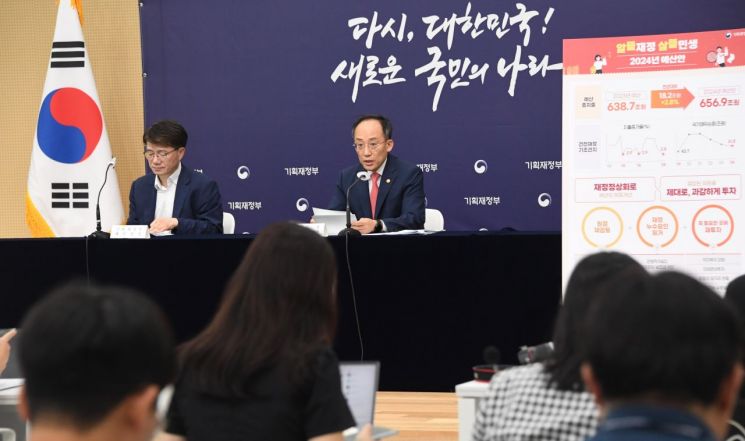 On the 24th of last month, Deputy Prime Minister and Minister of Economy and Finance Choo Kyung-ho (right) speaking at the detailed briefing on the '2024 Budget Proposal and 2023-2027 National Operation Plan' held at the Government Complex Sejong,
The Ministry of Economy and Finance has cut over 1 trillion won from national treasury subsidy project budgets that were either not spent meticulously or deemed ineffective. This marks the most intensive restructuring since the system's introduction, with dozens of subsidy projects having their budgets completely eliminated. However, some subsidy projects related to vulnerable groups were also reduced or abolished due to perceived ineffectiveness, raising concerns that this approach conflicts with the policy direction of 'welfare for the vulnerable.'
According to the Ministry of Economy and Finance's '2023 Subsidy Project Extension Evaluation Plan' released on the 6th, out of 278 projects subject to evaluation, 176 (63.3%) were judged for abolition, consolidation, or reduction. The largest category was reduction, with 141 projects (3.8326 trillion won), followed by phased abolition of 22 projects (180.1 billion won), immediate abolition of 11 projects (131.2 billion won), and consolidation of 2 projects (10 million won). Forty-four projects (775.7 billion won) had their budgets fully cut. The total budget for these projects will shrink from 4.1532 trillion won this year to 3.1509 trillion won next year, a reduction of 1.022 trillion won (31.8%).
The subsidy project extension evaluation is a procedure to assess the necessity and effectiveness of projects funded by national treasury subsidies. Decisions are made on whether to continue the projects or increase funding. The Ministry of Economy and Finance is the decision-making body, conducting this evaluation annually since 2016. In May, the ministry announced at the Subsidy Management Committee meeting that it would prepare the most rigorous restructuring plan ever, finalizing details during the budget formulation process and releasing them earlier this month.
4 Trillion Won National Treasury Subsidy Fully Cut... Unprecedented Restructuring
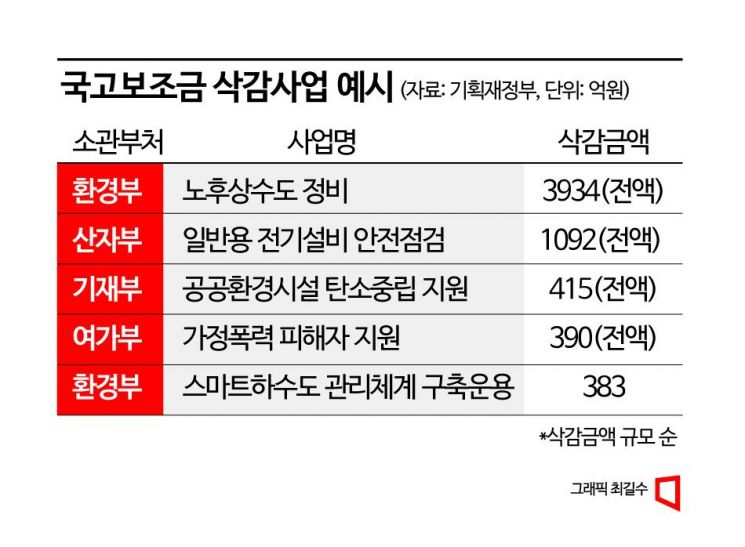
Projects that either did not spend their budgets according to plan or whose effectiveness was difficult to measure faced severe budget cuts. The subsidy project with the largest cut was the Ministry of Environment's 'Aged Water Supply System Maintenance (Regional Support).' Although 339.4 billion won was allocated this year, the entire budget was cut in next year's plan. This is because the budget allocated for subsidy projects increased significantly beyond the original plan. The total project cost, which was 3.0962 trillion won (1.788 trillion won from the national treasury) at the time of planning in 2016, has grown to 4.8 trillion won this year. The national treasury subsidy had already reached 1.7 trillion won in 2022.
The Ministry of Economy and Finance acknowledged the necessity of the subsidy project but emphasized the need for thorough feasibility verification. It particularly criticized the Ministry of Environment's plan to proceed with the second phase of the aged water supply system maintenance project. This is because, after investing more money than expected, an additional massive budget of 14 trillion won must be allocated. The ministry instructed to comprehensively consider the necessity and urgency of the maintenance project, review all necessary costs and construction expenses, and then reallocate the project budget.
The Ministry of Trade, Industry and Energy's 'Safety Inspection of General Electrical Facilities' project also faced a full budget cut of 109.2 billion won due to difficulty in assessing its effectiveness. The ministry managed performance using indicators such as the number of electrical fires and prevention effects of electrical accidents but failed to meet targets in 2020 and 2021. Although new performance indicators were introduced last year and targets were met, the Ministry of Economy and Finance diagnosed that 'the targets were set excessively low.' It also criticized that the indicators merely counted numbers rather than qualitatively measuring effectiveness.
The harshest evaluation was given to the Ministry of Employment and Labor's 'Foreign Worker Employment Management' project. It was judged that there was 'no reasonable reason to conduct this as a separate budget project.' Since the 'Foreign Worker Support Center' project already exists, similar subsidy projects were deemed unnecessary. The project was immediately consolidated and abolished, with its entire budget of 180 million won cut.
Subsidy Cuts Continue for Vulnerable Group Support Projects Without Effectiveness Verification
Budgets for subsidy projects supporting vulnerable groups were also adjusted under the pretext of low effectiveness. A representative example is the Ministry of Gender Equality and Family's 'Support Project for Victims of Domestic Violence,' which had a budget of 39 billion won this year. The Ministry of Economy and Finance fully cut the budget, citing low actual execution rates of detailed projects. The actual execution rate for residential support operations for female victims of violence was only 64.7%, and medical expense support for treatment and recovery programs for domestic violence victims was just 88.5%. The 'Domestic Violence and Sexual Violence Recurrence Prevention Project,' which had a budget of 1.23 billion won this year, was also reduced entirely due to the absence of concrete performance indicators.
The Ministry of Health and Welfare's 'Expansion of Elderly Care Facilities' budget was also nearly halved, from 54.7 billion won to 21.55 billion won. This was due to a lack of legal grounds for subsidy support and insufficient indicators demonstrating the performance of elderly care facility infrastructure. For the same reasons, the budget for the Elderly Protection Specialized Agency project, which operates shelters for abused elderly, was reduced by about 1 billion won from 11.92 billion won this year to 11.08 billion won next year.
Experts expressed concerns about restructuring subsidy projects related to welfare for the vulnerable due to lack of effectiveness. Welfare projects typically have difficulty measuring quantitative and qualitative effects, and even if there are no short-term results, long-term effects often emerge. Professor Jeong Jae-hoon of the Department of Social Welfare at Seoul Women's University said, "There is a need to organize and consolidate the many projects that have increased to the point of being difficult to tally," but added, "Projects related to welfare should not be judged solely by visible effectiveness because they often have significant long-term effects."
A Ministry of Economy and Finance official emphasized, "No matter how good a project is, if its efficiency is low, it must be reduced, changed, or abolished," and added, "There are voices that it is difficult to create indicators to measure project performance, but the government needs to clearly understand the efficiency of the budget."
© The Asia Business Daily(www.asiae.co.kr). All rights reserved.


















