Mock Evaluation to be Conducted from the Morning of the 6th
Evaluation Institute: "High School Curriculum Level"
The Korea Institute for Curriculum and Evaluation announced that it excluded 'killer questions' from the September mock test of the College Scholastic Ability Test (CSAT) held on the 6th, and designed questions to secure discriminative power using only content covered in the public education curriculum.
On the morning of the same day, the institute released the direction for the 2024 academic year CSAT September mock test through a press release. From 8:40 a.m., the mock test was simultaneously conducted at 2,139 high schools nationwide (including education offices) and 485 designated academies.
The institute stated that it aimed to create questions aligned with the content and level of the high school curriculum. Even if the content had been previously tested, core and fundamental topics covered in the curriculum were presented by modifying the form, concept, and approach of the questions.
Additionally, questions were designed to measure understanding and application abilities of basic concepts necessary for university education, as well as thinking skills such as problem-solving, reasoning, analysis, and inquiry through given situations. Each question was assigned different scores comprehensively considering importance in the curriculum, cognitive level, difficulty, and required time.
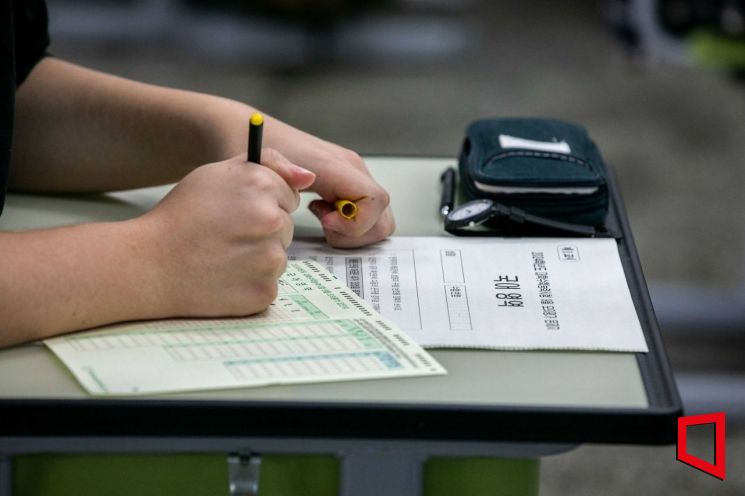 On the morning of the 6th, when the final mock exam before the 2024 College Scholastic Ability Test (November 16) was conducted, students were taking the test at Yeouido High School in Seoul. Photo by Joint Press Corps
The institute conveyed that, following the Ministry of Education's 'Measures to Reduce Private Education' announced in June, killer questions were excluded. The Korean language and English sections were created using various passages and materials based on the scope of the test. Mathematics, social/science inquiry and vocational inquiry, and the second foreign language/Chinese characters sections aimed to focus on thinking skills evaluation based on the characteristics of each subject.
The Korean history section was designed to be straightforward, focusing on core content to assess basic historical literacy, and elective subjects were created to minimize any advantages or disadvantages depending on subject choice.
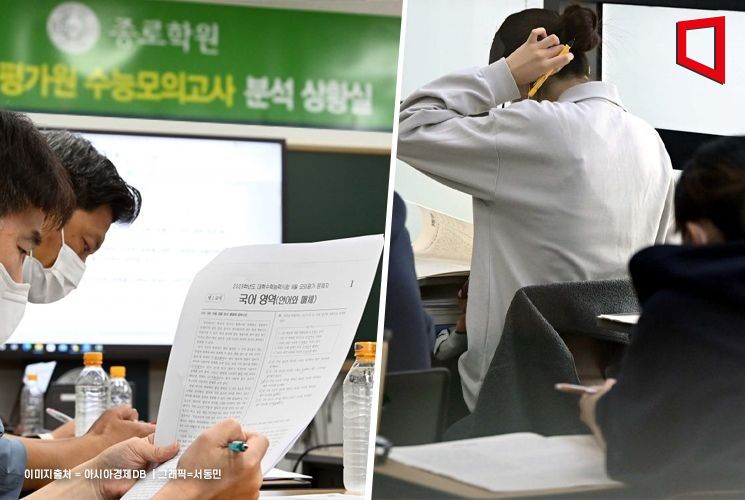
The EBS linkage rate is approximately 50% based on the number of questions per section/subject, and the linked materials are textbooks published for this year's high school seniors, which were reviewed by the institute and used in lectures.
© The Asia Business Daily(www.asiae.co.kr). All rights reserved.


















