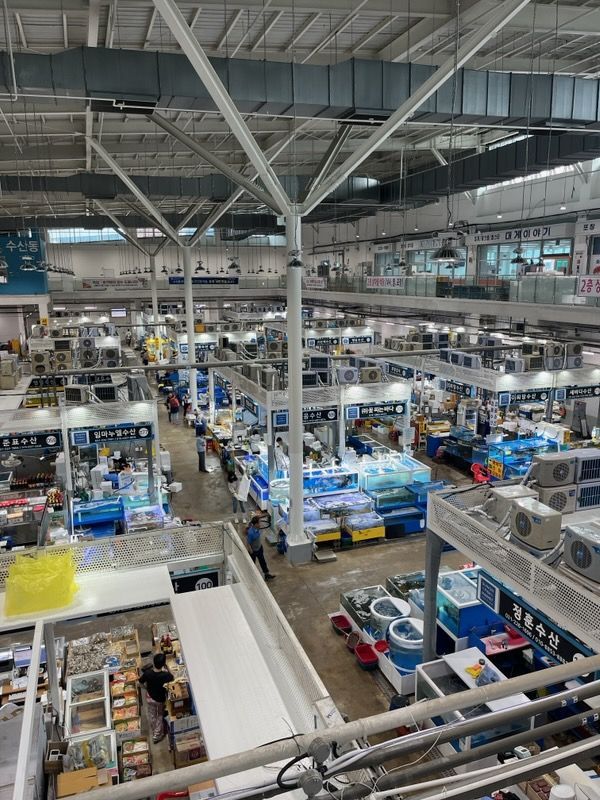
The Nong-Susanmul Wholesale Market in Suwon, Gyeonggi Province, conducted radiation safety tests on five types of distributed seafood and all were judged to be 'suitable.'
The Nong-Susanmul Wholesale Market collected test samples of five seafood types: live sea bream (from Japan), live yellow croaker (from China), frozen pollock (from Russia), live rockfish (domestic), and live flatfish (domestic), and requested radiation safety tests from the Gyeonggi-do Institute of Health and Environment on the 28th of last month.
The Institute of Health and Environment notified Suwon City that all five types were judged 'suitable' after testing for radioactive substances such as iodine and cesium to check if they exceeded the standard limits.
Since January 2014, the Nong-Susanmul Wholesale Market has conducted safety tests on 345 distributed seafood cases over 40 occasions, all of which were judged suitable. In radiation tests conducted in February and July of this year, all were also judged 'suitable.'
The Suwon Nong-Susanmul Wholesale Market significantly strengthened seafood safety inspections even before Japan's nuclear wastewater discharge. The 'radiation safety test,' which was conducted once per quarter, will be conducted monthly starting in August.
Additionally, a simple radiation detector (T401) is used for daily preliminary inspections. If the preliminary test exceeds the standard value of 3 cps (cps: counts per second, the unit measuring total radiation signals per second), distribution is immediately stopped and a detailed test is requested from the Gyeonggi-do Institute of Health and Environment.
A representative of the Suwon Nong-Susanmul Wholesale Market stated, "We will also strengthen inspections of seafood origin labeling," and added, "We will inspect all distributed seafood to create a Nong-Susanmul Wholesale Market that citizens can trust."
© The Asia Business Daily(www.asiae.co.kr). All rights reserved.

















