The prolonged strike by Hollywood writers and actors in the United States is directly impacting film studios. Major film studio Warner Bros. Discovery has lowered its annual profit forecast for this year in response to the strike's effects.
On the 5th (local time), Warner Bros. Discovery announced in a report submitted to the U.S. Securities and Exchange Commission (SEC) that it has lowered its EBITDA (Earnings Before Interest, Taxes, Depreciation, and Amortization) forecast for this year to a range of $10.5 billion to $11 billion (approximately 14 trillion to 14.67 trillion KRW). This figure is up to $500 million lower than the forecast presented during last month's earnings announcement.
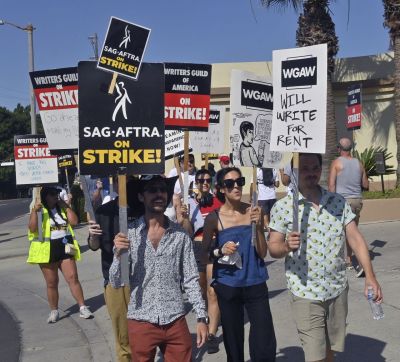
The company explained, "The adjusted EBITDA mainly reflects the impact of the strike." It also stated, "At the earnings announcement on August 3, the company provided financial guidance for this year assuming the strike would be resolved by early September," adding, "It is uncertain when the strike will end, and we expect these financial repercussions to affect the company through the end of this year." The Writers Guild of America (WGA) and the Screen Actors Guild?American Federation of Television and Radio Artists (SAG-AFTRA) have been on strike for several months since May and July, respectively, demanding basic wage increases and protection of writers' and actors' rights against the introduction of artificial intelligence (AI).
However, Warner Bros. expects that, buoyed by the strong box office performance of the film Barbie, its free cash flow forecast for this year will reach at least $5 billion. Reduced production spending due to the strike has also contributed to the increase in free cash flow. The company plans to provide further updates on its outlook depending on the strike situation.
Matt Thornton, an analyst at investment bank Truist, said that considering the strike situation, this downward revision of the annual guidance is not surprising. Kevin Gloden, Senior Global Strategist at the Milken Institute, estimated that the strike will cause losses exceeding $5 billion to the U.S. national economy. According to the August employment report released by the Department of Labor on the 1st, employment in the film and music industries decreased by 17,000 due to the strike's impact.
The Alliance of Motion Picture and Television Producers (AMPTP), which includes Warner Bros., resumed negotiations with the writers' and actors' unions at the end of last month, but no progress has been made yet. If the strike prolongs, it is highly likely that the release and production schedules of TV series and films for the 2023?2024 season will be delayed or canceled one after another. Previously, Warner Bros. postponed the release date of the highly anticipated sequel to Dune from November this year to March next year. Local media reported that the strike will deal a significant blow to the overall box office, which has yet to return to pre-pandemic levels.
Meanwhile, on the New York Stock Exchange today, Warner Bros.' stock price initially declined due to the impact of this downward revision but is currently showing an upward trend in the afternoon session.
© The Asia Business Daily(www.asiae.co.kr). All rights reserved.

















