Opposition Expected Due to Additional Annual Support of Billions of Won Upon Introduction
As the residents' initiative ordinance for the introduction of the ‘Jinju City Bus Semi-Public Operation System’ in Gyeongnam is being promoted, a public hearing for general citizens was held on the 5th at the Cultural Lecture Room of the City Hall.
Hosted by the Jinju City Council, this public hearing was arranged to conduct a multifaceted review of the introduction of the semi-public operation system after the ‘Jinju City Bus Semi-Public Operation System Ordinance’ was accepted by the Jinju City Council in March this year.
At the hearing, two presenters from the initiators of the ordinance and two from the Jinju City side, along with about 100 general citizens, expressed their opinions for and against the introduction of the semi-public operation system. The session concluded after a Q&A with city council members from the Urban Environment Committee of the Jinju City Council.
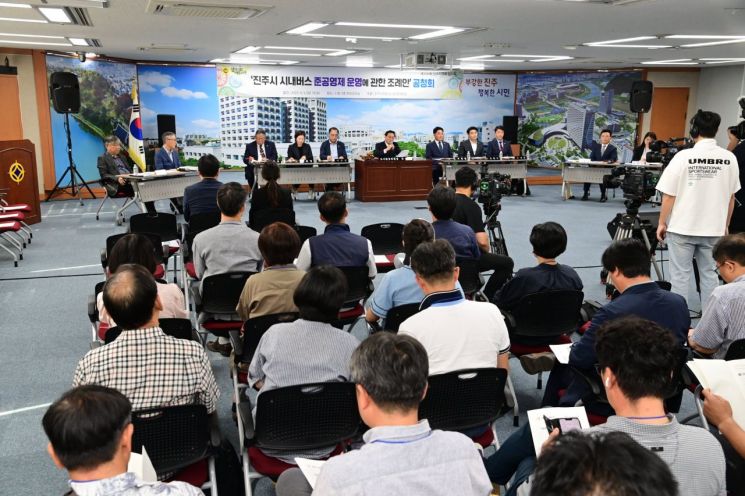 A public hearing for general citizens is being held for the introduction of the semi-public operation system for city buses in Jinju.
At the public hearing, the initiators argued that the semi-public operation system should be introduced because transparent management and supervision through itemized settlement of financial support funds provided by Jinju City to city bus companies can lead to budget savings. On the other hand, the Jinju City side claimed that the introduction of the semi-public operation system would rather cause a surge in financial support funds and risk of strikes, citing actual cases from Changwon City and Cheongju City, where the system was recently introduced.
The city’s presenter stated, “The initiators say that itemized settlement under the semi-public operation system can recover leftover funds and save the budget, but they do not mention the downside of the system where, according to agreements between the administration and companies, if more costs are incurred, additional subsidies must be paid accordingly.” He added, “Changwon City, which most recently introduced the semi-public operation system, set various preventive measures to reduce the financial support burden, but still could not prevent a sharp increase in financial support funds,” expressing deep concern about the increased tax burden on citizens due to the introduction of the semi-public operation system.
The initiators’ presenter said, “Since wage increases can be adjusted through agreements, support funds will not increase just because the system changes.” However, the Jinju City side predicted that “if the semi-public operation system is introduced, transportation companies will demand an increase in transportation costs at the level of local governments currently implementing the system,” forecasting that tens of billions of won in additional subsidies will be required annually without significant changes to city bus services.
The ‘Jinju City Bus Semi-Public Operation System Ordinance’ discussed at this public hearing is scheduled to be reviewed and approved at the 251st Jinju City Council extraordinary session to be held in October.
© The Asia Business Daily(www.asiae.co.kr). All rights reserved.

















