Held in New Delhi, India on 9-10th... Biden and others attending
Ukraine war and Xi Jinping's absence inevitably impact agreement
With the upcoming Group of Twenty (G20) summit scheduled to take place in India on the 9th and 10th (local time), the anticipated absence of China and Russia is expected to result in a half-hearted meeting, placing Indian Prime Minister Narendra Modi, the host nation's leader, on a political trial. Amid growing divisions over the Russia-Ukraine war, Chinese President Xi Jinping's declaration of non-attendance has raised concerns that the G20 summit may conclude without a joint communiqu? for the first time in history.
This summit was seen as an opportunity to elevate India's international stature, with Modi aiming to lay the groundwork for a decade-long rule ahead of next year's general elections. However, there are concerns that he could suffer diplomatic and political setbacks instead.
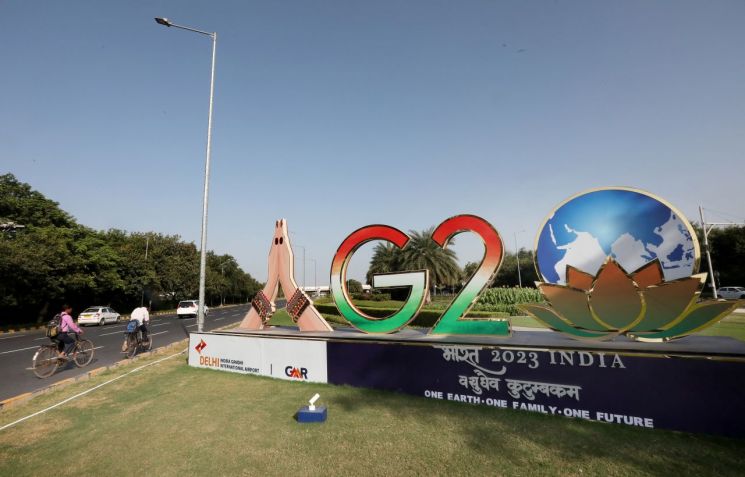
No Joint Communiqu? Issued Even Once at Ministerial Meetings... Differences Persist
CNBC reported on the 4th that the likelihood of a joint communiqu? being issued at the upcoming G20 summit in New Delhi is diminishing. If, as expected, no joint communiqu? is produced at this meeting, it would be the first time since the G20 summits were institutionalized as an annual event following the 2008 global financial crisis.
The reason for the low probability of reaching a joint communiqu? is that nearly 20 ministerial meetings have been held ahead of the summit, yet not a single joint communiqu? has been issued. Typically, G20 summits are preceded by ministerial meetings, including those of finance ministers, to narrow differences on key issues before culminating in a final joint communiqu? at the summit.
The main sticking point in the ministerial meetings has been the ongoing war between Russia and Ukraine. Whenever attempts were made to include items related to the war?ranging from food and energy crises to trade and finance?in the joint communiqu?, Russia consistently opposed, preventing unanimous agreement. China has also sided with Russia on certain issues.
Considering these factors, Russian President Vladimir Putin, who has not traveled abroad since the International Criminal Court (ICC) issued an arrest warrant in March, will not attend the G20 summit. The meeting is expected to be led by Western leaders such as U.S. President Joe Biden, U.K. Prime Minister Rishi Sunak, German Chancellor Olaf Scholz, and French President Emmanuel Macron.
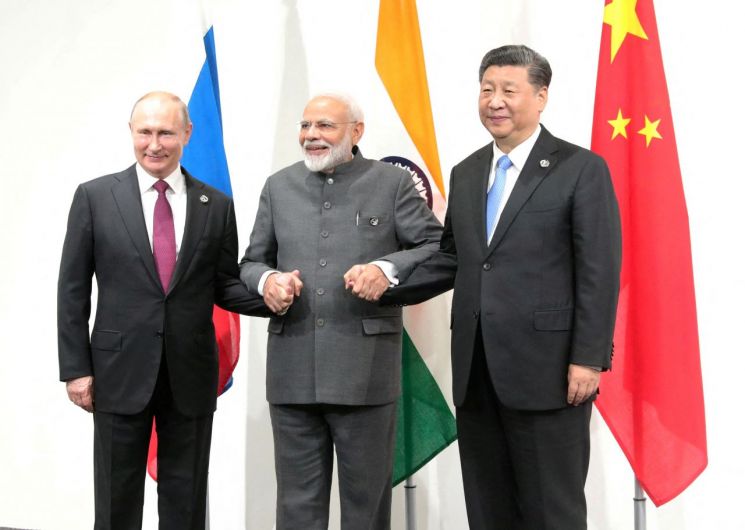 At the 2019 G20 Summit held in Osaka, Japan, Indian Prime Minister Narendra Modi is seen holding hands with Russian President Vladimir Putin (far left in the photo) and Chinese President Xi Jinping (far right) while posing for a photo.
 [Image source=Reuters Yonhap News]
President Xi's absence from the G20 summit for the first time since taking office also lowers the chances of producing a joint communiqu?. Foreign media note that the joint communiqu? was possible at last year's G20 summit in Indonesia, despite the ongoing war, because China partially supported and participated in the agreement. However, this time, Premier Li Qiang will attend the meeting in Xi's place.
China has not explained Xi's reason for not attending, but foreign media assess that China could not ignore the ongoing territorial disputes with India and the economic shift from China, known as the "world's factory," to India. Additionally, with rapidly deteriorating relations with the U.S. and tensions with pro-Western countries within the G20, attending a Western-led G20 summit would be uncomfortable from China's perspective.
"If the Summit Fails, Modi Will Suffer Diplomatic and Political Damage"
Experts predict that if the G20 summit fails to produce a joint communiqu?, Prime Minister Modi, who led the meeting as the host country, will suffer significant damage. With concerns rising that the G20, a symbol of multilateral cooperation involving both developed and developing countries, is facing an existential threat, it will be difficult for Modi to avoid criticism for failing to mediate.
Within the Indian government, there is some hope that the leaders might produce results at the last moment, but it is reported that the differences this year are even greater than last year when a joint communiqu? was barely finalized, making it realistically difficult to produce any outcome.
Michael Kugelman, South Asia program director at the Wilson Center in Washington, told a foreign media outlet, "It is not desirable to see a split between Western and non-Western blocs in responding to global threats," adding, "If the summit fails, India and especially Modi will suffer diplomatic and political damage."
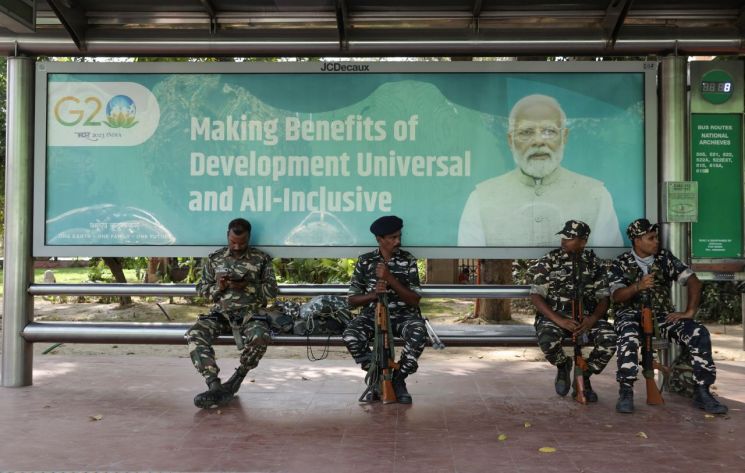
Manjari Chatterjee Miller, senior fellow at the U.S. think tank Council on Foreign Relations (CFR), analyzed that one of the risks India faces as the G20 chair is having raised expectations that it could provide concrete breakthroughs, stating, "India aims to serve as a bridge between the underdeveloped countries of the Global South and Western nations, but Russia and China remain problematic."
Prime Minister Modi appears to have intended the G20 summit not only as an event to elevate India's international standing but also as an opportunity to promote his diplomatic achievements ahead of next year's general elections.
Ahead of the G20 summit, posters featuring Modi's photo and G20 summit advertisements have been posted throughout New Delhi. Bloomberg News analyzed that the G20 logo's incorporation of a lotus, similar to the emblem of the ruling Bharatiya Janata Party (BJP), reflects this intention.
If Modi succeeds in the upcoming general elections, having first taken office in 2014, he would secure a mandate for the next decade. Recent polls show his approval rating at 52%, indicating a high likelihood of continued governance at present.
© The Asia Business Daily(www.asiae.co.kr). All rights reserved.

![Clutching a Stolen Dior Bag, Saying "I Hate Being Poor but Real"... The Grotesque Con of a "Human Knockoff" [Slate]](https://cwcontent.asiae.co.kr/asiaresize/183/2026021902243444107_1771435474.jpg)

















