August Consumer Price Trends
Agricultural Products Surge 5.4% as Overall Rises 3.4%
Food 4.7%↑ · Non-Food 3.3%↑
Last month, consumer prices rose at the largest rate in four months, returning to the 3% range. The significant increase was largely due to the impact of heatwaves and heavy rains, which caused prices of agricultural products such as apples and rice to surge by more than 5% compared to the same period last year. Prices for dining out and processed foods also showed increases of 5-6%, adding to the burden of food prices.
According to Statistics Korea on the 5th, agricultural product prices in August rose 5.4% compared to the same period last year. The increase was 5.1 percentage points higher than the previous month (0.3%), pushing the overall inflation rate (3.4%) up by 0.26 percentage points.
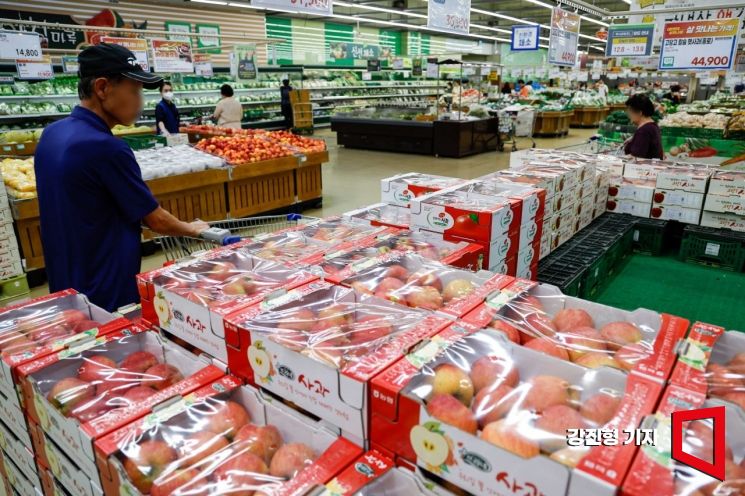 On August 5th, at Hanaro Mart Yangjae Branch in Seocho-gu, Seoul, apples are displayed at the fruit sales counter as consumer prices rose to the 3% range with the largest increase in four months due to the impact of heatwaves and heavy rain. Photo by Jinhyung Kang aymsdream@
An official from the Ministry of Agriculture, Food and Rural Affairs explained, "Prices of vegetables and fruits rose due to weather impacts such as the concentrated heavy rains in July and the heatwave and typhoons in August. Additionally, rice prices increased because the private stock of 2022 rice decreased."
By item, apples and peaches jumped 30.5% and 23.8% respectively compared to the same period last year. Rice also became 7.8% more expensive. Other items such as sweet potatoes (22.0%) and red pepper powder (9.3%) also rose. Recently, retail prices of rice, peaches, and apples have also been on the rise. According to the Korea Agro-Fisheries & Food Trade Corporation (aT), as of the 4th, the retail price of peaches (Baekdo variety, 10 pieces) was 29,734 KRW, up 33.6% (7,486 KRW) from 22,248 KRW a year ago. Apples (Hongro variety, 10 pieces) were 29,771 KRW, up 3.1% (894 KRW), and rice (20 kg) was 54,658 KRW, a 12.6% (6,114 KRW) increase compared to the same period last year.
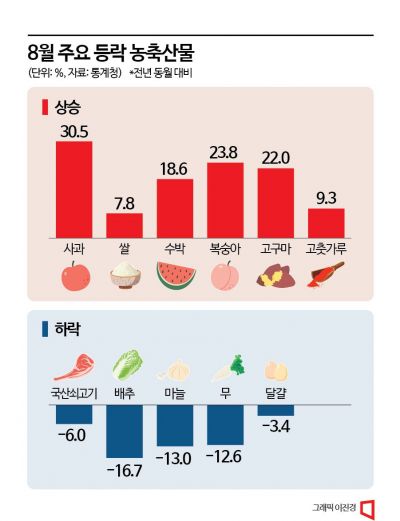
In August, prices for processed foods and dining out also exceeded the overall inflation rate. Processed foods rose 6.3% year-on-year, and dining out increased by 5.3%. Accordingly, the 'living cost index,' which reflects prices of frequently purchased and high-expenditure items sensitive to price changes, rose 3.9% compared to the same month last year, with food prices up 4.7% and non-food prices up 3.3%. This indicates a sharp rise in prices related to agricultural products, processed foods, and dining out.
The Ministry of Agriculture, Food and Rural Affairs forecasts that the supply and demand situation for agricultural and livestock products in September, which includes the Chuseok holiday, will generally remain stable. However, there are concerns that prices will be high for premium-grade apples and pears affected by cold and frost damage in spring.
In response, the government announced on the 31st of last month, through the 'Chuseok Livelihood Stabilization Measures,' plans to supply the largest-ever volume of seasonal products (149,000 tons, 1.6 times the usual amount) starting three weeks before Chuseok (September 7), and to expand the budget for discounts on agricultural and livestock products (from 40.3 billion KRW last year to 41.0 billion KRW this year). The government's goal is to keep prices of 20 major seasonal products 5% lower than the same period last year. Additionally, the Ministry of Agriculture, Food and Rural Affairs plans to hold a 'Price Stabilization Meeting with the Food and Dining Industry' on the 8th to request cooperation from the industry in stabilizing prices.
Park Su-jin, Director of the Food Policy Office at the Ministry of Agriculture, Food and Rural Affairs, said, "As the demand for agricultural and livestock products peaks during the Chuseok holiday, we will form a 'Supply and Demand Stabilization Task Force' three weeks before Chuseok to monitor the supply situation of seasonal products daily and respond promptly to any instability, doing our best to stabilize the supply of agricultural and livestock products and ease the burden on consumers' shopping baskets."
© The Asia Business Daily(www.asiae.co.kr). All rights reserved.
![Clutching a Stolen Dior Bag, Saying "I Hate Being Poor but Real"... The Grotesque Con of a "Human Knockoff" [Slate]](https://cwcontent.asiae.co.kr/asiaresize/183/2026021902243444107_1771435474.jpg)

















