Samsung to Lecture at Seoul National University Following KAIST and Yonsei University
Addressing Global Semiconductor Workforce Shortage
TSMC Faces Workforce Challenges in Germany After the US
SK Hynix Supports Global Talent Development

As the semiconductor labor shortage becomes a reality, the industry is facing an emergency in securing talent. Samsung Electronics executives are visiting schools in person to meet future semiconductor talents, while overseas efforts include providing scholarships to secure local workforce. Taiwanese foundry (semiconductor contract manufacturing) company TSMC is facing concerns that delays in factory operations in Germany, following the U.S., due to the global labor shortage could disrupt its business.
Kyung Kye-hyun, President of Samsung Electronics’ Device Solutions (DS) Division, will visit Seoul National University on the afternoon of the 5th to give a semiconductor lecture to students. Following lectures at Korea Advanced Institute of Science and Technology (KAIST) and Yonsei University, which have semiconductor contract departments, in May and June, he will now visit his alma mater, Seoul National University, a specialized semiconductor university. As before, this lecture will include an introduction to the current semiconductor industry status and Samsung Electronics’ business vision.
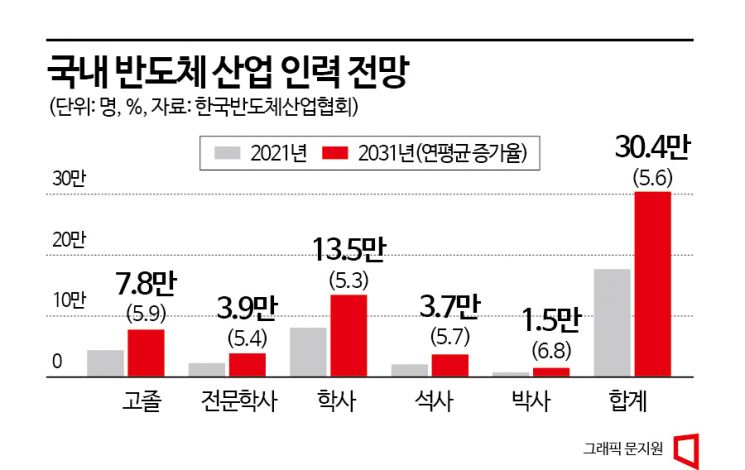
The reason the head of Samsung Electronics’ semiconductor division is personally meeting students is due to the industry’s labor shortage. As the importance of semiconductors grows and the related market rapidly expands, the supply of skilled workers is not keeping pace. The Korea Semiconductor Industry Association projected that the domestic semiconductor workforce, which was 179,000 in 2021, could increase to 304,000 by 2031. It also forecasted a shortage of 30,000 to 50,000 workers around that time.
This is not a problem limited to South Korea. Major countries worldwide, including the U.S., Taiwan, Japan, China, and the European Union (EU), are all striving to grow their semiconductor industries, intensifying the labor shortage. The U.S., which has launched large-scale investments through the CHIPS Act, is a prime example. The Semiconductor Industry Association (SIA) of the U.S. reported in July that by 2030, 67,000 jobs locally will remain unfilled.
TSMC is experiencing difficulties in advancing its global business due to this. In the U.S., the shortage of workers delayed the planned 2024 start of operations at its Arizona plant by one year. There are concerns that similar issues could arise at the €3.5 billion Dresden plant in Germany. The UK’s Financial Times recently reported that TSMC’s entry into Germany could further exacerbate the local semiconductor labor shortage.
Samsung Electronics is focusing on local investments to respond to this labor shortage. In the U.S., it is investing $3.7 million in the University of Texas to secure talent in the Texas region, a semiconductor business hub. It donates funds to the Cockrell School of Engineering at the University of Texas at Austin to support scholarships and other programs. Koo Bon-young, head of Samsung Electronics’ Austin office, explained the investment background by saying, "Securing a large skilled workforce is the most important thing for us."
SK Hynix is supporting Korea University’s semiconductor engineering department, which is its contract department, to nurture global talent. Starting next year, when students reach their sophomore year, they will be able to take major courses for a certain period at the University of California, Davis (UC Davis), one of the California State Universities. Going forward, Korea University and UC Davis plan to increase student exchanges as well as international cooperation in semiconductor research fields.
© The Asia Business Daily(www.asiae.co.kr). All rights reserved.



















