The Future of the Media Industry Amid AI Evolution and Global Expansion
"Content and Platform Co-Growth Needed"
Recently, amid fierce conflicts over carriage fees between the paid broadcasting industry and TV home shopping, an analysis has emerged suggesting that the home shopping carriage fee dispute is essentially a matter of time. With the emergence of online video services (OTT) and changes in content viewing patterns, red flags have been raised in the paid broadcasting market, increasing the need to discover new growth engines.
On the 4th, Professor Lee Sung-min of the Department of Media and Video at Korea National Open University stated at the conference titled 'The Future of the Domestic Media Industry Amid the Evolution and Global Expansion of AI' that the carriage fee dispute signals a crisis in the core revenue source of the paid broadcasting industry.
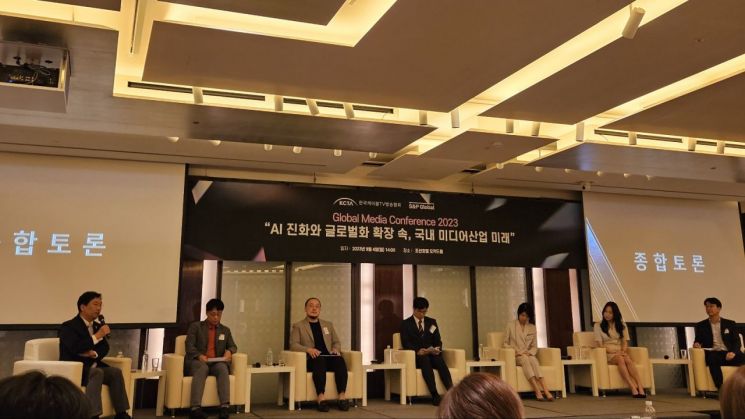 Participants at the 'Future of the Domestic Media Industry Amid AI Evolution and Global Expansion' are discussing growth strategies for paid broadcasting.
 [Photo by Oh Su-yeon]
The proportion of home shopping carriage fee revenue (1.3243 trillion KRW) in Internet TV (IPTV) sales reaches 28.6%. This has been on a continuous rise since surpassing 20% in 2018. However, in the first quarter of this year, the operating profit of the top four home shopping companies plummeted by 32.4% compared to the same period last year, which is the background of the conflict. Professor Lee diagnosed this as a sign of crisis in the core revenue of paid broadcasting. He said, "It is not a crisis caused by the growth of live commerce but rather an overall change in the landscape and generational issues. If the generation that prefers home shopping endures longer, the crisis may be delayed, but it will not continue to grow."
This is because the Korean paid broadcasting market has reached its growth limit. Professor Lee focused on the fact that people are not watching broadcast programs rather than not watching TV. This is because even if they do not purchase TVs, the trend of consuming content such as OTT on large screens continues. To seek new growth engines, he suggested expanding content to the global market and exploring new methods for advertising and commerce. He also emphasized the need to turn the growth of artificial intelligence (AI) services into a driving force for innovation.
Jessica Phook, a researcher at S&P Global Market Intelligence, presented on the topic of 'Global Video Trends and Outlook.' Researcher Phook said, "The most important strategy is to find content that will be the jewel of the platform," adding, "For example, Indian operators provide various content at much lower prices and understand local user characteristics well, which made it difficult for Netflix to enter the market."
The subsequent comprehensive discussion was chaired by Professor Kim Jung-hyun of Korea University, with participants including Research Fellow Kwak Dong-gyun from the Korea Information Society Development Institute, Professor Kim Jeong-hwan of Pukyong National University, Senior Researcher Lee Ji-eun of the law firm Sejong, and Professor Ji Sung-wook of Hankuk University of Foreign Studies. Research Fellow Kwak pointed out the increasing trend of single-person households and their preference for OTT over paid broadcasting, stating, "The long-term outlook for paid broadcasting, which relies on bundled and low-cost products, is not bright. When 'code-nevers' (people who have never subscribed to paid broadcasting) become the social mainstream, there will be no place for paid broadcasting." He also said, "The weak competitiveness of the platform sector is already causing a vicious cycle that excessively deepens the global platform dependence of K-content," and added, "The task is to maximize the advantageous use of the era's trend of media border disappearance caused by OTT expansion through the co-growth of content and platforms."
Professor Ji diagnosed the current situation as a 'crisis fixation.' He said, "The main cause triggering the media industry's crisis started with the market encroachment by overseas operators rather than domestic ones, and the current situation may become fixed in the future," adding, "Global OTTs increase content production costs in proportion to the global market size, whereas the production budget that domestic operators can bear is basically limited to the domestic market." He continued, "It is time to consider ways to directly distribute video products produced domestically to the global market."
There was also an opinion on the need for a glocal (global-local) strategy. Professor Kim said, "A strategy to nurture global platforms that can incorporate local stories is necessary," adding, "Looking at the situation where webtoon platforms have gone global, they distribute not only Korean content but also local content and hire local creators. We need to nurture platforms that have global distribution capabilities, not platforms that only distribute and deliver domestic content."
© The Asia Business Daily(www.asiae.co.kr). All rights reserved.

















