- The benefit of limiting sale prices to a certain amount increases scarcity due to reduced applicable areas, boosting popularity
- Most complexes sold this year with first-priority applications under the price ceiling system attract attention with high subscription competition rates
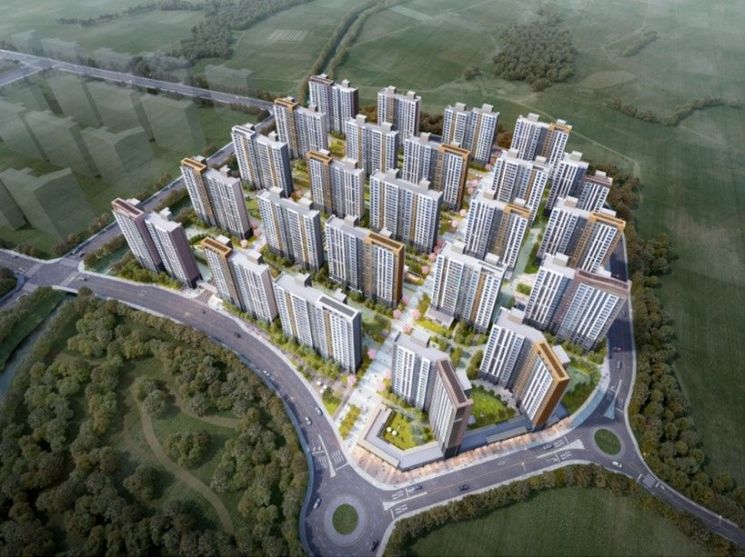
As pre-sale prices begin to rise in earnest, pre-sale complexes subject to the 'Pre-sale Price Ceiling System' are attracting attention.
The Pre-sale Price Ceiling System is a policy introduced to stabilize housing prices by limiting pre-sale prices to an amount not exceeding the sum of land costs, construction costs, and additional costs, thereby easing the financial burden on buyers. In January, the government significantly reduced the areas where this system applies, leading to a concentration of demand in complexes under the Pre-sale Price Ceiling System.
On the 22nd, 'Hillstate Cheomdan Central,' supplied in Gwangju Cheomdan 3 District, received 6,700 applications for 1,071 units (excluding special supply), resulting in an average competition rate of 6.25 to 1. The high number of applicants was driven by expectations for the future value of Cheomdan 3 District and the reasonable pre-sale prices set under the Pre-sale Price Ceiling System.
Additionally, last month in Pyeongtaek, Gyeonggi Province, the 'Pyeongtaek Godeok International New City Hoban Summit Phase 3' drew attention with a high-score subscription account nearly achieving the maximum points for winning. The high-score account appeared in the 84㎡A exclusive area in other regions, scoring 83 points?just one point shy of the perfect 84 points, effectively near perfect.
The commonality between these two complexes is that they are subject to the Pre-sale Price Ceiling System.
Furthermore, the ongoing rise in construction costs seems to have stimulated consumer sentiment. Recently, prices of key raw materials such as cement and rebar have been on the rise, and the industry expects construction cost increases to be inevitable for the time being. According to the 'Private Apartment Pre-sale Price Trends as of the End of July' report released by the Housing and Urban Guarantee Corporation (HUG) on the 16th, the average pre-sale price per 3.3㎡ nationwide was 16,259,100 KRW, up 0.26% from the previous month and 11.86% higher compared to the same month last year.
An industry insider explained, “With the trend of rising pre-sale prices expected to continue, a market atmosphere is forming where buyers want to secure their homes before prices go up further. Especially, complexes under the Pre-sale Price Ceiling System are becoming more scarce due to regulatory easing, leading to a concentration of applicants.”
Amid this, Jeil Construction Co., Ltd. plans to supply the highly scarce Pre-sale Price Ceiling System complex 'Cheomdan Jeil Punggyeongchae' this month in two blocks of Gwangju Metropolitan City's Gwangju Research and Development Special Zone Cheomdan 3 District.
Cheomdan Jeil Punggyeongchae will be introduced in A2 and A5 blocks of Cheomdan 3 District. The A2 block consists of 24 buildings from basement level 2 to 20 floors, with a total of 1,845 units ranging from 59㎡ to 84㎡ exclusive area. The A5 block consists of 12 buildings from basement level 1 to 20 floors, with a total of 584 units ranging from 116㎡ to 184㎡ exclusive area.
Cheomdan Jeil Punggyeongchae is a Pre-sale Price Ceiling System complex located within a public land development district, so reasonable pre-sale prices will be set. Regardless of the number of houses owned, even homeowners can apply for subscription, and both household heads and household members are eligible. Anyone aged 19 or older can apply regardless of their place of residence.
Cheomdan 3 District, where the complex is located, is being developed as a research and industrial complex centered on an AI (Artificial Intelligence)-based science and technology startup cluster. The largest AI data center in Korea is scheduled to begin full operation in October, and the country's first National Cardiovascular Center is also planned.
Cheomdan 3 District is being built as a self-sufficient city with about 7,700 residential units along with education and commercial facilities, promising high-quality residential infrastructure.
Looking at the unique features of each block, the A2 block is planned as the largest apartment complex in Cheomdan District, equipped with community facilities befitting its scale. The complex will include a swimming pool, golf practice range, fitness center, and a small library among various community amenities.
The A5 block consists entirely of large-sized units with high scarcity value in the Gwangju area. It features a popular 4- to 5-bay layout and specialized floor plans such as alpha rooms reflecting demand for large areas, maximizing scarcity value. Additionally, a refreshing open corridor design secures views and a wide-open feeling within the complex.
Cheomdan Jeil Punggyeongchae is located in an excellent position within Cheomdan 3 District. Right in front of the complex, kindergartens, elementary and middle schools (planned sites), and an AI gifted high school (planned) are scheduled, providing a one-stop school zone within walking distance. Moreover, a commercial district and neighborhood park are planned in front of the complex, and residents can also share the well-developed infrastructure of the already completed Cheomdan 1 and 2 Districts and Suwan District.
Transportation conditions are also noteworthy. The complex is connected to a wide-area transportation network including Honam Expressway and Gwangju Outer Ring Expressway. A new road linking Sangmu District (Yuchon-dong) and Cheomdan Industrial Complex (Sanwol-dong) is scheduled for completion in 2026, expected to benefit the area. Additionally, three stations on Gwangju Subway Line 2 (Phase 2 project, scheduled for completion in 2029) will be newly established in Cheomdan 1 District, and one station in Cheomdan 2 District, making access convenient.
© The Asia Business Daily(www.asiae.co.kr). All rights reserved.

















