Unique Collaborations Draw Attention Amid Bookstore and Publisher Revenue Declines
Actively Partnering with Other Industries for Joint AI Development
Amid the global publishing industry's ongoing struggles, some companies in Japan are gaining attention for pursuing unique collaborations as a way to find new opportunities. Collaborations with industries completely different from publishing and with local communities are increasing, and some publishers are diversifying their businesses by joining forces to jointly develop artificial intelligence (AI) technology.
On the 4th, Nihon Keizai Shimbun (Nikkei) reported that 'collaborative bookstores' promoting partnerships with various industries are on the rise in the Japanese publishing sector. At a Tsutaya bookstore branch in Miyazaki Prefecture, a collaboration with a nearby agricultural high school has been in place for four years, allowing part of the bookstore space to be used as a market where students sell flowers, vegetables, and processed dairy products they have grown. At a dairy product sale event held last month, about 150 cheeses and 200 yogurts prepared were sold out in no time, showing a strong response.
According to Culture Convenience Club (CCC), which manages Tsutaya's businesses, 35% of municipalities in Miyazaki Prefecture and 44% in Kumamoto Prefecture have no bookstores, making it practically difficult for bookstores to exist solely for the purpose of 'selling books.' Because of this, the ability to attract people to offline stores has become crucial. CCC President Shiobara Reiki told Nikkei, "In an era where anything can be obtained online, the value of offline stores lies in people meeting people."
Tsutaya has sent many collaboration requests to schools, chambers of commerce, and tourism associations, and currently holds numerous unique collaborative events such as music recitals and painting experience classes at bookstores. On days when events are held, actual book sales have been shown to increase by an average of 10%, demonstrating tangible effects.
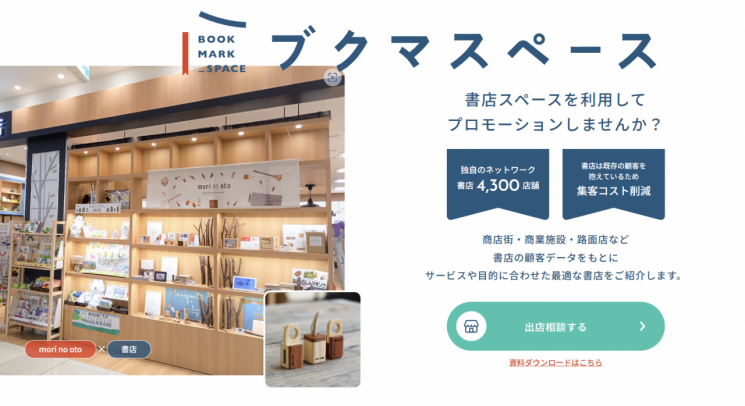
Some bookstores have even started a bookstore space rental business, lending out their space. Distribution company Tohan launched the 'Bookmark Space' business in October last year, which mediates the rental of leftover bookstore spaces. Companies wishing to rent can search for desired conditions and apply through the Bookmark Space website. In this collaboration system, 30% of the revenue goes to the intermediary company Tohan, and 70% goes to the bookstore.
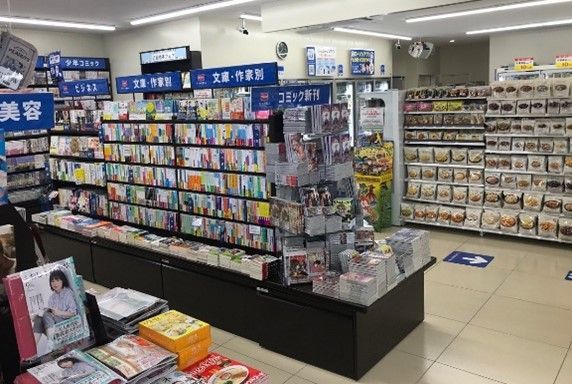
Additionally, a unique collaboration method combining convenience stores and bookstores has emerged. Japan Publishing Sales recently partnered with convenience store chain Lawson to open a convenience store that also functions as a bookstore. About 30% of the store is dedicated to the bookstore, handling approximately 6,000 books and magazines. A representative from Japan Publishing Sales said, "The risk of trying a new business is smaller than the risk of doing nothing and losing customers, leading to bookstore closures." Because bookstores can be included in prime-location convenience stores, some locations have average book and magazine sales 20 times higher than typical bookstores, showing strong performance.
Some publishers, facing the greatest threat from the emergence of artificial intelligence (AI), are making counterintuitive investments by jointly developing AI. They aim to create AI systems tailored to the publishing industry to drive sales.
Major Japanese publishers such as Kodansha, Shueisha, and Shogakukan launched 'PubTex' in March last year to develop AI. This AI system analyzes publisher customer data to predict customer demand. These publishers plan to use AI to forecast demand by customer segment for each bookstore, significantly reducing return rates.
© The Asia Business Daily(www.asiae.co.kr). All rights reserved.
![Clutching a Stolen Dior Bag, Saying "I Hate Being Poor but Real"... The Grotesque Con of a "Human Knockoff" [Slate]](https://cwcontent.asiae.co.kr/asiaresize/183/2026021902243444107_1771435474.jpg)

















